Digital Element Announces NAT Detector — Industry’s New Standard for Accurate IP Geolocation and Risk Intelligence.

Choosing the Right IP Geolocation Granularity: How Digital Element Balances Precision & Usability

When it comes to IP address geolocation, the numerous use cases that our customers employ require data to be parsed in many different ways. We often find ourselves playing a game of geographical Goldilocks, looking for the level of IP granularity that is not too big, not too small, but juuuuuust right.

Here are some examples of how challenges with city-level precision in the NetAcuity Pulse IP geolocation database can translate into real-world operational and user-experience issues:

  • Giving website visitors a drop-down of city names to choose from, and the NetAcuity database returns an overly long list
  • IP to city-level targeting where the city response is too granular for practical market-level use
  • Using NetAcuity for Flat File deployments where there are too many rows or IP ranges to ingest due to city-level IP range fragmentation

Based on scenarios like this, Digital Element set out to solve this challenge. To do so, our team mapped small cities and suburbs around the world to the larger metropolitan areas that they fall within. This enables Digital Element customers to target major metropolitan areas without having to identify and manually select every surrounding suburb or neighborhood.

As outlined in our blog The Tricky Science Behind IP GeolocationIP address density in a major city often fails to reflect the true population of its surrounding metropolitan area, particularly when addresses are correctly assigned to nearby suburbs.

Small City Mapping

To meet the needs of our customers’ wide range of use cases and reduce operational complexity, Digital Element introduced Small City Mapping. This capability allows customers to convert an existing “small city” response from the Pulse city field into its associated larger metropolitan city, saving time, simplifying logic, and improving usability.

To demonstrate how this works, let’s use India as our geographic example and apply it to a common use case mentioned above: reducing overly long city selection lists.

Imagine you’re on the web development team for the IKEA India website, building a store locator for visitors. IKEA typically operates stores in major metropolitan areas, so visitors from surrounding cities need to be mapped accurately to the nearest metro where a store exists.


One of India’s 28 regions, Maharashtra (MH), contains approximately 350 cities. Asking users to manually scroll through hundreds of city options creates unnecessary friction.


Using Small City Mapping, visitors whose IP addresses fall within smaller surrounding cities are automatically associated with the closest major metropolitan area, ensuring relevant store locations are displayed instantly.

Here is an example of IP address traffic observed on the IKEA website.


IP Address
1.6.35.225
1.6.35.125
1.6.35.19
1.22.44.22
1.22.52.81
1.22.102.218
1.22.9.152
1.22.80.73
1.22.80.196

The web development team can query these addresses against the NetAcuity database to determine the Region, City, and City Code associated with these IP addresses. Below is what NetAcuity will return.

Start IP End IP Country Region City Metro City-Code
1.6.35.0 1.6.35.255 ind mh andheri 356002 148717
1.22.8.196 1.22.8.196 ind mh andheri 356002 148717
1.22.80.251 1.22.80.251 ind mh andheri 356002 148717
1.22.44.16 1.22.44.63 ind mh bandra west 356002 246533
1.22.52.81 1.22.52.81 ind mh bandra west 356002 246533
1.22.102.218 1.22.102.218 ind mh bandra west 356002 246533
1.22.9.152 1.22.9.152 ind mh dharavi 356002 148743
1.22.80.72 1.22.80.73 ind mh dharavi 356002 148743
1.22.80.196 1.22.80.196 ind mh dharavi 356002 148743

The cities associated with the IP addresses from web traffic were Andheri, Bandra West, and Dharavi. The web development team can then use the Small City Mapping decode file To determine what big cities these three smaller cities map to.

Country Region City-Name Metro-Code City-Code Big-Small Big-City-Name Big-City-Code
ind mh andheri 356002 148717 small mumbai 34785
ind mh bandra west 356002 246533 small mumbai 34785
ind mh dharavi 356002 148743 small mumbai 34785


As you can see, the IP address ranges all map to Mumbai as the big city. Because these small cities all map to Mumbai, logic can then be built into the website to ensure that visitors from any of the IP ranges that correspond with these cities are shown the Mumbai stores when using the store locator tool.

In any cases where IP address ranges are consecutive, the rows will be consolidated.

Start IP End IP Country Region City Metro City-Code
1.6.34.0 1.6.34.255 ind mh mumbai 356002 34785
1.6.35.0 1.6.35.255 ind mh andheri 356002 148717

Small City Mapping decode result:

Start IP End IP Country Region City Metro City-Code
1.6.34.0 1.6.35.255 ind mh mumbai 356002 34785

How This Enables Modern, Cookieless Use Cases

A/B testing content by market using IP context
Small City Mapping allows teams to test messaging, layouts, or offers at the metro level instead of fragmented city responses. This produces cleaner experiments, more reliable attribution, and consistent market definitions without relying on cookies or logged-in users.

Cookieless geo-targeting with trustworthy measurement
Because NetAcuity uses authoritative IP intelligence rather than user-declared location, organizations can localize experiences while maintaining consistent, privacy-forward measurement, especially critical as third-party cookies continue to disappear.

Minimizing false blocks in live sports streaming
Overly granular or misaligned city-level targeting can lead to accidental content blocks. By mapping suburbs and small cities to their correct metro areas, Small City Mapping helps streaming platforms enforce regional rights accurately while reducing false positives that frustrate legitimate viewers.

How to Access the Small City Mapping Decode File

The Small City Mapping Decode File is available to all Digital Element customers at no additional cost and can be accessed in the following ways:

  • Downloadable via the Digital Element support portal on the Decode Files page as a .tab or .csv file
  • Loadable into a local database and usable across NetAcuity deployment options, including Server/API, Flat File, Embedded API, and Cloud Service
  • Customers using NetAcuity Server/API, Flat File, or Cloud Service can query or dump Feature Code 93 (Decode DB) and Feature Code 26 (Pulse) to automatically populate big-city mappings

Feature Code 93 mirrors the fields in the Small City Mapping Decode File and can be licensed through the Client Success team.

In the coming months, we will be introducing Feature Code 93 which will enable DE customers to make a single query or create a flat file where there is a dedicated field to the existing “pulse-city” and the “decode-big-city”. This new Feature Code will produce an industry-first data set that returns two locations for a single IP address: the small city that the IP address is located, and the larger metropolitan city that it is associated with.

Frequently Asked Questions About Balancing IP Precision with User Needs

How can I A/B test content by market using only IP context?

By using NetAcuity IP geolocation with Small City Mapping, teams can group users into consistent metropolitan markets based on IP address alone. This enables clean A/B testing across defined regions without cookies, logins, or self-reported location data.

Can Digital Element support cookieless geo-targeting?

Yes. Digital Element’s IP-based geolocation enables location-aware content delivery and measurement without relying on cookies. This supports privacy-forward targeting while maintaining reliable geographic attribution.

How does Digital Element reduce false blocks in geo-restricted live streams?

Small City Mapping ensures that IP addresses in surrounding suburbs are accurately associated with the correct metropolitan area. This reduces accidental blocks caused by overly granular city-level enforcement while still respecting regional content rights.

What level of IP granularity does NetAcuity support?

NetAcuity supports country, region, metro, city and postcode y-level targeting, globally. Small City Mapping adds flexibility by allowing customers to operate at the most appropriate geographic level for each use case.

How does Small City Mapping improve user experience without sacrificing accuracy?

Small City Mapping preserves precise IP placement at the city level while allowing organizations to present cleaner, more intuitive experiences—such as simplified city lists, metro-level store locators, or regional content groupings. This balance helps reduce user friction without compromising the underlying accuracy of NetAcuity IP data.

Can Small City Mapping help simplify IP data ingestion and processing?

Yes. By consolidating multiple small-city IP ranges into their associated metropolitan areas, Small City Mapping can reduce IP range fragmentation and row counts in flat files or databases. This makes IP data easier to ingest, manage, and operationalize across analytics, targeting, and enforcement workflows.

Choosing the Right Level of IP Geolocation Granularity

Effective IP geolocation isn’t about choosing the smallest possible data point, it’s about choosing the right one for your business goals. Digital Element helps organizations localize experiences, test markets, and enforce regional rights with confidence, accuracy, and scale.

If you’re evaluating how IP geolocation can support cookieless targeting, reduce false blocks, or simplify market-level decisioning, our team can help you identify the right data and deployment model. Contact Digital Element to speak with Sales and see how NetAcuity fits your use case.

Beyond Geolocation: Time, Stability, and Reducing VPN Geo-Evasion with Digital Element IP Intelligence

Back in the late 90s when beanie babies, boy bands and the Macerana were winding down, e-commerce was heating up. As more and more people took their spending online, companies went to work, looking for new ways to understand as much as they could about their geographically dispersed audience.

To do that, they started examining how IP addresses could answer the burning question “Where is my audience coming from?”

Concurrently, Digital Element’s plaid flannel-clad founders saw the need for greater tools to understand web traffic and founded the company to do just that.

In the nearly 25 years since, the company has earned over 50 patents related to the advancement of IP intelligence, and has helped organizations worldwide drive greater business intelligence from IP addresses.

In the vein of continued advancement, our R&D team has been busy mining IP address data to define the new set of criteria upon which we can deliver the next generation of IP intelligence. Over the past three years, we have devoted a variety of resources to examining one of the most elusive elements of IP addresses: stability. More specifically, how stable is an IP address at a specific location.  

Before we dive into what we’ve found (spoiler alert – it’s eye-opening!) let’s dig into why we went looking in the first place.

The Misunderstood Reality of IP Address Geolocation

In the numerous customer and prospect conversations that we have at Digital Element, we noticed an interesting dichotomy emerge. When it comes to leveraging IP intelligence for audience creation one party puts too much trust in IP address geolocation, while the other party doesn’t trust it at all – “they are too unstable.”

In actuality, both parties are wrong. 

While it’s true that IP addresses create a great way to match visitors across websites, the data is really only correct if the visitors are looking at both websites at the same time, which is rarely the case.

How IP Intelligence Reduces Collateral Damage from VPN Geo-Evasion

Blocking VPNs and proxy traffic is necessary for preventing fraud, enforcing compliance, and protecting digital services, but overly aggressive blocking can come at a cost. When legitimate users are mistakenly denied access, organizations experience reduced scale, lost revenue, and poor customer experiences.

This is where advanced IP intelligence makes a true, measurable difference. Rather than treating all VPN or proxy traffic as inherently malicious, our tools can analyze how IPs behave over time, including stability, usage patterns, and infrastructure signals. By understanding whether an IP address consistently operates as part of a known anonymization service—or whether it represents legitimate traffic that occasionally routes through shared infrastructure—organizations can make more precise enforcement decisions.

The result is less collateral damage: high-risk VPN-based geo-evasion attempts are blocked, while legitimate users are preserved. This balance is critical for businesses that need both security and scale, especially in global or high-volume environments.

Why is this? Because IP addresses are unstable. Meaning, that the geo of an IP address that visited website A, may have changed by the time that the same IP address visited website B.  Or, said differently, the IP address of a user may have changed between their visits to website A and website B.

So when company A and company B, who invest too much trust in IP address stability, are comparing website data and IP addresses to understand user behavior across their web properties, they should also be examining timestamp information to determine if the user’s traffic was within the same time period. Otherwise, there is a good chance that the traffic was from two different visitors.

On the flip side, those who dismiss IP addresses as too transient are also missing the important point that IP addresses can actually be stable. Especially fixed wifi IP addresses, which happen to account for most of the traffic websites receive.

How is that possible? 

Consider your own web browsing habits. The vast majority of people are more likely to browse the web while on wifi in a fixed location, like at home, work, cafe, airport, etc… Comparatively speaking, much less traffic originates from people who are on the go (driving, running errands, out with friends/family, etc…) and don’t have wifi access.

Put simply, you are more likely to visit websites when you are on wifi, rather than when you are on a mobile IP connection. And, don’t forget, cellular carriers and mobile device operating systems prefer that you use wifi over cellular data (mobile IP addresses). If you want to test this, simply turn off your wifi on your mobile device, and see how long before your mobile phone is back on wifi. Answer: no more than 1 day.

So if wifi traffic rules the internet, and we have all been thinking about IP addresses wrong, what is the missing piece of data that can help us reconcile these two opposing opinions? The answer is TIME.  

Why Time-Based IP Stability Matters More Than Static Location Data

IP addresses are not static. They are reassigned, repurposed, and reused across different networks, geographies, and services, sometimes rapidly. As a result, IP intelligence that relies solely on a single snapshot in time can quickly become outdated or misleading.

Time-based IP stability introduces critical context. By examining how long an IP address has remained associated with a given location, network, or behavior, organizations gain a clearer picture of whether that IP can be trusted. Recent observations carry more weight than historical ones, and consistent patterns are more meaningful than isolated data points.

This temporal perspective is especially important when identifying VPNs, proxies, and other forms of geo-evasion. Many anonymization services rotate infrastructure frequently, while legitimate consumer ISPs tend to demonstrate more stable behavior over time. Factoring in time helps distinguish between the two, improving accuracy while minimizing false positives.

The next logical question is “For how long?” To answer this question, we must acknowledge that how we talk and think about IP addresses has to be more nuanced so that it considers the dimension of time in addition to geography.  Because IP addresses can be stable in a given location, it is best to look at stability in specific blocks of time, like – ‘less than a week’, ‘less than 1 month’, ‘6 months to 12 months’, and ‘more than 1 year’.

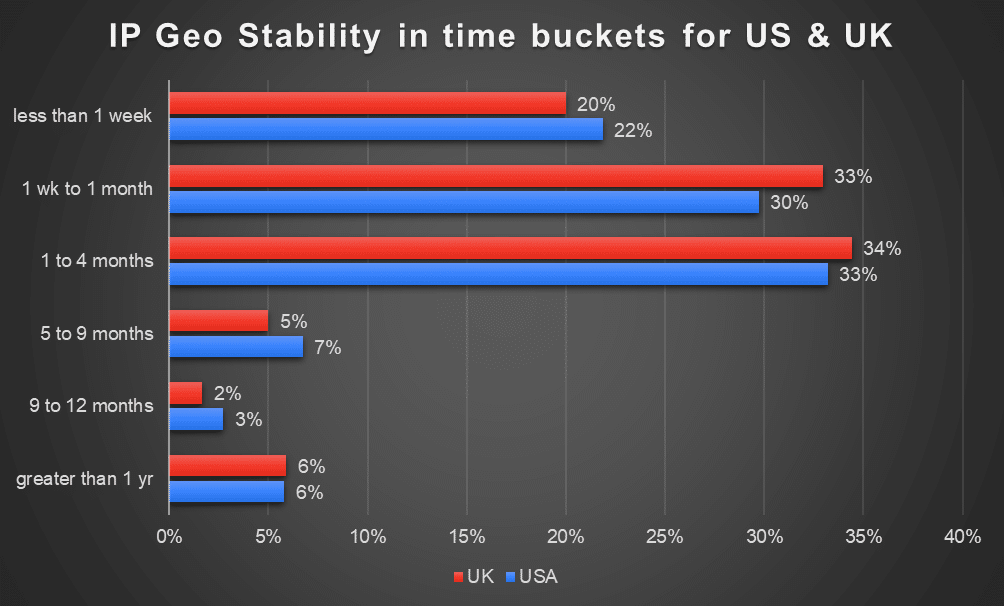
Now that we have established how to talk about IP addresses correctly, let’s reveal what our research found. In the tables below you’ll find a summary of IP address stability by location granularity, and time intervals for the US, and UK.

What this chart shows is that the US and UK are similar within a range of how stable IP addresses are in a given location. Around 6% of IP addresses are expected to remain associated with households for longer than 1 year, and around 20% of IP addresses are constantly moving between households from week to week.

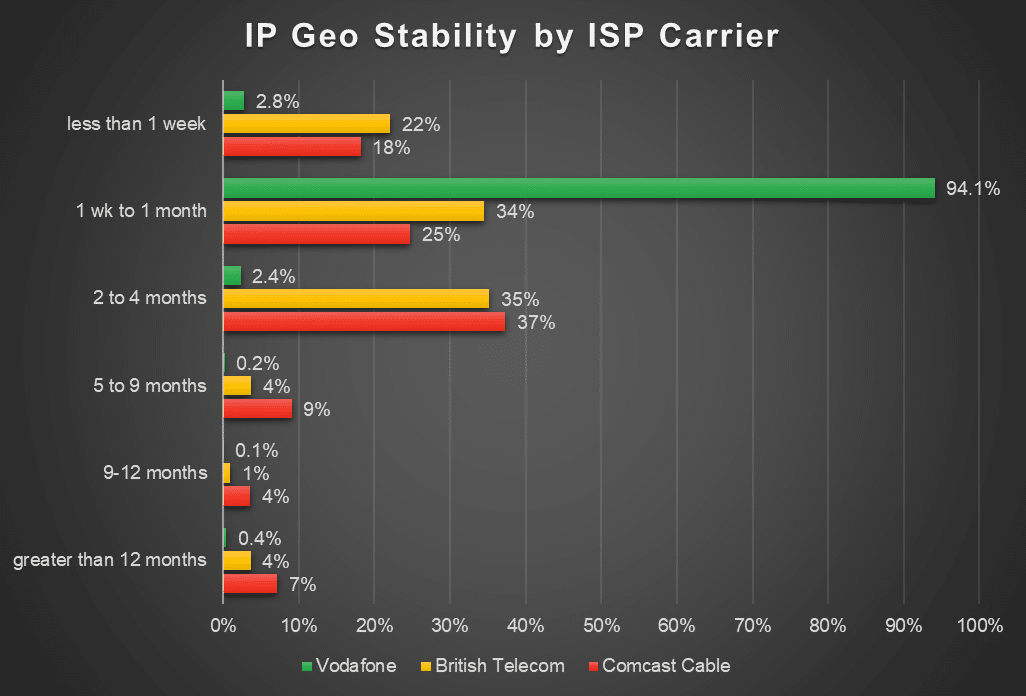
The reasons for the stability, or lack thereof, are complicated but at a high level, it comes down to the whims of the Internet service providers (ISP). A larger ISP that serves multiple countries may have different internal rules for allocating IP addresses vs. one that is only serving one country, for example. Note that this is just one reason among many. Comparing a few large ISPs gives a better picture of the dynamic nature of IP address allocation by ISPs.

Here we have compared Vodafone, British Telecom, and Comcast Cable. As we can see Vodafone behaves completely differently than the other two when it comes to IP allocations to their customers.

As you can see from the numbers, the importance of understanding IP address stability is paramount and can support decision-making across numerous business scenarios. Ultimately; however, what this leads to is the notion that there is much more to IP geolocation than the geolocation piece.

How IP Intelligence Reduces Collateral Damage from VPN Geo-Evasion

Blocking VPNs and proxy traffic is necessary for preventing fraud, enforcing compliance, and protecting digital services, but overly aggressive blocking can come at a cost. When legitimate users are mistakenly denied access, organizations experience reduced scale, lost revenue, and poor customer experiences.

This is where advanced IP intelligence makes a true, measurable difference. Rather than treating all VPN or proxy traffic as inherently malicious, our tools can analyze how IPs behave over time, including stability, usage patterns, and infrastructure signals. By understanding whether an IP address consistently operates as part of a known anonymization service—or whether it represents legitimate traffic that occasionally routes through shared infrastructure—organizations can make more precise enforcement decisions.

The result is less collateral damage: high-risk VPN-based geo-evasion attempts are blocked, while legitimate users are preserved. This balance is critical for businesses that need both security and scale, especially in global or high-volume environments.

Preserving Scale by Pairing IP Intelligence with Verification Partners

Modern fraud prevention and compliance strategies rarely rely on a single signal. Instead, organizations combine multiple data sources such as device intelligence, identity verification, and IP analysis to make informed decisions without introducing unnecessary friction.

When used alongside verification partners, time-aware IP data helps validate whether user behavior aligns with expected geographic and network patterns. This layered approach allows organizations to preserve scale, approving legitimate users confidently while escalating only higher-risk interactions for further review.

Rather than forcing hard blocks that reduce reach, IP intelligence enhances partner verification workflows by adding context. It answers not just where an IP appears to be, but whether that makes sense given its recent history. 

Time-Stamped IP Location Evidence: IP Forensics vs. Traditional Competitor Data

When disputes arise whether related to fraud claims, chargebacks, policy enforcement, or legal investigations, timing matters as much as location. Knowing where an IP address appears now is often insufficient. 

What organizations need is evidence of where that IP was at a specific moment in time.

Digital Element introduces this capability through time-stamped historical IP intelligence, offering visibility into IP behavior and location over extended lookback periods. This contrasts with many traditional IP data providers that focus only on present-day resolution, limiting their usefulness in post-event analysis.

By correlating IP addresses with historical location, network ownership, and usage patterns, organizations can strengthen dispute cases and improve win-rates. 

The comprehensiveness of the IP address data that Digital Element provides transcends pure geolocation, offering a wider variety of intelligence that can be used to drive significant outcomes for your business. By incorporating time-based IP stability, organizations move beyond static geolocation toward intelligence that reduces risk, preserves scale, and delivers defensible insight when it matters most.

Partner With Digital Element Today!

Interested in learning more about our new IP address stability insights? Reach out to support@digitalenvoy.com or contact our sales team.

The Top Guide To Choosing the Best IP Geolocation Service for Your Business

When evaluating an IP geolocation service, it’s important to look beyond surface-level claims and focus on the factors that matter most for your specific business and use case.

While many vendors offer some form of IP geolocation data, there are meaningful differences in how that data is sourced, validated, updated, and delivered. Those differences can directly impact accuracy, scalability, and long-term performance.

In this guide, we’ll walk through what to look for in an IP geolocation service while covering accuracy, data freshness, coverage, and real-world applicability, so you can make an informed decision and understand how Digital Element approaches IP-based location intelligence.

What is IP Geolocation and Why Does it Matter?

IP geolocation refers to identifying the physical location of a device connected to the internet using its IP address. Businesses can use this information for various applications, such as improving user experience, personalizing content, managing digital rights, detecting fraudulent activities, and targeting marketing campaigns.

IP geolocation data

IP geolocation is helpful for businesses that operate online and need to provide location-based services or track the location of their website visitors.

What to look for in an IP geolocation service

With so many options available, how do you choose the best IP geolocation database for your business? Read on to dive deeper into these factors and provide actionable tips to help you make an informed decision.

1. Trusted Brand Reputation

Perhaps the most important part of selecting any vendor for your business, it’s critical to start by ensuring the IP geolocation service provider has a proven track record of success and a reputation for providing high quality data, reliable service, and exemplary customer support. This is bigger than simply ensuring your business gets results — your own reputation is also at stake. 

Ask vendors for a client list, examples of tangible results, and any awards recognizing their superior technology and solutions.

2. Accuracy of Data Beyond Country and Region

Data accuracy is one of the essential features to consider when selecting an IP geolocation service provider. Accuracy varies widely among vendors, and depends on several factors, such as the number of data sources, the frequency of updates, and the methodology used to collect and analyze the data. The data’s accuracy and reliability directly affects the service’s usefulness for your business.

Country-level accuracy is generally 95-99.99% for most IP geolocation vendors, whereas city-level accuracy can range from 40-97%. Poor accuracy results in off-target ads and content, or might allow unauthorized access to digital content and services.

You want an IP geolocation service that can provide up-to-date and precise geolocation data, such as real-time ISP and ASN lookup, IPv4 and IPv6 data, and time zone and postal/ZIP code information. 

Look for an IP geolocation service with a reputation for providing the most accurate data, which can positively impact your business.

Beyond merely accepting accuracy at face value, it’s important to choose a vendor that can verify its data accuracy with independent review from third-party auditors. This assesses the data itself and the methods used to collect it, and is a great way to prove that a vendor can “put its money where its mouth is.”

3. City-Level and ZIP-Code Granularity at Scale

Ask yourself: How hyperlocal is the data within my target geographies? Do you return postcode-level geography? If so, do you default to city-center postcodes?

If highly granular city or postcode-level data is important to your business, then it is important to understand that most vendors do not perform well (or at all) at this level. Most either aggregate traffic into large metropolitan areas and/or provide city-center default postcodes which may be 10 or even 100 miles away from web visitors’ actual locations. 

ZIP+4 data is especially beneficial to marketers who want to target very specific audiences concentrated in more pinpointed locations within the United States.

4. Data Freshness and Update Frequency

IP geolocation provides various features and functionalities that enable you to get accurate geographical information about an IP address. The API returns essential details such as the country, region, city, postal code, time zone, ISP, and ASN of the IP address. 

Additionally, it provides endpoint URLs to retrieve the country flag, calling code, and other essential information such as proxy and VPN details.

One of the fundamental features of IP geolocation is its ability to provide location-based information, which can be used for ad targeting, content personalization, online fraud detection, and digital rights management.

Most IP geolocation vendors simply repackage publically available (free) Whois registration data, and some supplement with user-supplied data. Simple Whois information and/or user-supplied data, however, are not reliable methods for accurate geolocation when used in isolation.

If accuracy, coverage, and granularity are important to your business, select a vendor that employs multiple methodologies, including network infrastructure analysis and user-validated location feedback, as well as has a team of data analysts that double checks automated data collection methods and runs quality-assurance checks.

5. IP Coverage and Global Reach

Ask yourself: Besides IP geolocation information, what other datasets do they offer?

Information such as proxy or VPN type; mobile carrier; connection type/speed; home/business user; industry classifications; longitude/latitude; time zone; domain name; ISP; company name; organization name; demographics; and more can be impactful datasets for creating more meaningful user experiences.

6. Ease of Geolocation Integration

Ease of integration is another crucial factor when choosing an IP geolocation service. 

You want an API that can be quickly and seamlessly integrated into your existing systems, such as your website, mobile app, or CRM. Look for an IP geolocation API with various integration options, such as REST API, JSON, XML, and CSV.  Some IP geolocation services also offer SDKs and client libraries for popular programming languages like JavaScript.

Integration is a massive compliment to accuracy, especially for things such as urban planning and placing locational services. The easier it is to integrate the IP geolocation service, the faster you can start taking advantage of the benefits it provides.

7. Product Pricing

The pricing model of IP geolocation varies from one service provider to another. While some IP geolocation providers offer a free plan, others require a subscription plan. Pricing depends on various factors, such as the number of API calls, the level of accuracy and precision required, the level of support, and the number of features needed.

Some IP geolocation service providers have a pay-as-you-go pricing model, while others require an annual or monthly subscription. Some providers offer discounts for bulk purchases or special pricing for non-profit organizations or educational institutions.

When selecting an IP geolocation service provider, it is necessary to consider the pricing model and ensure that it is within your budget. Consider the API’s response time, uptime, and latency to provide a smooth user experience.

IP Geolocation vs. GPS: Understanding Accuracy at Scale

When teams evaluate location data for advertising or personalization, IP geolocation is often compared directly to device‑based GPS. While both serve important roles, they’re designed for very different use cases.

GPS data delivers extremely precise, real‑world positioning, often down to a few meters. However, that level of accuracy comes with limitations: it requires explicit user permission, is restricted by mobile operating systems, and doesn’t scale easily across all devices, browsers, and environments.

IP geolocation, on the other hand, is built for scale. It allows businesses to understand where users are connecting from without relying on app‑level permissions or device sensors. For ad delivery, streaming, ecommerce personalization, and fraud prevention, IP geolocation offers a practical balance of accuracy, reach, and privacy compliance.

Rather than replacing GPS, IP geolocation complements it by enabling consistent location intelligence across desktop, mobile web, CTV, and server‑side environments where GPS simply isn’t available.

Frequently Asked Questions About IP Geolocation for Businesses

How accurate is IP geolocation in general?

High-quality IP geolocation data can reliably identify a user’s country, region, and city, and in many cases supports ZIP-code or postal-level targeting. Accuracy depends on factors such as data sources, validation methods, IP coverage, and how frequently the data is updated.

For most digital use cases, IP geolocation provides a strong balance of precision, scale, and reliability.

How does IP geolocation compare to device GPS for advertising use cases?

Device GPS can provide very precise real-world location data, but it requires explicit user permission and is limited to environments where GPS access is available. That makes it difficult to scale across all advertising channels.

IP geolocation is designed for scale. It works across desktop, mobile web, connected TV, and server-side environments without relying on device-level permissions. While it doesn’t offer meter-level precision, it supports consistent city- and ZIP-level targeting, which is often more practical for large-scale ad delivery and personalization.

Why does data freshness matter for IP geolocation?

IP addresses and network assignments change frequently as internet infrastructure evolves. If geolocation data isn’t updated regularly, accuracy can degrade over time, especially at the city and ZIP-code level.

Frequent updates help ensure location mappings reflect how users are actually connecting to the internet, rather than relying on outdated assumptions.

How can ecommerce teams evaluate the freshness of IP geolocation data week to week?

Ecommerce teams often look at update frequency as a key indicator of data quality. Weekly updates are generally considered best practice, as they help capture changes in IP usage patterns and reduce the risk of mis-targeted traffic.

Fresher data supports better regional personalization, more accurate analytics, and improved performance for time-sensitive campaigns like promotions or seasonal sales.

How does Digital Element’s NetAcuity data compare to other IP geolocation providers?

Most leading providers deliver strong accuracy at the country level, but differences become more apparent at finer levels of granularity and at scale. NetAcuity is designed to support consistent city-level and ZIP-code targeting across large global audiences, which is particularly important for programmatic and connected TV advertising.

When comparing providers, teams often look beyond headline accuracy claims to factors like update cadence, IP coverage, and consistency across markets.

Is IP geolocation suitable for connected TV and programmatic advertising?

Yes. IP geolocation is widely used for CTV and programmatic advertising because it works across devices, doesn’t require user opt-in, and supports geographic targeting at scale. This makes it well suited for streaming and household-level environments where GPS data isn’t available.

Looking for the best IP geolocation service? Try Digital Element today.

Choosing the right IP geolocation service starts with understanding your goals—whether that’s improving website personalization, strengthening fraud detection, supporting cybersecurity efforts, enabling targeted advertising, localizing content, or managing digital rights.

Many providers can deliver basic IP location data. What separates leading solutions is how well they balance accuracy, precision, coverage, and granularity at scale. These factors become especially important when location data is used to power real-time decisions across advertising, ecommerce, streaming, and security environments.

Digital Element’s NetAcuity solution is designed to meet those demands, offering highly accurate and consistently updated IP geolocation and intelligence data, broad global coverage, and dedicated service and support.

To see how Digital Element approaches IP-based location intelligence, watch the video below or schedule a conversation with one of our experts to discuss your specific use case.

Resources to help you learn more about Digital Element’s capabilities

Digital Element Adds Deterministic IP Address Metadata to Nodify

In November, Digital Element announced a new IP address data solution designed to help our customers better understand anonymous traffic, enabling them to make strategic decisions regarding advertising, cybersecurity, DRM, and other use cases.

IPC Characteristics, aka IPC, is the newest addition to our Nodify platform, the industry’s most comprehensive proxy/VPN IP address traffic data. When used together, IPC, Nodify and NetAcuity offer our customers unmatched insights into anonymous traffic, enhancing their ability to understand and manage online activities effectively.

4 Pillars of IPC Metadata

Think of IPC as a vast collection of metadata, meticulously collected, validated and aggregated on a massive scale. This aggregation process unlocks a wealth of valuable insights and information. It has four pillars of metadata, all of which are essential for assessing the relative risk of an IP address.

  • Activity. This metric signifies the quantity of devices observed by Digital Element connecting to a particular IP address over a period. This type of data provides insight into the type of location where the wifi is set up, i.e. a public building with many devices or a private space with just a few.
  • Geolocation. IPC identifies how many unique locations have been associated with an IP address. As IP addresses are dynamic, the number of geolocations the IP has been seen provides intelligence about the general area it has been seen in, and is an indication of threat level if it has been seen in multiple countries.
  • Range. Let’s say an IP address is observed in multiple locations, the next question is what is the distance between those locations. A small average distance may indicate that only one ISP is using it, and it is therefore potentially benign, vs a large average distance which would indicate it could be a proxy.
  • Persistence. A unique feature to Digital Element, persistence asks the question: how long has this fixed IP address been at the same location? A greater persistence at a given location indicates the general innocuity of that IP address.

Each pillar serves various purposes and applications. For instance, activity helps advertisers with audience targeting. If you’re an advertiser aiming to target households, and the activity level indicates that over 100 devices are connected to certain IP addresses, it suggests that those IP addresses are less likely to correspond to residential locations.

That sample pillar also helps cyber security teams make smart decisions as to when to prompt users for additional authentication. When the activity level is high, it can serve as an indicator that the traffic originates from a public Wi-Fi service, such as at a local café or airport. This information bolsters threat intelligence and helps cybersecurity professionals assess potential risks and take appropriate security measures.

IPC Metadata and Machine Learning

IPC metadata can be a valuable resource for data scientists looking to enhance machine-learning capabilities and improve their models. For instance, it can provide additional features and context that can be used for feature engineering in machine learning models. These features can help improve the accuracy and relevance of the models.

IPC metadata used to identify anomalies or unusual behavior in network traffic. Data scientists can leverage this data to create anomaly detection models that can help identify security threats or system issues.

Deterministic Data

Another important characteristic of IPC metadata is that it is deterministic, not probabilistic. The GPS coordinates come from the mobile devices themselves, meaning the longitude and latitude information is accurate and reliable. Digital Element also captures the data and time when the geolocation data is observed.

Additionally, the sheer volume of data collected increases the accuracy of understanding traffic, identifying anomalies, and making informed decisions in various contexts, such as cybersecurity and personalized content delivery. This massive volume of data leads to more precise insights and improved performance in IP-related applications.

Why Digital Element is Unique

Digital Element’s ability to collect and analyze billions of IP observations is unique in the IP intelligence data space. This extensive dataset forms the backbone of all our products, and enables our customers to glean valuable insights about the traffic that accesses their networks.

Aggregating this data creates metadata lets us determine context such as:

  • Is this IP address coming from a public or private space?
  • Can I trust this IP address’s current geolocation? Based on if its dynamic or stable
  • Is this potentially a proxy IP address?
  • Does this IP address generally always belong to a given geographic region or is it geographically dynamic?
  • How much confidence can I have about its given location based on the number of observations at that location?
  • How much confidence can I have about its given location based on its last seen location?

Let’s see it in action.

The above table shows five unique IP addresses. From the IP characteristics we can obtain nuanced context of each:

Key Takeaways: Example 1 is a stable IP address based on one geolocation observed over 600 times over 46 weeks. This IP address would likely be considered safe by all measures by a cybersecurity firm.

Key Takeaways: Example 2 is also a stable IP address even though it was only stable for 7 weeks. We see that there were over 8 devices from the same geolocation, making it likely it is a household with multiple computers and mobile devices.

Key Takeaways: Example 3 provides intelligence that this IP address is stable when considering the macro geographic location, but is unstable when looking at the city and postal code level, since it has over 20 devices connecting to it. Even though this IP address is considered unstable, it is likely safe due to the fact that the average and maximum distance between all the postal codes is small. This fact indicates that this IP address is likely a regional NAT. It is likely in a rural area where there are not enough IP addresses allocated there (unstable dynamic one).

Key Takeaways: Example 4 (mobile activity) and Example 5 (proxy activity) are clearly proxy IP addresses given the number of observations and devices connected to them being extremely high. However, the key difference is that Example 4 could be a corporate proxy IP address (relatively less malicious) given that it stays within the same country.

Key Takeaways: Example 5 has been seen in 9 countries. This IP address is clearly one that should be blocked when considering access to secure content.

IP Address Intelligence Experts Since 1999
Since our founding we have sought to provide context to anonymous traffic.

We started in the 1990s helping advertisers accurately and non-invasively target audiences based on their IP address. Since that beginning, we’ve been on a mission to provide as much IP address intelligence and data-driven context as possible to deliver even more value across many verticals.

Our product suite includes:

NetAcuityShines a spotlight on geography, delivering critical insights into location data
Nodify VPN CharacteristicsProvides unique context into VPNs, proxy networks and dark networks
Nodify IP CharacteristicsProvides deterministic data about an IP address:
  • Unique context you can’t find elsewhere
  • Enhances insight from NetAcuity and Nodify VPN for a fuller picture.


To learn more about our new IPC database, visit here.

What IP Address Stability Reveals About Your Audience

When Digital Element introduced its geotargeting technology in 1999, the most in-demand data point we gleaned from the IP address was a device’s geographic location. With the explosion of the Internet and ecommerce, numerous people, from digital marketers and advertisers, to cybersecurity professionals needed an accurate way to target messages based on location.

Over the decades, we introduced many new, non-geographic-based targeting parameters such as connection speed, domain name, language and ISP. This “IP Intelligence” encapsulated so much more than location, opening up new insights for organizations that they can use as a strategic advantage. IP stability is one of the highly strategic intelligence data points Digital Element can now offer clients.

Knowing the stability of an IP address can enhance numerous business use cases, such as protecting digital assets, enhancing digital analytics, and detecting and preventing online fraud.

What is IP Stability?

First let’s start with the basics: what is IP stability? The stability of an IP address refers to the period of time an IP address is observed in a specific geolocation. Some IP addresses are highly stable, meaning they’re associated with the same geolocation for months or years at a time. Others range in stability, as in stable to a given city for a given period of time, to  highly unstable mobile addresses that are associated with a different geolocation daily, or even hourly.

Types of IP Addresses

There are multiple types of IP addresses, which means there are also levels of IP stability. When speaking of IP stability, knowing the range of IP address type is essential. Let’s review:

Private IP addressThese are IP addresses that can only be used by devices (aka “hosts”) on the same network, such as a corporate network. These are non-Internet routable, and are clearly defined in RFC6761. The Request For Comment is the main standards setting body for the Internet.
Public IP address (aka internet routable addresses)These are IP addresses that are internet routable, meaning they can be reached from any device/machine in the world, and are clearly defined RFC1366, aka “Guidelines for Management of IP Space.” 
Fixed IP addressThese are IP addresses that are routed via cable, DSL or fiber infrastructure for internet connectivity, assigned to non-mobile devices. Fixed IP addresses can be both static and dynamic (see below).
Mobile IP addressThese are IP addresses that are routed via cell tower infrastructure for internet connectivity assigned to mobile devices. Mobile IP addresses are always dynamic IP addresses.
Static IP addressThese are IP addresses that have a consistent geolocation, meaning at the time it is analyzed, its geolocation is the same as previously identified. Static IP addresses are likely tied to the same building(s) if within an ISP block — i.e. the range of consecutive IP addresses that are grouped together for administrative or routing purposes.
Dynamic IP addressThese are addresses whose geolocations change frequently. They’re dynamic because they can service different end users at any given moment. Dynamic IP addresses are common in ISP, mobile carrier and proxy blocks because end users fluctuate within a given area. 

Naturally, we expect to see a higher degree of stability in the static IP presence, and low stability in both the dynamic and mobile presence. Therein lies many useful insights, as we’ll see below.

ISPs are the Decision Makers

Who decides if fixed locations will be assigned a static, rather than a dynamic, IP address? The answer is the ISPs themselves. Some ISPs will assign highly static IP addresses for their customers, while others opt to assign dynamic ones. 

For instance, Charter, an ISP that provides connectivity in the South, has very stable IP addresses, and some of its customers have had the same IP address for years. Across the pond, however, British Telecom will change the IP address of its residential customers on a daily basis. 

Mobile IP addresses have low stability. Digital Element has observed the same mobile IP addresses in dozens of locations over a brief period of time.

How Digital Element Assesses IP Stability

Digital Element’s IP Intelligence data can distinguish between static and dynamic IP addresses. We can also track the length of time a static IP address is tied to a specific geolocation, aka, its stability. We further break stability down into buckets of longevity:

Stability BucketNumber of Weeks Stable
No Stability0
Very Short Term1 – 4 weeks (1 month)
Short Term5 – 16 weeks (4 months)
Medium Term17 – 36 weeks (9 months)
Long Term37 – 52 weeks (12 months)
Very Long Term53 + weeks (more than 1 year)

Going further, Digital Element can look at the stability of IP addresses of each ISP within the fixed space (i.e. internet connectivity provided to residential homes or commercial spaces). This allows us to see their composition of static vs. dynamic. 

Finally, Digital Element tracks which ISPs have a high percentage of static IP addresses and which don’t. This, in turn, allows Digital Element clients to apply this insight for important business use cases, including eliminating waste in digital ad campaigns.

Digital Advertising and IP Stability

Storytelling is an important concept in digital advertising. Rather than target the same user with the same message over and over again, marketers want to display a progression of messages that take the user on a journey.

For instance, let’s say a user clicks on an auto manufacturer’s ad for a new car model. In this scenario, the user has shown an interest in the auto brand that the marketer will want to nurture by providing information about additional benefits, such as state-of-the-art safety features or fuel efficiency. To prompt the user along the journey the campaign will aim to target that same user with sequential messages.

Now let’s say the campaign fails to perform as expected, the brand manager may conclude that something was off with regards to the channels, creatives or messages chosen for the campaign. But is there another factor at play?

IP addresses are a standard method for targeting consumers within specific geographic regions. Optimum is an ISP that services the tri-state area of New York, New Jersey and Connecticut. As such, Optimum is responsible for assigning the IP address for its customers.

Here’s where things get tricky: Digital Element’s IP Intelligence data reveals a single IP address assigned by Optimum was seen from 109 devices across 44 cities and 59 postal codes. What’s more, the average distance between users was 27 miles. This is a fixed — not a mobile — IP address, meaning it is an IP address that is assigned to a residence or a commercial establishment.

Now, let’s say the marketer has targeted a storytelling campaign at IP addresses assigned by Optimum. The marketer will have no way of knowing if the same consumer saw any or all campaign messages, even though the campaign targeted fixed IP addresses.

If, however, that same campaign targeted IP addresses assigned by Charter to residential customers, the marketer can have a high degree of confidence that the same device was targeted for the sequential messaging campaign. 

IP Stability and Campaign Planning

IP Intelligence data allows marketers to apply a level of granularity to campaigns:

  • Target users with highly stable IP addresses with sequential messaging
  • Target users with less stable or dynamic IP addresses with more general campaign message

In short, IP stability insight helps marketers drive efficiency in media spend by suppressing sequential messaging for unstable or dynamic IP addresses. This is incredibly relevant, as media agencies tend to bid higher for impressions when they believe a user has been exposed to the initial messages in the sequence.

The stability of an IP address can also help marketers determine whether or not a specific user has visited a brand’s website. Let’s say a user clicks on an ad and visits the brand’s site. Now let’s say a device with the same IP address arrives on the site two months later.

If the stability of that IP address is short term or above, we can assume it’s a repeat visit — insight that can initiate a set of actions, such as offering an incentive to convert. If that IP address is dynamic and has very short term stability, it’s unlikely to be the same user who clicked on the ad or visited the website previously. 

Learn More

The availability of IP stability data allows digital marketers to make informed decisions in their campaigns, leveraging IP Intelligence’s granular data and vital context to reduce wastage, drive better outcomes, and ultimately deliver these benefits.

Want to learn more? Click here to get in touch.

Understanding Cybersecurity Solutions: A Comprehensive Guide

According to recent data analyzed by Digital Element, a single data breach costs the average company by $9.44 million in the US. But if a company can contain that same data breach within the first 200 days, it can save an average of $1.12 million in damages.

Cybersecurity solutions, such as IP geolocation and VPN identification, can help your business protect the integrity of your network, systems, and data. But how do you evaluate a cybersecurity solution to decide if it’s right for your organization? 

In this guide, we’ll break down everything you need to know about the cybersecurity landscape. We’ll talk about everything from IP location to firewall applications to IoT security — helping you dissect the uses of each in protecting your business data and systems.

What are cybersecurity solutions?

Cybersecurity solutions are a collection of methods, technologies, and practices designed to protect digital systems, networks, and data from various forms of cyber threats. These threats can range from ransomware, viruses, and malware to sophisticated cyber-attacks aimed at harming digital infrastructure.

At a high level, cybersecurity solutions use automation to safeguard digital assets. This involves ensuring the confidentiality, integrity, and availability of data for both businesses and individuals:

  • Confidentiality means that data is accessible only to authorized individuals.
  • Integrity ensures that the data is accurate and hasn’t been tampered with.
  • Availability ensures that data and services are accessible when needed.

The cybersecurity solutions industry is vast and dynamic, continually evolving to keep up with the changing threat landscape. As new types of threats emerge, the industry develops new solutions to counter them. 

This constant evolution makes the cybersecurity industry a critical component of the modern digital economy. It’s an industry that not only protects businesses and individuals but also enables them to operate with confidence in the digital world.

Importance of cybersecurity solutions

Security solutions play a critical role in combating digital threats by providing a multi-layered defense mechanism that safeguards networks, systems, and data from every type of cybercriminal. Here’s a more detailed breakdown of their role:

  • Prevention: The first line of defense in any cybersecurity strategy is prevention. Cybersecurity solutions, such as antivirus software, firewalls, and intrusion prevention systems, are designed to prevent threats from penetrating networks and systems.
  • Detection: Despite the best prevention efforts, some threats may still manage to infiltrate systems. This is where detection comes in. Cybersecurity solutions like intrusion detection systems (IDS) and security information and event management (SIEM) systems monitor networks and systems for unusual activity that could indicate a security breach.
  • Response: Once you detect a threat, it’s crucial to respond quickly to minimize damage. Cybersecurity solutions can automate certain response actions, such as isolating infected systems to prevent the spread of malware or blocking IP addresses that are the source of an attack.
  • Recovery: After a cyberattack, cybersecurity solutions play a key role in remediation and recovery efforts. This can involve removing malware from systems, restoring systems and data from backups, and patching vulnerabilities to prevent future attacks.
  • Education: Cybersecurity solutions also include training and awareness platforms. These tools educate users about potential threats, such as phishing emails or malicious websites, and teach them how to avoid falling victim to these threats.

In-depth look at different cybersecurity solutions

Businesses, big and small, are increasingly reliant on online platforms and digital technologies. While this digital transformation has opened up a world of opportunities, it has also exposed businesses to a new world of threats from hackers.

Cyberattacks are no longer a matter of ‘if’ but ‘when’. From sneaky malware slipping through the cracks to large-scale data breaches, digital threats are real and can cause serious damage. The fallout isn’t just about losing data—it can lead to financial loss, damage to reputation, and shaken trust from customers and partners.

Here’s an overview of the different types of cybersecurity services that have emerged to combat this growing security threat, from IP geolocation to encryption tools to IoT security:

IP geolocation

IP geolocation is a cybersecurity solution that identifies the geographical location of an Internet-connected device using its IP address. This technology is crucial in detecting and mitigating potential threats based on geographic anomalies.

Key features

  • Location Identification: It can pinpoint the geographic location of a device, down to the post code level, providing valuable context about user behavior and potential threats.
  • Geo-blocking: It allows or denies access to content or services based on the user’s location, helping businesses comply with regional regulations and licensing agreements.
  • Threat Intelligence: It identifies potential threats based on geographic patterns, such as a sudden surge in traffic from a specific location.

Benefits

  • Enhanced security: By identifying unusual or suspicious locations, businesses can detect potential cyber threats and take preventive action.
  • Regulatory compliance: Geo-blocking helps businesses comply with regional regulations and licensing agreements.
  • Improved user experience: Businesses can customize content and services based on the user’s location, improving the user experience.

Antivirus software

Antivirus software is a fundamental security tool designed to detect, prevent, and remove malware, including viruses, worms, and trojans, from computers and network systems.

Key features

  • Real-time scanning: It continuously checks all files and programs on a computer or network for malware, providing ongoing protection.
  • Virus definition updates: It regularly updates its database of virus definitions, enabling it to recognize and combat new threats.
  • Automatic cleaning: Upon detecting malware, it automatically removes or quarantines it to prevent further harm.

Benefits

  • Device and application security: It provides a crucial line of defense against a wide range of malware, keeping devices and applications safe.
  • Data security: By preventing malware infections, it helps protect sensitive data from theft or corruption.
  • Peace of mind: Users can browse the internet and download files with confidence, knowing that their antivirus software is protecting them.

Firewalls

Firewalls serve as a gatekeeper for networks, controlling incoming and outgoing network traffic based on predetermined security rules and blocking unauthorized access. They’re crucial to both on-premises and cloud security.

Key features

  • Traffic control: It regulates network traffic based on security rules, allowing or blocking specific types of traffic.
  • Intrusion prevention: It blocks unauthorized access attempts, preventing intruders from gaining access to the network.
  • VPN support: Many firewalls support Virtual Private Networks (VPNs), allowing secure remote access to the network.

Benefits

  • Network protection: It shields internal networks from external threats, providing a fundamental layer of security for any network.
  • Enhanced privacy: By controlling outbound traffic, it prevents unauthorized transmission of data from the network, protecting user privacy.
  • Controlled access: It allows businesses to control which services and applications can send or receive data over the network, reducing the potential attack surface.

Encryption tools

Encryption tools use complex algorithms to convert readable data into a coded form, preventing unauthorized access to the data.

Key features

  • Data encryption: It transforms readable data (plaintext) into coded form (ciphertext), ensuring that even if malicious actors intercept the data, it cannot be understood without the decryption key.
  • Secure key management: It provides mechanisms for securely generating, distributing, storing, and retiring encryption keys.
  • File and disk encryption: It allows specific files or entire storage devices to be encrypted, protecting data at rest.

Benefits

  • Data protection: It provides a high level of security for sensitive data, ensuring that only authorized parties can access it.
  • Compliance: Many regulations require data to be encrypted, so encryption tools help businesses comply with these requirements.
  • Confidentiality: It ensures the confidentiality of data during transmission and storage, protecting it from unauthorized access.

Network security

Network security involves a range of practices and technologies designed to protect the usability, reliability, integrity, and safety of a network and its associated data.

Key features

  • Access control: It regulates who can access the network and what they can do, based on user profiles, roles, and policies.
  • Intrusion Detection Systems (IDS): It monitors network traffic for suspicious activity and alerts administrators to potential security incidents.
  • Security policy enforcement: It enforces rules governing network use, such as password policies and acceptable use policies.

Benefits

  • Protection from attacks: It defends the network against a wide range of threats, including hacking attempts, malware, and denial of service (DoS) attacks.
  • Data integrity: By preventing unauthorized access and modification of data, it ensures the integrity of data on the network.
  • Business continuity: By protecting the network infrastructure, it ensures that network services remain available, supporting business continuity.

Endpoint security

Endpoint security is a strategy where businesses manage network security at individual access points, such as laptops, smartphones, or desktops, rather than at the network level.

Key features

  • Device protection: It secures each endpoint device on a network, preventing threats from gaining a foothold on the network via vulnerable devices.
  • Threat detection: It identifies and blocks potential threats at the endpoint level before they can spread to other parts of the network.
  • Centralized management: It allows you to control all endpoint security measures from a single point, simplifying administration and ensuring consistent security policies.

Benefits

  • Comprehensive protection: By securing all network entry points, it provides comprehensive network protection.
  • Remote work security: It protects devices outside the traditional network perimeter, making it ideal for businesses with remote workers.
  • Rapid response: By identifying and neutralizing threats at the endpoint level, it enables rapid response to security incidents.

IoT security

IoT security involves safeguarding internet-connected devices and networks in the Internet of Things (IoT), which can range from smart home devices to industrial control systems.

Key features

  • Device authentication: It verifies the identity of IoT devices, preventing unauthorized devices from joining the network.
  • Data encryption: It protects data transmitted between IoT devices, preventing eavesdropping and data theft.
  • Regular updates: It ensures devices receive regular security updates, protecting them against known vulnerabilities.

Benefits

  • Device security: It protects a wide range of IoT devices, which often lack the built-in security measures found in traditional IT devices.
  • Data privacy: It ensures the sensitive data collected by IoT devices is secure, protecting user privacy.
  • Network protection: By securing IoT devices, it prevents them from becoming points of intrusion into the network.

How to choose the right cybersecurity solution

Choosing the right cybersecurity solution is a critical decision that can significantly impact a business’s resilience against cyber threats. Here are some key factors to consider and common pitfalls to avoid during the selection process:

Factors to consider when selecting cybersecurity solutions

  • Size of the business: The size of your business can influence the type and scale of cybersecurity solutions you need. Larger businesses may require more comprehensive solutions, while smaller businesses may need more cost-effective, scalable options.
  • Industry-specific needs: Different industries face different types of threats and have different regulatory requirements. For example, a healthcare organization must comply with HIPAA regulations, which require specific data protection measures.
  • Financial budget: Cybersecurity solutions can range in cost, and it’s important to find a solution that fits your budget but doesn’t compromise on essential features.
  • Existing IT infrastructure: The cybersecurity solutions you choose should be compatible with your existing IT infrastructure. Consider the systems and software you’re already using and how a potential solution will integrate with them.
  • Type of data: The sensitivity and type of data you handle can also influence your choice. If you handle sensitive customer data, robust encryption, and data protection measures are crucial.
  • Future growth: Consider your business’s future growth and how that might impact your cybersecurity needs. Choose a solution that can scale with your business.

Common pitfalls to avoid with cybersecurity solutions

  • Overlooking employee training: Human error can undermine even the best cybersecurity solutions. Don’t overlook the importance of employee training in cybersecurity best practices.
  • Ignoring mobile security: With the rise of remote work, mobile devices are increasingly being used for business purposes. Ensure your cybersecurity solution covers mobile device security.
  • Failing to plan for incident response: It’s not enough to just prevent cyber threats; you also need a plan for how to respond if a breach occurs. Look for solutions that include incident response capabilities.
  • Choosing based on price alone: While budget is a factor, the cheapest solution may not provide the protection you need. Consider the potential cost of a data breach when deciding how much to invest in cybersecurity.
  • Neglecting regular updates and maintenance: Cybersecurity is not a set-it-and-forget-it solution. Regular updates and maintenance are crucial to protect against new threats.

Unlock the power of cybersecurity through threat intelligence with Digital Element

We’ve journeyed through the ins and outs of cybersecurity solutions, explored what to consider when choosing one, and even tackled some common traps to avoid.

Whether it’s ad targeting, analytics, or fraud and security applications, it’s important for businesses to get the most returns from their digital infrastructure while staying on top of advanced cybersecurity threats.

For over 20 years, Digital element has provided top-notch IP geolocation solutions to businesses across the globe. 

If you’re ready to level up your cybersecurity game, check out Digital Element and our complete list of Cybersecurity Solutions

Distinguishing Between Fixed and Mobile IP Addresses

The world of IP addresses is amazingly complex. This complexity stems from the fact that there are myriad types of IP addresses — private, public, fixed, mobile, static, dynamic — each of which are assigned a unique range.

In this blog post we’ll discuss two types of IP addresses: fixed and mobile IP addresses. We’ll cover what they are, how they differ, insights between the two of them, as well as how to tell one from the other. 

Let’s get into it.

A Quick Word on How IP Addresses are Assigned

IP addresses are just a string of numbers, which by themselves don’t tell you much. How they’re assigned — as well as to whom and for what purpose — is the source of Digital Element’s insights.

The process starts with the Internet Assigned Numbers Authority (IANA), an international governance body which is responsible for coordinating both the IP addressing systems across the globe, as well as the Autonomous System Numbers (ASNs) that are used for routing Internet traffic. An ASN is a unique identifier that is assigned to each network or a group of networks that are under common administrative control (e.g. an ISP located here in the U.S.). 

ASNs serve a crucial role in the operation of the Border Gateway Protocol (BGP). BGP is a routing protocol, and its purpose is to direct data (actually, data packets) between different autonomous systems in the most efficient manner possible. Naturally, those autonomous systems need unique IDs, ergo the ASN. The ASN itself includes a lot of data, including the organization to which it’s assigned and routing policies or the paths that data should take to reach it.

Back to assigning IP addresses … the IANA allocates pools of unallocated addresses to regional registries known as Regional Internet Registries (RIRs), according to their needs as described by Global Addressing Policies

The RIR then assigns the IP address blocks to a local Internet registry (LIR) or National Internet Registry (NIR), which then assigns them to an Internet Service Provider (ISP). Sometimes the RIR will assign a block of IPs directly to an ISP.

With the knowledge of which IP address blocks are assigned to which entities, powerful insights can be gleaned.  

What is a Fixed IP Address?

Fixed IP addresses are IP addresses that are routed via cable, DSL, or fiber infrastructure for internet connectivity and are assigned to non-mobile devices. Think: the home router or corporate network. Fixed IP addresses can be static or dynamic, it’s generally up to the ISP to make that decision.

  • Static IP addresses are those that have a consistent geolocation, meaning at the time Digital Element observes it, its geolocation is the same as previously identified. We track the degree to which static IP addresses are stable in weeks and months. Static IP addresses are likely tied to the same buildings within an ISP block.
  • Dynamic IP addresses are addresses whose geolocations change frequently. They’re dynamic because they can service different end users at any given moment. Dynamic IP addresses are common in ISP, mobile carrier and proxy blocks because end users fluctuate within a given area. 

What is a Mobile IP Address?

These IP addresses are typically assigned to mobile devices such as smartphones and tablets for internet connectivity that’s routed via cellular networks.

Mobile IP addresses are always dynamic, meaning they change frequently. When a mobile device connects to a cellular network, it is assigned an IP address from a pool of available addresses. This dynamic assignment allows cellular providers to efficiently manage their IP address resources.

Distinguishing Between Fixed and Mobile IP Addresses

Simply knowing the ISP that’s tied to an IP address itself can provide insight into the geolocation of the IP address, as well as whether it’s fixed or mobile. That means, of course, that we’ll need to understand a bit more about the ISP market.

There are four types of ISPs:

  1. Fixed ISP, such as Comcast and Charter. These ISPs provide internet connectivity to both homes and commercial entities. Some businesses, educational institutions and governments can act as their own fixed ISP. Some ISPs also provide WiFi hotspot connectivity.
  2. Mobile and fixed ISPs, such as AT&T. These ISPs provide connectivity to homes and businesses, as well as users on the go.
  3. Mobile-Only ISPs, such as Cricket Wireless. These ISPs provide connectivity for mobile devices only.
  4. Mobile connectivity for homes and businesses, such as T-Mobile and other 5G providers.

Again, knowing the blocks of IP addresses assigned to each type of ISP helps Digital Element to glean insights about the devices behind those addresses. For instance, we can look at an IP address and know that it is a fixed IP address that is highly stable and associated with a particular building in an office park. 

Why Distinguish Between Fixed and Mobile IP Addresses?

The ability to distinguish between the two types of IP addresses is very useful for businesses. Take, for instance, digital ad-tech companies that execute or measure mobile app install campaigns on behalf of agencies and app developers.

App install campaigns are rife with fraud. Nefarious players will attempt to pilfer the marketer’s budget by claiming installs that didn’t occur. The presence of a valid mobile IP in the data can help legitimate companies ascertain the validity of the install. Note: mobile IP alone will not be enough to validate app installs, but it provides critical context.

In other cases, a company, such as a brokerage, may only allow for on-premise access to sensitive information. Any request from a device with a mobile IP can be blocked automatically. That’s not to say that all mobile devices will be blocked; a user who is within the building can still access that data via a mobile phone. In this scenario, the user will sign in via the WiFi, and will have a fixed IP address, indicating that he or she is within the building.

Distinguishing between fixed and mobile IPs can also help drive efficiencies in knowing when to request additional authentication. Let’s say a consumer signs on to his bank from home every day in order to check his balance. The bank is likely to have a history of sign-ins from that fixed IP. Now let’s say that the consumer signs on from a mobile IP that is in a location far from his house. In this case, the bank may opt to require a second form of authentication.

IP address intelligence data alone won’t secure networks, but it can provide critical context to help businesses set smart rules to protect their — and their customers’ — data.

To learn more insights, download “The Definitive Guide to Understanding IP Addresses and VPNs and Implications for Businesses” or contact us to learn how IP geolocation can be leveraged in your industry. 

3 Common Types of Digital Fraud (+ Prevention Strategies)

In 2022, PwC surveyed nearly 1,300 company executives in 53 countries. Within the past two years, 52% reported experiencing some kind of digital fraud, and 18%  reported losses of more than $50 million USD from a single incident.

A comprehensive digital fraud prevention strategy — one that includes robust cybersecurity measures, advanced fraud detection technologies, and employee training programs — is key to preventing digital fraud and having a plan of action for worst-case scenarios.

Ready to improve your cybersecurity systems and prevent your business from becoming a victim of digital fraud? In this article, we’ll discuss the three most common types of digital fraud prevalent today so that we can get a better understanding of the tools and strategies used to prevent cybercrime.

Understanding digital fraud

Digital fraud, also known as cyber fraud, refers to any fraudulent activity that takes place online or through digital channels. It involves the use of technology and digital platforms to deceive people or businesses into revealing private company data, transferring funds, or making unauthorized transactions. Online fraud can take many shapes, from account takeovers on banking or social media sites to card-not-present fraud on retail sites.

All businesses that operate online or use digital technologies are at risk of digital fraud. This includes e-commerce businesses, financial institutions, healthcare providers, technology companies, and even brick-and-mortar small businesses that use digital tools for operations or transactions. 

The risk is not limited to any specific industry or business size. Any organization that handles data or conducts transactions online can be a target.

Having a digital fraud prevention strategy in place helps with the following:

  • Carding prevention: A digital fraud prevention strategy can implement multi-layered authentication, monitor transaction patterns, and use machine learning to detect and block suspicious activities, thereby preventing unauthorized use of stolen credit card details, or “carding.”
  • DDoS protection: DDoS attacks are an attempt to make an online service, such as a website or application, unavailable by overwhelming it with a flood of internet traffic. Deploying traffic filtering solutions, using content delivery networks (CDNs) to distribute traffic, and implementing rate limiting can help protect against these.
  • Account takeover prevention: Account takeover refers to the unauthorized access and control of a user’s online account, typically to steal funds or personal information. Emphasizing strong password policies or two-factor authentication informed by aberrations in IP geolocation of users, and monitoring for suspicious account activities can help prevent this type of fraud.
  • Financial protection: Digital fraud can lead to significant financial losses. A robust prevention strategy can help detect fraudulent activities early and prevent financial damage.
  • Data security: Digital fraud often involves data theft. Protecting this data is not only crucial for business operations but is also a legal requirement in many jurisdictions.
  • Customer trust: Customers trust businesses with their personal and financial information. Any breach of this trust, such as through a fraud incident, can lead to loss of customers and damage to the business’s reputation.
  • Regulatory compliance: Many industries have regulations requiring businesses to take measures to prevent fraud. Having a strategy in place helps ensure compliance and avoid potential fines or legal action.
  • Business continuity: By preventing digital fraud, businesses can ensure smooth operations without disruptions caused by fraud investigations or recovery efforts.

Common types of digital fraud (+ prevention techniques)

So, how does digital fraud actually occur? Here are the three most common types of cyber fraud prevalent today, along with a few strategies to prevent them. 

Remember that a comprehensive fraud prevention strategy should take all these different types of threats into account to create a combination of technologies, processes, and people to stop them from happening.

1. Account takeover

Account takeover involves unauthorized access to a user’s digital account, often through credential stuffing or brute force attacks. Once the attacker gains access, they can misuse the account for fraudulent transactions, data theft, or even launch further attacks. This type of fraud poses a significant risk to both financial assets and personal data.

Prevention techniques to prevent account takeover

  • Create user profiles using historical IP addresses associated with an account.
  • Leverage IP geolocation data to verify whether a login attempt is coming from a legitimate location associated with the user.
  • Monitor accounts for unusual activity and have a response plan in place.
  • Encourage the use of strong, unique passwords for each account.
  • Implement multi-factor authentication (MFA) for added security.
  • Regularly update and patch systems to fix potential vulnerabilities.
  • Educate users about the importance of not sharing their credentials.

2. Fraudulent payments

Fraudulent payments occur when an attacker uses stolen credit card information or manipulates online payment systems to make unauthorized transactions. Malicious actors often target businesses that handle numerous transactions, making it easier for fraudulent payments to go unnoticed. These attacks can lead to significant financial losses and damage to customer trust.

Prevention techniques to avoid fraudulent payments

  • Study geological data to isolate IP addresses commonly associated with fraud.
  • Implement secure payment processing systems with built-in fraud detection.
  • Regularly monitor transactions for suspicious activity.
  • Use address verification systems (AVS) and card verification value (CVV) checks.
  • Encrypt data to protect it during transmission.
  • Educate customers about secure online shopping practices.

3. Ransomware attacks

Ransomware attacks involve malware that encrypts a victim’s files, with the attacker demanding a ransom to restore access. Attackers often target businesses due to their reliance on data and the potential for larger ransom payments. These attacks can cause significant operational disruptions and financial loss. 

Prevention techniques to stop ransomware attacks

  • Monitor geolocational data to block IP addresses of known hackers, specific regions, or countries associated with high ransomware activity.
  • Integrate IP data with threat intelligence feeds to receive real-time updates on emerging ransomware threats and their associated IPs.
  • Use IP data to identify blacklisted and whitelisted IPs to block or allow traffic accordingly.
  • Regularly back up data and ensure it can be restored easily.
  • Keep all systems and software updated to fix potential vulnerabilities.
  • Use reliable security software to detect and block threats.
  • Educate employees about the risks of clicking on unknown links or attachments.
  • Implement a robust incident response plan to handle any attacks promptly.

The importance of digital fraud prevention software

Digital fraud prevention apps serve as a critical line of defense against cyberattacks. This software employs advanced technologies to safeguard businesses from a wide variety of threats, including the ones mentioned above. 

Here are a few ways digital fraud prevention tools help protect against common types of cyberattacks:

  • Real-time monitoring: Cybersecurity software continuously monitors network traffic, user behavior, and system activities to detect any unusual patterns or activities that could indicate a potential threat.
  • Advanced threat intelligence: Using AI and machine learning algorithms, the software can identify and flag suspicious activities, such as multiple failed login attempts, rapid-fire transactions, or unusual data transfers.
  • Multi-factor authentication: By requiring additional forms of identification beyond just a password, multi-factor authentication makes it harder for unauthorized users to gain access to accounts and prevents 99.9% of all modern automated cyberattacks. 
  • Encryption: Cybersecurity software encrypts data both at rest and in transit, making it unreadable to anyone without the correct decryption key.
  • Firewalls and intrusion prevention systems: These tools block unauthorized access to networks and systems and can detect and prevent attacks in real-time.
  • IP geolocation: Some cybersecurity software can track the geographic location of IP addresses. This software can help identify suspicious activities, such as login attempts from unfamiliar locations. Companies can also use this software to enforce location-based access controls.
  • Anti-phishing tools: These tools can identify and block phishing emails and websites, protecting users from scams designed to steal their personal information.
  • Risk scoring: Cybersecurity software can assign risk scores to activities or transactions based on various factors, triggering additional security measures for high-risk scenarios.
  • Regular updates and patches: Cybersecurity software is regularly updated to address new threats and vulnerabilities, ensuring the highest level of protection.
  • Incident response: In the event of a security breach, cybersecurity software can help identify the source of the attack, contain the damage, and aid in recovery efforts.
  • User education and training: Many cybersecurity solutions include features designed to educate users about safe online practices and how to recognize potential threats.

Protect your company from digital fraud with Digital Element

Digital Element is a global leader in IP geolocation technology, providing businesses with data and intelligence to make informed decisions, enhance user experience, and protect assets. Digital Element provides IP intelligence designed to help businesses effectively identify external threats in order to better protect themselves and their customers.

Want to learn more about how you can IP data intelligence to prevent fraud with Digital Element? Find out about our online fraud prevention suite and request more information today!

A Step-By-Step Guide for Building an Information Security Strategy

According to IBM, the average cost of a single data breach in 2023 is a jaw-dropping $4.45 million. This marks a 15% increase over the past three years. 

Faced with an ever-growing number of threat actors and security risks, companies need effective security measures and a comprehensive security plan more than at any point in the past. 

In this step-by-step guide to building a strategic plan for data protection, we’ll cover everything you need to know to create a cybersecurity framework for your company. 

Understanding information security

Information security is the process of securing digital data by mitigating cyber risks.

Given the current state of cyber threats and the importance of risk management, Information security is an essential part of any company’s overall business strategy.

Hackers pose a wide variety of information security threats — from ransomware to phishing attacks to malware. Because of this, there are also a variety of strategies companies use to make their information security program robust and effective.

 IP-based data gathering is one of the most important of these strategies. 

With IP-based data like Digital Element provides, companies analyze the source of their web traffic to see where attacks originate in real time. The data, when used with other security tools, can help identify nefarious traffic before a security incident occurs. 

The benefits of an IP-based information security strategy

Companies hoping to strengthen their security posture using an IP-based information security strategy reap many benefits. Some of the benefits of using an IP intelligence data solution like Digital Element to fuel your information security strategy include:

Protects valuable information

The most obvious benefit of an effective IP-based information security strategy (and arguably the most important) is it helps eliminate vulnerabilities to your company’s sensitive data, whether that’s confidential intellectual property, credit card data, or anything else you want to keep private. 

Exposing your company’s valuable and sensitive data to bad actors can happen in a single security issue, but IP-based data solutions can help boost network security and prevent this exposure in real time. 

IP-based cybersecurity strategies allow security teams to perform traffic and threat analytics that pinpoint where cyberattacks originate and what nefarious traffic looks like. You can then use these insights to set rules and alerts for traffic that meets specific criteria, helping prevent security breaches that could expose your confidential information.

Ensures compliance with regulations

Maintaining a strong security posture isn’t always optional. In many cases, the law requires companies to meet certain IT security standards.

Regulatory requirements and industry standards regarding cybersecurity vary from one industry to the other. For example, the law requires healthcare companies that handle sensitive medical information to comply with HIPAA’s data security requirements. Similarly, the law requires companies handling financial information to comply with the Payment Card Industry Data Security Standard (PCI DSS).

In such cases where strong security controls are a regulatory requirement, adopting an information security strategy helps ensure your company remains compliant and avoids costly fees.

Prevents financial losses

Financial losses due to cyberattacks come in several different forms. From ransomware payments to operational disruption, regulatory fines, or a loss of customers due to reputational damage, there is no shortage of ways porous information security can hurt a company’s bottom line.

By preventing these attacks from occurring (and reducing their impact in the event they are not prevented), IP-based information security can mitigate the financial losses caused by cyberattacks, ensuring a simple vulnerability doesn’t cost your company a fortune.

Improves decision making

A good information security strategy will serve as a roadmap for your company and its IT teams, providing the guidance you need for swift and effective decision-making in the face of a cyber threat.

This allows companies to quickly respond to threats in an organized, collaborative, and appropriate way. At a time when every minute matters, the speed of action an information security strategy enables is invaluable.

Key elements of an effective information security strategy

We’ve mentioned there are a lot of different elements that make up an information security strategy. The exact details of an information security plan will vary from company to company, but the core elements tend to remain the same.

Some of the most important elements to cover in your information security strategy include:

1. Risk assessment

Before you can safeguard against cyber threats, you need to form a complete understanding of the exact threats your company faces. A risk assessment sheds light on these threats as well as your company’s security vulnerabilities

Risk assessments allow you to identify the threats and vulnerabilities that pose the biggest risk so you can focus on mitigating them. In this way, your risk assessment will guide the rest of your information security strategy, dictating specific security measures you should take and how you can best allocate your company’s cybersecurity resources.

2. Security policies and procedures

Well-defined security policies and procedures establish the framework for how a company handles its data and technology. These documents outline the rules and procedures employees should follow to maintain strong security, covering concerns such as access control, password management, and the acceptable use of company devices. 

84% of US-based organizations have stated that conducting regular security awareness training has reduced the rate at which employees fall prey to phishing attacks, so having these policies and procedures in place is vital to maintaining an effective information security strategy.

3. Employee training

Along with providing security policies and procedures to your employees, it’s also important to thoroughly train them on those policies and procedures. By conducting regular training sessions to familiarize your employees with proper cybersecurity practices, you can reduce the risk posed by human error. 

Likewise, it’s also important to train your employees on how to respond in the event of a security incident so everyone understands their roles and responsibilities. This will be integral when responding to and recovering from security incidents.

4. Use of secure technology

Implementing the right cybersecurity technology is a pillar of a strong cybersecurity program. Technologies such as antivirus software, firewalls, instruction detection systems, access control/authentication systems, and numerous others all play a vital role in preventing hackers from gaining access to your company’s data. 

Choosing and installing the right tools for the job is something every information security strategy should address.

5. Regular audits and updates

Cybersecurity is still a rapidly evolving field, and the nature of cyber threats is constantly changing. This makes it essential for companies to regularly audit their security controls and update them as necessary to keep them aligned with the latest cyber threats

By regularly auditing your information security strategy and updating your security policies and controls, you can ensure your company does not fall victim to outdated tools and practices.

6. Incident response plan

Companies tend to focus most of their information security strategy on preventing security breaches. But there are times when prevention is not enough, and responding to a security incident becomes the primary concern. 

Your information security strategy should outline the exact steps your company will take in case of a security breach, including procedures for containing the incident, notifying stakeholders, conducting forensic analysis, and recovering affected systems.

7. Disaster recovery planning

Once you’ve contained a security breach, how your company recovers from the incident will play a major role in determining how costly its impact is. 

Your company’s information security strategy should include a disaster recovery plan that details the steps to take following a data breach or other security incident, including vital areas of concern such as data recovery, stakeholder/customer communication, and forensic analysis for understanding the cause and scope of the incident.

8. Compliance

You should design your company’s information security strategy to ensure compliance with any legal or regulatory requirements related to data security. This allows you to maintain a strong security posture while also ensuring you remain compliant and avoid the fees and reputational damage that can come from non-compliance.

How Digital Element helps with information security

At Digital Element, we’re committed to helping companies strengthen their information security and prevent costly incidents. 

Using patented technology along with over 20 proprietary methods to gain context into IP addresses, Digital Element provides real-time IP intelligence data that brings context and transparency to your company’s information security strategy, helping you identify threats and pinpoint the origins of security breaches.

Digital Element also partners with companies that provide device-derived data from SDKs and apps, enabling even more transparency into your web traffic. 

When it comes to empowering better decision-making and faster threat detection, we can’t overstate the value of IP data. 

To start leveraging IP intelligence data to bolster your company’s security, learn more about the insights Digital Element has to offer.

Information security use cases

IP intelligence data has several key use cases for strengthening information security. Some of the top use cases for the IP data provided by Digital Element include:

Web Application Firewall (WAF)

A web application firewall (WAF) serves as a gate to keep out suspicious traffic that could pose a security risk. If you don’t know which traffic qualifies as being suspicious, though, the value of this technology is limited.

By using IP data to inform their WAF, companies can effectively identify, process, and potentially block traffic originating from specific areas known for fraudulent activity (for example, traffic originating from countries such as Russia that do not restrict hacking of foreign computer systems). 

Once traffic has been flagged based on its origin, companies can then process it according to a set of internal rules, such as invoking multi-factor authentication steps.

VPN usage

VPN usage is on the rise, with the VPN market growing to $31 billion in 2021. This increased usage of VPNs presents a worrying trend for cybersecurity professionals, making it increasingly difficult to analyze web traffic and identify its origin.

Thankfully, an IP intelligence solution such as Digital Element identifies VPN traffic and provides rich insights security professionals can use to detect potential criminal activity, including connection type, log-in location, and domain name. 

This goes a long way toward helping companies prevent attacks, such as credential stuffing, that stem from VPN proxies.

IoT devices

IoT devices offer the potential to change the business world as we know it and are already well on their way to doing so. However, a world where everything is connected to the internet (and thus poses a potential security vulnerability) is concerning for many security professionals.

As the prevalence of IoT devices continues to grow, shoring up their vulnerabilities via IP-based information security will be a key cybersecurity objective.

Harness the power of information security with Digital Element

Strong information security is like your company’s armor, ensuring a single cyber attack doesn’t bring the whole operation to a halt. If you want to strengthen your company’s information security and create a comprehensive security strategy, leveraging the power of IP-based data is one of the best steps you can take.

With Digital Element, companies automatically and comprehensively analyze their web traffic to identify and address potential threats before a security incident occurs.

Try Digital Element today and harness the power of IP-based information security.

Top Features to Look for in an Effective Cybersecurity Service

Valued at $153.65 billion, the global cybersecurity industry is booming. Cybersecurity services, from geolocation services to anti-malware platforms, are the first line of defense against cyber threats, making them a crucial part of digital transformation efforts and overall business strategy. 

A successful cyber-attack or data breach can do irreparable harm to a company’s reputation — and that’s not even considering the financial overhead of threat removal, disaster recovery, and crisis management.

In this detailed roundup of the best cybersecurity services of 2023, we’ll help you weigh the pros and cons of each major cybersecurity provider so you can make the right choice based on your needs.

The essential role of cybersecurity services

A single data breach can cost a company an average of $9.44 million in the U.S. But the financial loss is just the tip of the iceberg. 

The reputational damage and loss of current and future customers can be even more devastating, particularly for resource-stretched small and medium-sized businesses (SMBs), which account for nearly half of all cybersecurity incidents.

On average, it takes 287 days to contain a breach, but businesses that can do so in 200 days or fewer stand to save an average of $1.12 million. This shows how essential it is to have a good cybersecurity stack to support your organization in the event that a security breach does happen. With the right set of tools and services, you can isolate the source of the attack, perform any remaining vulnerability management, and stop an ongoing threat dead in its tracks.

Cybersecurity solutions play a crucial role in protecting businesses from the financial and reputational damage that can result from cyber threats. They bring automation to essential functions like risk management, monitoring, and detection, as well as disaster recovery, to make the mitigation process as smooth as possible for businesses.

 Here’s an overview of how they do it:

  • Risk assessment: Cybersecurity services begin by conducting a thorough risk assessment to identify potential vulnerabilities within a business’s network security and system setup. This involves evaluating the business’s current security posture, identifying weak points, and determining the potential impact of different types of security threats.
  • Protection measures: Once the risk assessment is complete, cybersecurity services implement a variety of protection measures. These can include firewalls, intrusion detection systems (IDS), intrusion prevention systems (IPS), and secure gateways to protect the network. They also use encryption and secure protocols to protect data in transit and at rest.
  • Monitoring and detection: Cybersecurity services continuously monitor the business’s network and systems for any unusual or suspicious activity. They use advanced threat detection tools that can identify and alert potential threats in real-time.
  • Incident response: In the event of a security incident, cybersecurity services have security controls in place to respond quickly and effectively. This can involve isolating affected systems to prevent the spread of the threat, identifying and removing the threat, and restoring systems to normal operation.
  • Training and awareness: Cybersecurity services also provide training and awareness programs for employees. Since human error is a significant factor in many security incidents, these programs aim to educate employees about safe online practices and how to recognize and respond to potential threats.
  • Compliance: Many industries are subject to regulations that include requirements for protecting data and maintaining privacy. Cybersecurity services help businesses comply with these regulations, which can include conducting audits and providing reports for regulatory bodies.
  • Disaster recovery and business continuity planning: Cybersecurity services help businesses prepare for worst-case scenarios through disaster recovery and business continuity planning. This involves creating a plan to recover data and restore system functionality as quickly as possible after a major incident.

Types of cybersecurity services

Different types of IT security services cater to different aspects of a business’s security needs, from managing security operations to responding to incidents to securing cloud environments to protecting physical endpoints

Here’s a brief overview of the different types of cybersecurity solutions currently available in 2023:

Managed security services

Managed security consulting services involve outsourcing the day-to-day management of security to a specialized third-party provider. These services can include 24/7 monitoring and management of intrusion detection systems and firewalls, overseeing patch management and upgrades, performing security assessments and audits, and responding to emergencies. 

Businesses often opt for managed security services to reduce the burden on their internal teams, gain access to specialized expertise, and ensure round-the-clock protection against threats.

Incident response

Managed detection and response is a critical cybersecurity service that focuses on managing and mitigating the impact of a security breach or cyberattack. This involves a set of procedures businesses follow when an incident is detected, including identifying the nature and extent of the incident, containing the threat, eliminating the cause of the breach, and recovering systems and data. 

Incident response teams also conduct a post-incident analysis to learn from the event and improve future response efforts.

Cloud security

As businesses increasingly move their data and applications to the cloud, securing these environments has become paramount. Designed to protect data stored in the cloud and ensure compliance with various regulations, cloud security helps secure data transmission, manage user access, set up firewalls, and monitor for suspicious activity. 

Cloud security also involves working with cloud providers to ensure they have robust security measures in place.

Endpoint security

Endpoint security focuses on securing each endpoint on the network, including desktops, laptops, smartphones, and other remote devices, from potential threats. This is particularly important with the rise of remote work and bring-your-own-device policies. 

Endpoint security services typically involve the use of antivirus software, firewalls, and other tools to detect, prevent, and respond to threats at the device level.

IoT security

IoT security is concerned with protecting internet-connected devices and networks in the Internet of Things (IoT). These devices, which can range from smart home devices to industrial sensors, often have unique security considerations due to their connectivity and the types of data they handle. 

IoT security services can involve securing device firmware, managing device updates, securing data transmission, and monitoring suspicious activity.

Key criteria for evaluating cybersecurity services

The right cybersecurity program can provide robust protection against threats, while the wrong choice can leave a business vulnerable. 

Here are some key criteria to consider when evaluating cybersecurity services.

Look for a well-established cybersecurity service with a proven track record

When it comes to cybersecurity, experience matters. 

A well-established cybersecurity service with a proven track record is likely to have encountered a wide range of threats and scenarios. They should be able to provide case studies or examples of how they’ve helped similar businesses mitigate cyber threats

Additionally, a proven track record can also indicate stability and reliability, both important factors in a long-term security partner.

Look for a provider that offers a comprehensive range of services

Cyber threats can come from many directions, so it’s important to choose a cybersecurity service that offers a comprehensive range of services. This includes not only protection measures like firewalls and encryption but also monitoring and detection, incident response, and recovery services. 

A provider that can offer a full suite of services can offer an all-inclusive solution, but combining different specialized services can help create a more foolproof strategy.

The solution should use state-of-the-art technology

The field of cybersecurity is constantly evolving, with new threats emerging and new with cybersecurity services developing new technologies to combat them. Therefore, it’s important to choose a cybersecurity service that uses state-of-the-art technology and keeps up-to-date with the latest developments in the field. 

This includes advanced threat detection tools, AI, and machine learning technologies for identifying and responding to threats, as well as cutting-edge encryption technologies for protecting data.

Make sure the cybersecurity tool offers top-of-the-line customer support

Finally, top-notch customer support is a crucial factor in a cybersecurity service.

Cyber threats don’t adhere to business hours, so you need a provider that offers 24/7 support and can respond quickly in the event of a security incident. Good customer support should include regular communication about potential threats and updates on the state of your security, as well as assistance with understanding and implementing security measures.

Digital Element: An industry-leading cybersecurity service

Choosing a cybersecurity solution can be hard if you don’t know what you’re looking for. That’s exactly why it’s important to create a comprehensive cybersecurity strategy that clearly indicates the tools and solutions you require, along with the estimated budget and necessary features for each.

Digital Element is a leading provider of IP Intelligence and geolocation solutions, offering services that enhance cybersecurity resilience. We provide accurate geolocation data, ensuring businesses deliver the right content while personalizing the user experience and protecting the digital rights of content owners.

Our IP Intelligence data helps broadcasters, security professionals, and businesses make informed decisions to keep data safe and mitigate damage if an attack is successful.

Unlock the power of cybersecurity through threat intelligence with Digital Element

Among the best cybersecurity services of 2023, you’ll find several that provide comprehensive protection through risk assessment, monitoring and detection, incident response, training and awareness, compliance, and disaster recovery.

If you’re looking for a well-established provider with a proven track record, a comprehensive range of services, state-of-the-art technology, and top-of-the-line customer support, try Digital Element.

Our geolocation services offer a unique approach to cybersecurity, providing accurate data for informed decision-making, personalized user experiences, and robust digital rights protection.

As a trusted partner to broadcasters, security professionals, and businesses worldwide, Digital Element is a key player in the cybersecurity landscape. 

Discover how Digital Element can enhance your cybersecurity resilience today.