Security teams rarely get a clean signal from potential threats. An IP address alone tells them where a connection is coming from, but not whether it is a traveling employee, compromised credential, or an anonymized threat actor trying to stay concealed. Closing that gap of uncertainty is where IP address intelligence providers for cybersecurity show their real value.
The most reliable IP address intelligence platforms for cybersecurity extend beyond just geolocation lookups. They combine location accuracy, network context, and anonymization detection into a multi-layered view that supports real-time decisions and after-the-fact investigations. These are three of the core ways that security teams can put that IP intelligence to work:
Scoring Session Risk from IP Behavior
A login or transaction rarely ever provides a complete picture of information on its own. Session risk scoring changes that by weighing multiple IP-derived signals together (location, connection type, VPN or proxy use, and deviation from a user’s habits) into a single score that teams can act on in real time.
With granular geolocation down to the city or postal code level, security teams are able to determine whether a legitimate login from a distant city is regular behavior or something that should trigger step-up verification. Because location data updates frequently and reflects real-world network behavior, scoring can remain accurate even as users travel or change networks.
NetAcuity provides the geolocation and connection-type foundation that session risk models need, mapping IP addresses to more than four million unique locations worldwide so risk scoring can be built on accurate and current data.
Unmasking Threat Actors Behind VPNs, Proxies, and Anonymizers
Mitigating cybersecurity threats with IP intelligence requires accounting for the traffic that is actively hiding from detection. VPNs, commercial proxies, residential proxies, and darknet nodes are all commonly used by threat actors to hide their true location, and each requires a unique detection approach.
Security teams need to know not just that a connection is anonymized, but also what kind of anonymization it is and how that information determines what response to take. A known commercial VPN might warrant a lighter check than a residential proxy network with a history of abuse.
Nodify identifies VPNs, proxies, residential proxies, and darknet traffic in real time. It refreshes continually to keep pace with rapidly evolving anonymization infrastructure, giving security teams the contextual detail they need to minimize false positives while still filtering malicious traffic.
Building IP Evidence for Suspicious Activity Reports (SARs) and Fraud Investigations
Not every security decision will happen in real time. Compliance teams that file SARs and investigators reconstructing a fraud incident need to understand how an IP address behaved over time, and not just where it is now.
With historical IP intelligence, security teams can trace an IP address’s location, persistence, and associated activity across a multi-month window to help investigators establish patterns, verify claims, and build the kind of documented evidence that SARs and fraud investigations require.
IP Forensics provides exactly this kind of historical lookback. This way, cybersecurity, fraud, and compliance teams can trace an IP address’s history of activity and uncover the location and timing patterns behind a particular incident.
Experience the Most Reliable IP Address Intelligence for Cybersecurity
Not every IP intelligence provider can handle high-stakes decisions. Digital Element has been providing IP location and intelligence data since 1999, combining infrastructure-level analysis, proprietary device-derived validation, and more than 20 data sources to maintain accuracy that holds up at scale.
Digital Element offers 99.9999% coverage of routable IPv4 and IPv6 addresses, geolocation mapped to more than four million unique locations across the planet, and data refreshed on a schedule built for security use cases, with NetAcuity updated weekly, Nodify updated continually, and IP Forensics preserving that history for investigations that happen months later.
Combined with 24/7 technical support from a team that works with IP data daily, Digital Element provides security teams the accuracy and context they need to make important decisions.
If you are ready to see how IP intelligence fits into your security stack, contact us today to get a free personalized consultation from our team.
Frequently Asked Questions
What IP-derived signals matter most for session risk scoring?
The signals that matter most are location accuracy, connection type, VPN or proxy use, and deviation from a user’s usual patterns. NetAcuity supplies precise, current geolocation and connection context, and Nodify flags VPN and proxy traffic, so security teams can build accurate risk models and detect anomalies without over-flagging authentic users.
How far back can IP history be traced for a fraud investigation?
With IP Forensics, investigators can trace an IP address’s history back more than 24 months, including its past locations, how long it stayed in each, and any related risk indicators over time. That history helps document patterns and support SAR and fraud findings with reliable data.
What makes Digital Element one of the most reliable IP address intelligence platforms for cybersecurity?
Digital Element combines more than two decades of experience, infrastructure-level data validation, and proprietary device-derived accuracy checks to provide IP intelligence meant for high-stakes decisions. NetAcuity, Nodify, and IP Forensics cover location, anonymization, and IP history in one place. With 99.9999% coverage of routable IPv4 and IPv6 addresses, regularly refreshed data, and 24/7 expert support, security teams get resources they can trust instead of a black-box location lookup.
Security teams are no longer asking “what is this IP?”
They’re asking, “what has this IP been doing over time?”
That shift changes everything.
Modern threats aren’t static. Attackers rotate infrastructure, reuse residential proxies, and blend into legitimate traffic patterns over weeks or months. A point-in-time IP lookup simply isn’t enough to support effective investigations or incident response. By the time a fraudulent transaction, cyberattack, or compliance violation surfaces, the digital trail has often already gone cold.
This is where long-term IP intelligence becomes critical, and where IP Forensics by Digital Element was purpose-built to deliver.
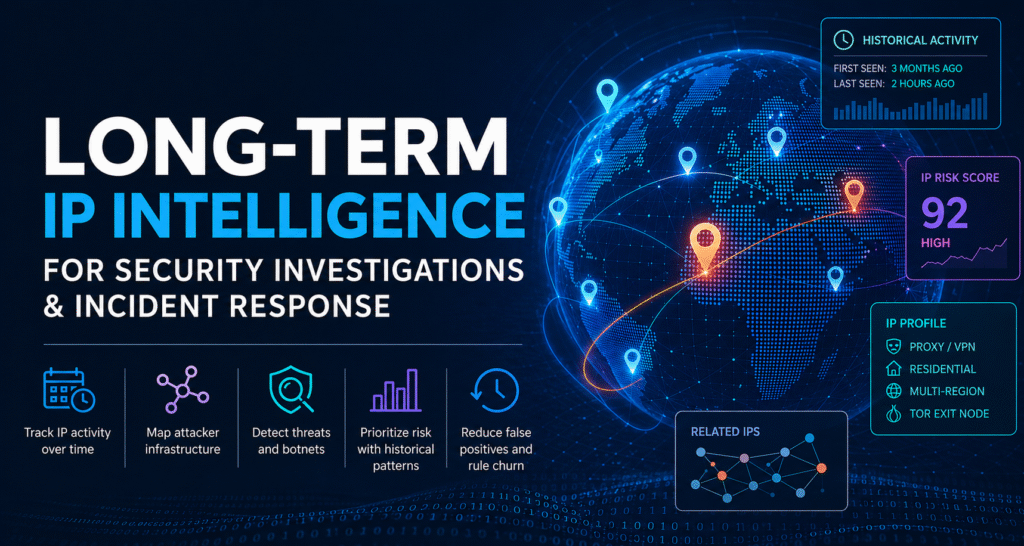
IP Forensics is the industry’s first comprehensive historical IP intelligence lookback service. Drawing on over 24 months of behavioral IP data, it gives cybersecurity investigators, fraud prevention teams, and legal and compliance professionals the ability to trace IP addresses across time. This uncovers behavioral patterns, detecting anonymization tools, and reconstructing digital journeys that point-in-time tools simply cannot see.
In this post, we’ll break down how IP Forensics answers the most pressing investigation questions security teams face today.
Why Long-Term IP Intelligence Matters in Modern Security
Traditional IP intelligence focuses on attributes like location, ISP, or proxy detection at a single moment.
While useful, this snapshot misses the bigger picture:
Infrastructure reuse across campaigns
Gradual shifts in attacker behavior
Persistence signals across rotating IP pools
Relationships between seemingly unrelated traffic
IP Forensics transforms IP data into a time-series signal, allowing security teams to analyze 24+ months of behavioral history for any IP address or batch of addresses.
That historical depth supports:
Behavioral pattern detection across weeks and months
Threat clustering across sessions and campaigns
Risk scoring grounded in demonstrated historical activity
More stable and accurate blocking decisions
In short, IP Forensics answers not just what an IP is, but what it has been doing, and for how long.
How to Map an Attacker’s IP Infrastructure Across Months of Activity
Attackers rarely rely on a single IP.
Instead, they operate across distributed infrastructure (VPNs, residential proxies, cloud nodes, and compromised devices).
IP Forensics is built to expose this infrastructure by looking back across time, not just at the moment.
1. Track IP Attribute Consistency Over Time
IP Forensics reveals patterns in Autonomous System Numbers (ASNs), the shift between hosting providers and residential ISPs, and geographic drift patterns over the lookback window. Even when IPs rotate, underlying infrastructure often leaves fingerprints — and IP Forensics makes those fingerprints visible.
2. Build Temporal Clusters
By analyzing time-based activity overlaps, repeated access patterns, and shared behavioral signatures across 24+ months of data, investigators can group related IPs into clusters. This allows teams to identify coordinated attacker infrastructure rather than treating each IP as an isolated event.
3. Analyze Historical Proxy and VPN Classifications
IP Forensics reveals past proxy and VPN classifications at specific points in time, including which provider was involved and what type of anonymization was used. This lets investigators identify when an IP changed behavior, detect reuse across multiple campaigns, and determine whether masking services were active at the exact moment of an incident. For teams that also need real-time proxy and VPN detection alongside historical lookback, Nodify provides 30+ contextual data points per provider and complements IP Forensics as part of a layered intelligence strategy.
In result, investigators move from chasing individual IPs to mapping entire attacker ecosystems across months of activity.
Correlating Lateral Movement with IP Persistence Signals
Lateral movement is one of the clearest indicators of a sophisticated attack, but it’s tricky to track when IP addresses are constantly changing. IP Forensics gives investigators the historical depth to connect movement events even when attackers attempt to obscure their tracks.
Step 1: Identify Initial Access Points
Start with known suspicious IPs and use IP Forensics to surface first-seen timestamps, geographic entry points, and historical classifications at the time of initial access.
Step 2: Track Session-to-IP Relationships
Correlate user sessions across multiple IPs over time, identifying IP reuse across different accounts and timing consistency between logins. IP Forensics supports both single-IP API queries and bulk batch analysis for large-scale investigations.
Step 3: Analyze Persistence Signals
Look for IPs that repeatedly reappear across the 24-month lookback window, consistent infrastructure patterns despite apparent rotation, and behavioral continuity; the same attack patterns appearing across different IPs over time.
Step 4: Enrich with Historical Masking Intelligence
IP Forensics identifies not just whether a masking service was involved, but which provider was used and when with detailed provider insights rather than simple yes/no flags. This allows investigators to detect residential proxy abuse, surface risk signals tied to historical activity, and connect lateral movement events with confidence.
Separating Shared Networks from Malicious Clusters
One of the biggest challenges in IP-based security is avoiding false positives, particularly with shared networks.
A single IP could represent a household, a corporate network, a mobile carrier NAT, or a proxy service. Without historical context, these can look similar in the present moment. IP Forensics provides the historical intelligence needed to distinguish legitimate network sharing from coordinated malicious activity.
Behavioral Diversity Over Time
Legitimate shared networks show varied, organic behavior across the lookback window. Malicious clusters exhibit repetitive, automated patterns that remain consistent even as IPs rotate. IP Forensics surfaces these differences by providing a time-based view of how each IP has actually behaved.
Temporal Pattern Analysis
Shared networks show natural usage cycles like activity tied to waking hours, weekends, and normal browsing behavior. Attack traffic often shows unnatural consistency or burst patterns that stand out clearly in a 24-month behavioral view.
Historical Classification Context
IP Forensics reveals how an IP has been classified over time, such as residential vs. commercial vs. hosting, and whether proxy or VPN usage appeared at specific points in that history. This classification history is what separates an informed decision from a guess.
Pro DE insight: Malicious clusters tend to prioritize efficiency and scale. Legitimate shared networks show organic variability. IP Forensics makes that distinction visible across time.
Distinguishing Botnet Traffic from Dynamic Consumer IPs
Botnets are increasingly sophisticated, often leveraging residential IP space specifically to evade detection. But even the most advanced botnets leave detectable patterns. Those patterns are most visible in historical data.
Botnet Indicators in Long-Term Data
High request uniformity across time
Coordinated timing across IPs that persists over weeks
Repeated actions at scale with minimal variation
Rapid IP rotation with consistent behavioral signatures beneath the surface
Dynamic Consumer IP Indicators
Irregular usage patterns tied to real human behavior
Mixed activity types across sessions
Natural geographic consistency without sudden unexplained shifts
Session variability that reflects organic use
IP Forensics enables detection of IPs that frequently change classification, residential IPs that exhibit automated behavioral patterns over time, and historical anomalies that point to botnet membership. The platform’s 24-month lookback window is what makes these patterns visible because botnet behavior doesn’t emerge from a single data point. It reveals itself over time.
Prioritizing Blocks Using Historical Risk Patterns
Static blocklists are reactive and often outdated by the time they’re applied. IP Forensics enables a fundamentally different approach: prioritizing blocking decisions based on demonstrated historical risk, not just current-state intelligence.
Build Risk Scores Grounded in History
IP Forensics supports risk scoring that incorporates the frequency of suspicious activity across the lookback window, the duration of an IP’s involvement in detected threats, and recurrence across multiple incidents over time. This produces risk signals that are stable and evidence-based rather than reactive.
Identify and Act on High-Risk Clusters
Rather than blocking individual IPs, investigators can use IP Forensics to identify clusters with shared historical characteristics and apply blocking rules at the infrastructure level.
Apply Time-Based Risk Weighting
Not all historical risk is equally relevant! IP Forensics allows teams to weigh recent behavior more heavily while maintaining visibility into older activity. This avoids overblocking legitimate users whose IPs may have changed hands while keeping focus on IPs with recent and sustained risk signals.
IP Forensics: Built for the Investigations That Matter Most
For organizations operating in cybersecurity, fraud prevention, e-commerce, fintech, or legal and compliance functions, IP Forensics addresses a fundamental gap in conventional IP intelligence: the inability to look back.
Incidents surface weeks or months after they occur. Fraudulent chargebacks are disputed long after the transaction. Compliance reviews require evidence from a specific date in the past. In each of these scenarios, a current-state IP lookup provides almost no investigative value, but 24 months of behavioral history changes the picture entirely.
IP Forensics is designed specifically for these situations:
Cybersecurity analysts use it to trace attacker infrastructure across campaigns, detect lateral movement, and identify persistent threat actors operating behind rotating IP pools.
Fraud prevention teams use it to validate transaction origins, reconstruct behavioral patterns, uncover false chargeback claims, and feed historical signals into machine learning models.
Legal and compliance professionals use it to support litigation, sanctions reviews, and audits with reliable historical IP geolocation and masking detection evidence.
And critically, IP Forensics focuses on network-level intelligence (not personal data) and is built to comply with global privacy standards. It reveals digital behavior without crossing the line into personal identification.
Ready to Strengthen Your Investigations with Historical IP Intelligence?
Security threats don’t operate in snapshots. Your IP intelligence shouldn’t either.
IP Forensics by Digital Element delivers the 24-month behavioral lookback that modern investigations demand, helping teams map attacker infrastructure with precision, detect patterns that point-in-time tools miss.
Make smarter, more confident decisions at every stage of incident response.
Can IP Forensics detect VPNs and proxies that were active in the past?
Yes, and this is one of IP Forensics’ most distinctive capabilities. Most VPN and proxy detection tools operate in real time, flagging masking services as they appear. IP Forensics goes further by identifying whether a VPN or proxy was active at a specific historical moment, which provider was involved, and what type of anonymization was used.
How does IP Forensics help reduce false positives in security operations?
False positives are one of the most costly problems in security operations. They consume analyst time, create alert fatigue, and can erode trust in automated systems. IP Forensics reduces false positives by providing behavioral context that current-state intelligence cannot. Rather than flagging an IP based solely on its present-moment classification, security teams can evaluate how that IP has behaved across 24 months.
Is IP Forensics compliant with global privacy regulations?
Yes. IP Forensics operates entirely at the network level, analyzing IP address behavior rather than collecting or processing personal data. It does not identify individuals, track named users, or access device-level information. This approach is designed to comply with global privacy frameworks including GDPR, CCPA, and equivalent regulations in other jurisdictions.
But IP data is only as valuable as it is accurate. While many solutions provide basic IP-to-location mapping, what truly drives performance and trust is high-quality IP geolocation data enriched with context, usage patterns, and network-level visibility.
Understanding the real benefits of IP geolocation (and what separates the most accurate IP address geolocation providers from the rest) is key for any organization making location-based decisions at scale.
The Role of Accuracy in IP Geolocation Data
Location-based decisions have significant implications.
Consider an ad campaign targeting users in a specific metro area. If the IP data is even slightly inaccurate (misclassifying suburban users as urban, or placing mobile IPs in the wrong state), the performance of that campaign drops dramatically.
Impressions are wasted. Attribution data becomes unreliable. Budget efficiency suffers.
The same applies in regulated industries such as online gambling, where accuracy is non-negotiable. A betting platform that misidentifies a player’s location could allow wagers from a jurisdiction where gambling is prohibited, exposing the company to severe compliance penalties and reputational damage.
Similarly, a fintech company that fails to flag mismatched geolocation during a transaction could open itself to unnecessary risk or regulatory scrutiny.
These aren’t edge cases. They’re everyday operational realities. The margin for error is slim, and the consequences of getting location wrong ripple throughout the entire digital stack.
What Sets High-Quality IP Data Apart
High-quality IP data from our NetAcuity database goes far beyond matching an IP address to a city.
It’s built from a dynamic, multilayered system that incorporates frequent updates, usage insights, and infrastructure-level context.
Frequent, reliable updates. IP addresses, especially those used by mobile carriers or rotating proxies, change constantly. Without a data source that refreshes regularly, organizations risk making decisions based on outdated or misleading information. NetAcuity is updated weekly and Nodify is updated continually, so the data keeps pace with how quickly the internet evolves.
Usage and structural intelligence. High-quality IP intelligence identifies how many devices are behind an IP (through NetAcuity’s NAT Detector), how often it moves, and whether it’s associated with residential or commercial infrastructure. Nodify adds whether it’s currently linked to anonymization tools like VPNs or proxies, and IP Forensics shows whether it has been in the past. This depth of insight empowers businesses to assess risk, target effectively, and personalize responsibly.
Network-level context. Knowing which autonomous system (ASN) owns the IP, whether it’s tied to a mobile network or cloud host, and what kind of traffic behavior it typically supports helps companies separate normal user activity from potential threats or anomalies. IP geolocation providers that offer detailed contextual data at this level deliver a meaningful operational edge.
Why Basic IP Data Falls Short
Many businesses rely on off-the-shelf IP data that prioritizes breadth over depth. These datasets are often aggregated from third-party sources, updated infrequently, and lack transparency into how locations are derived.
This can result in major inconsistencies like identifying rural IPs as city-based or missing major reassignment events due to ISP reallocation.
What seems like a cost-saving choice often creates more problems down the line. Misattributed geolocation leads to misinformed decisions. Flagging the wrong users as suspicious erodes trust. Showing the wrong content or blocking access for legitimate customers leads to churn.
Ultimately, basic IP data isn’t just a weak link… it’s a liability.
The Benefits of Getting IP Geolocation Right
Investing in high-quality IP geolocation data, like Digital Element’s NetAcuity, gives organizations the confidence to act quickly and the clarity to act correctly.
The benefits of NetAcuity touch virtually every function that relies on location data:
Smarter ad targeting: Reach the right audiences in the right locations down to city, postal code, or sub-postal level without wasted impressions.
Stronger fraud prevention: Identify mismatched locations with NetAcuity and anonymized traffic with Nodify, catching suspicious patterns before they become costly incidents.
Content rights and jurisdiction rules: Support content licensing and jurisdictional requirements with precise location data.
Better user experiences: Serve localized content, language, and offers that match where users actually are.
Confident risk decisions: Approve legitimate users faster while flagging genuine threats, reducing friction without increasing exposure.
Whether it’s approving a login, launching a campaign, serving regional content, or verifying a user’s location, those decisions are stronger when powered by trustworthy data.
The more context you have, the better your systems perform, the smoother your user experiences become, and the more efficiently you can manage risk.
Work with One of the Best IP Geolocation Data Providers
The difference between basic IP data and high-quality IP geolocation intelligence isn’t subtle. It shows up in every campaign, every risk decision, and every user interaction.
As digital environments grow more complex, the organizations that invest in accuracy, depth, and contextual intelligence are the ones that consistently outperform.
Digital Element has been the trusted source for IP geolocation and intelligence data since 1999, powering some of the world’s largest brands across advertising, cybersecurity, streaming, and fraud prevention. Our data doesn’t just tell you where an IP address is. It tells you what it means.
Frequently Asked Questions About Digital Element’s IP Geolocation Data
How precise and comprehensive is Digital Element’s IP geolocation data?
Digital Element’s IP geolocation data covers 99.9999% of routable IPv4 and IPv6 addresses that organizations are likely to encounter. NetAcuity maps IP addresses to more than four million distinct locations worldwide, down to the city, postal code, and sub-postal level.
How does Digital Element collect its IP geolocation data?
Digital Element uses a multi-layered methodology that combines patented technology, global data partnerships, and proprietary validation techniques. This incorporates more than 20 data sources and signals, including network infrastructure analysis, traceroute-based techniques, ISP partnerships, and verified partner data continuously validated in-house.
How often is Digital Element’s IP data updated?
NetAcuity IP geolocation data is updated weekly to maintain accuracy and reflect changes in global network behavior.
In cybersecurity and fraud prevention, timing is everything. When a fraudulent transaction, cyberattack, or compliance violation is discovered, it often surfaces weeks—or even months—after it happens.
By then, the digital trail investigators need has gone cold. Traditional IP intelligence tools only provide a snapshot of where an IP address is right now, offering little help in reconstructing what happened in the past.
This gap in visibility leaves investigators and analysts at a disadvantage. Without access to historical IP intelligence, it’s nearly impossible to validate location claims, uncover fraud patterns, or detect whether anonymizing tools like proxies and VPNs were in play at the time of the incident. The result: slower investigations, weaker evidence, and greater risk exposure for organizations across industries.
Why Historical IP Data Matters
Every IP address tells a story—but most tools only show the ending. Fraudsters know this and exploit the blind spots in traditional IP intelligence. They use residential proxies to mimic legitimate users, VPNs to mask their true locations, and shared infrastructure to hide within normal traffic.
Historical IP data gives investigators the missing context they need to:
Reconstruct events by seeing where an IP was, not just where it is.
Detect masking tactics like proxy or VPN use during critical time windows.
Uncover fraud patterns by connecting activities across weeks or months.
Validate or disprove claims tied to timing and location, such as disputed transactions or insurance claims.
With this historical lens, fleeting online activity becomes actionable, evidence-backed insight.
Closing the Gap with IP Forensics
IP Forensics is the industry’s first and only comprehensive historical IP intelligence platform. Backed by more than 24 months of queryable IP history, it equips cybersecurity teams, and fraud specialists with the ability to trace an IP address’s journey over time.
Unlike conventional IP lookup tools, IP Forensics reveals where an IP has been, the types of networks it used, and whether anonymization services were involved—at the exact points in time that matter most to your investigation.
Core Advantages:
Historic Lookback: Trace IP address behavior patterns across 24+ months.
Proxy/VPN Intelligence: Detect masking services with detailed provider insights, not just binary “yes/no” flags.
Flexible Access: Run single IP lookups via API or process large datasets for batch investigations.
Context-Rich Insights: Combine location history with activity characteristics to strengthen investigative accuracy.
Who Benefits from IP Forensics
Legal & Compliance Teams: Support litigation, audits, and sanctions reviews with reliable historic IP geolocation and masking detection.
E-Commerce & Digital Platforms: Validate transaction origins, reduce chargebacks, and uncover high-risk behavior through historic IP insights.
Cybersecurity & Forensics Teams: Reconstruct incident timelines, reveal threat actor infrastructure, and flag malicious patterns earlier.
The Bottom Line
Cybercrime thrives in the blind spots left by conventional IP intelligence. IP Forensics closes that gap by giving organizations the ability to look back in time, reconstruct digital journeys, and uncover the truth behind every IP address.
Because sometimes, the past holds the key to solving the present.
If you’re exploring how historical IP intelligence can strengthen cybersecurity, fraud prevention, or compliance efforts, these FAQs explain what IP Forensics is, how it works, and how organizations use it to uncover digital truth.
What is IP Forensics?
IP Forensics is a historical IP intelligence platform that lets cybersecurity, fraud, and compliance teams trace an IP address’s activity over time.
Why is historical IP data important for investigations?
Incidents often surface long after they occur. Historical IP data helps investigators reconstruct what happened, validate claims, and reveal masking tactics.
How far back does IP Forensics’ data go?
The platform provides over 24 months of queryable IP history, covering changes in network type, region, and anonymization status.
How is IP Forensics different from a standard IP lookup?
Standard tools show where an IP is now. IP Forensics shows where it has been, offering continuity and behavioral context.
Can IP Forensics detect VPNs and proxies?
Yes. It identifies when masking services were active and which providers were involved, adding valuable context to investigations.
Who uses IP Forensics?
Cybersecurity analysts, fraud prevention teams, and legal or compliance professionals rely on it to validate events and strengthen evidence.
How does IP Forensics help prevent fraud?
It links suspicious activity to historical patterns, revealing repeat offenders and coordinated fraud networks.
How do organizations access IP Forensics data?
Users can query data through an API for automation or run bulk analyses for large investigations.
Is IP Forensics privacy-compliant?
Yes. It focuses on network-level intelligence, not personal data, and complies with global privacy standards.
What industries benefit most from IP Forensics?
E-commerce, fintech, cybersecurity, and legal/compliance sectors gain the most value from historical IP visibility.
How does IP Forensics improve digital investigations?
It provides a time-based perspective, connecting location, masking, and behavioral data into a coherent story.
Online fraud has evolved into a highly sophisticated threat, with criminals using tactics such as proxies, VPNs, and rotating IP addresses to mask their activities. These tactics can outpace traditional defenses such as blacklists and basic VPN detection, producing false positives while still allowing malicious actors through.
What those defenses lack is context. Digital Element’s Intelligent IP Characteristics (IPC) helps supply it. IPC pairs a dynamic IP risk score with the contextual metadata behind it: activity, geolocation, movement range, and location persistence. Teams can use the score as a fast signal for triage and the metadata when a decision requires more context.
What Is IPC?
IP Characteristics (IPC) is Digital Element’s proprietary IP address intelligence dataset for fraud scoring. It enriches IP address geolocation data with contextual and behavioral insights, analyzes patterns across four dimensions.
IPC produces this intelligence without relying on personally identifiable information (PII), which can support privacy and regulatory requirements alongside fraud detection.
The Four Dimensions of IPC
IPC evaluates four dimensions:
Activity — How many devices connect to the same IP? Dozens of devices on one IP address may reflect a legitimate shared network, a mobile carrier, or an anonymization service. An unusually high level of activity can therefore raise risk, but it should be interpreted alongside the other dimensions.
Geolocation — How many distinct locations are associated with the IP address? A large number of inconsistent observed locations may indicate shared or anonymized usage, spoofing, or other behavior that warrants review.
Range — What is the distance between observed locations? Broad or rapid changes in observed geolocation may be associated with VPNs, proxies, mobile networks, or other forms of IP volatility.
Location Persistence — How long does the IP address remain associated with a location? Low persistence can signal rotating proxy infrastructure, bot activity, or one-to-many network connections, although legitimate network behavior can also contribute.
Together, these dimensions help teams form a layered IP risk profile.
Why IPC Matters for Fraud Scoring
Adding Context to the IP Address
A raw IP address or typical IP lookup provides limited insight. IPC enriches it with activity, persistence, range, and geolocation data—turning a static identifier into a set of actionable signals.
Strengthening Risk Models
Organizations can incorporate IPC metadata into their own fraud models. High activity, wide distance ranges, low persistence, and geolocation mismatches can be weighed alongside account history, transaction details, device intelligence, or other signals, so each business sets the thresholds and responses that fit its own risk tolerance.
Practical Applications
Account Takeover (ATO) Prevention
If an account usually logs in from Chicago and then appears in Eastern Europe with low persistence, the wide movement range and short location dwell time are the kind of signals that can raise the IPC score. The metadata behind that score gives teams context for deciding whether to allow the session, trigger MFA, or block the attempt.
Rather than relying on a static “known location” rule that breaks the moment a legitimate user travels, teams can combine IPC with account and authentication data to help distinguish a traveler from a compromised credential.
Payment Fraud Detection
Transactions tied to IPs with abnormal activity or mismatched locations may warrant additional verification before payment is processed. Because IPC evaluates activity, range, geolocation, and persistence together, its score can help merchants prioritize which transactions to review.
This added context is especially useful for high-volume merchants and payment processors that need to reduce manual-review queues without overlooking transactions that genuinely warrant a second look.
Bot and Automation Detection
Bots power credential stuffing, fake signups, and scraping campaigns. Automated traffic often shows telltale patterns—many sessions from one IP, rapid changes in observed geolocation, or locations that do not remain stable.
IPC turns those patterns into a scored signal with the underlying characteristics attached—detail that can help separate a bot farm from a corporate NAT or a mobile carrier gateway.
Risk-Based Authentication
IPC enables adaptive security. A stable residential IP with consistent behavior may support a smooth login or checkout. Sudden range changes, low persistence, or mismatched geolocation may justify extra verification.
This tiered approach lets businesses apply friction where their own rules call for it, rather than uniformly.
How IPC Fits Your Existing Stack
Global Reach, Local Accuracy
IPC draws on Digital Element’s underlying data foundation: more than 600 billion unique observations each month from nearly 2 billion devices, spanning 249 countries. That volume is what gives each of the four dimensions enough observed history to be meaningful, including for IP addresses that legitimately move across borders.
Integration
IPC integrates with Digital Element’s broader portfolio, enabling businesses to layer IP intelligence with other identity and location signals. Both the score and the metadata are available via API for use in existing login, checkout, and fraud-analysis workflows.
Building Trust While Fighting Fraud
Fraud prevention is not just about blocking threats. It is about protecting customers while maintaining smooth experiences. By leveraging multi-faceted risk data, IPC helps businesses apply stronger checks when needed, investigate suspicious activity more effectively, and avoid treating every unusual IP pattern as fraud.
Work With Digital Element
Fraud prevention cannot rely on static IP address geolocation alone. Today’s threats demand a multidimensional approach that combines a usable risk signal with detailed contextual analysis.
From account takeover to chargebacks to bot traffic, IPC gives organizations more to work with than an IP address alone.
Ready to see IPC in action? Request a demo and explore how IPC can fit into your fraud-prevention strategy.
Frequently Asked Questions About IPC
What makes an IP address suspicious with IPC?
Unusually high activity, wide observed geolocation ranges, low location persistence, and location mismatches can all contribute to a higher IPC score. These signals indicate that the IP may warrant closer review; they do not prove fraud on their own.
Can IPC help reduce payment fraud and chargebacks?
IPC can help companies identify transactions that warrant additional review before they are processed. Its score supports fast triage, while the underlying metadata provides context for verification and broader fraud-model decisions.
What are the benefits of IPC for fraud scoring?
IPC gives fraud teams a dynamic score for faster IP risk triage, backed by contextual metadata for deeper investigation. Those signals can enrich broader risk models, and the added context is intended to reduce unnecessary false positives and customer friction — helping teams tune security thresholds against user experience rather than trading one for the other.
How do businesses implement IPC?
IPC can be integrated via API into existing login, checkout, authentication, or fraud-analysis flows. Teams can use the score to set review thresholds and use the metadata to support security decisions—from allowing a session to triggering MFA, routing a transaction to review, or blocking activity under established policies.
What is IP fraud scoring?
IP fraud scoring evaluates the risk associated with an IP address by analyzing factors such as activity level, geolocation consistency, movement range, and location persistence. Instead of relying on a static blacklist or a simple “good IP versus bad IP” label, it produces a dynamic risk profile that can change as observed behavior changes.
Is IP fraud scoring accurate for users traveling or using mobile networks?
It can be more accurate when the model accounts for legitimate reasons an IP may look unusual, including travel, VPN use, and shared mobile-network connections. IPC’s score can identify when a closer look is warranted, while the metadata helps teams avoid treating every mismatch as fraud.
Why proactive cybersecurity is a business imperative, not just a technical decision.
How IP intelligence enables real-time threat detection and mitigates risk before it escalates.
The hidden financial and reputational costs of reactive security models.
Industry examples illustrating the critical role of proactive defenses.
The strategic advantage of integrating AI-powered IP intelligence into your cybersecurity architecture.
Why proactive cybersecurity matters now more than ever
Does your organization have a plan in place to deal with cyber threats? It might not be top of mind, but cyberattacks are on the rise. According to Check Point, Q3 2024 saw a 75% increase in cyberattacks worldwide, with 1,876 attacks per organization in that quarter alone.
The question is no longer if your organization will face cyber threats, but when and how prepared you will be. As cybercriminals become more sophisticated, reactive security measures often fall dangerously short. Instead, forward-looking organizations are adopting proactive cybersecurity strategies that leverage real-time intelligence to identify, neutralize, and prevent threats before they impact operations.
How does proactive cybersecurity differ from reactive approaches?
Proactive cybersecurity focuses on anticipating and preventing threats before they occur, employing strategies such as threat intelligence and risk assessment. In contrast, reactive approaches respond to incidents after they happen. This forward-thinking mindset enables organizations to minimize vulnerabilities and enhance their overall security posture against emerging cyber threats.
The Cost of Waiting: Why Reactive Cybersecurity Fails
Reactive cybersecurity often means responding after the damage has already been done. After sensitive information is compromised, money lost, operations disrupted, and trust eroded.
Statista projects that cybercrime losses will continue to increase, reaching $15.56 trillion by 2029. While data breaches may feel increasingly “normal,” they are anything but benign. A 2024 report from Vercara found that 58% of consumers believe brands that suffer a breach are no longer trustworthy, and 70% would stop shopping with them altogether.
Beyond financial loss and brand erosion, data breaches can trigger regulatory fines, litigation, customer attrition, and long-term reputational harm, especially in high-risk industries like healthcare and finance, where data sensitivity is non-negotiable.
Reactive security gives attackers the upper hand. And cybercriminals are always trying to stay one step ahead by using automation, AI-driven attacks, and sophisticated social engineering tactics to evade traditional defenses. Organizations that wait to act until after an intrusion face compounding costs that extend far beyond the immediate technical remediation.
The Proactive Advantage: Real-Time Visibility and Control
Proactive cybersecurity flips the model: instead of waiting for incidents, it focuses on early detection, real-time intervention, and continuous monitoring. This shift isn’t just strategic—it’s measurable. According to Recorded Future, organizations can achieve up to 209% ROI from proactive risk reduction alone.
A cornerstone of this approach is IP intelligence, which offers unparalleled visibility into network activity across geographies, devices, and user behaviors. Unlike legacy solutions that rely heavily on known signatures or post-event alerts, IP intelligence continuously analyzes dynamic network data in real time.
It detects anomalies, flags suspicious access patterns, and intercepts potential threats before they escalate. This empowers security teams to act swiftly and decisively, often stopping attacks before a single system is compromised.
IP Intelligence in Action: Your First Line of Defense
Consider how IP intelligence transforms several common threat scenarios:
Scenario
Traditional Security
IP Intelligence
Real-Time Threat Detection
Delayed response, limited visibility
Instant detection of anomalies across global networks
Phishing Attack Prevention
Reactive user alerts post-delivery
Preemptive blocking of malicious IPs before phishing emails reach users
Malware Identification
Scans for known threats only
Detection of novel malware patterns using real-time behavioral data
The ability to proactively identify and neutralize these threats translates directly into improved uptime, protected intellectual property, and sustained business continuity.
High-Value Targets: Why Healthcare and Finance Face Elevated Risks
Sectors like healthcare and financial services face relentless targeting due to the sensitivity and value of the data they manage. According to Check Point, healthcare was the third most targeted industry in Q3 2024, experiencing an average of 2,424 cyberattacks per week—an 81% increase year-over-year from Q3 2023.
Patient health records, financial transactions, and personally identifiable information (PII) offer high rewards for bad actors. A single breach can lead to identity theft, regulatory investigations, and erosion of stakeholder trust that can take years to rebuild.
A proactive security framework reinforced by IP intelligence is not optional for these industries. It’s mission-critical. Real-time monitoring, granular access controls, and AI-enhanced threat analysis provide the continuous protection necessary to safeguard data integrity and public confidence.
Scaling Proactive Security in a Rapidly Evolving Threat Landscape
As cyber threats become increasingly complex and dynamic, traditional static defenses are no longer sufficient to stay ahead. Organizations need threat intelligence that adapts in real time, capable of analyzing vast network activity, detecting subtle anomalies, and responding to new attack patterns before they escalate.
IP intelligence supports this adaptability by providing real-time, high-resolution visibility into network behavior across geographies and devices. Integrating into a proactive security framework enables faster detection, smarter mitigation, and stronger overall resilience—even against emerging or unknown threats.
For business leaders, this means investing in agile, forward-looking security tools that protect revenue, safeguard brand equity, and reduce business risk.
Business Continuity Through Proactive Defense
Ultimately, proactive cybersecurity is a business continuity strategy. By embedding real-time threat intelligence into daily operations, organizations reduce the likelihood of disruptive incidents and minimize the potential impact when threats arise. This stability supports ongoing growth, regulatory compliance, customer trust, and competitive differentiation.
Digital Element: Enabling Smarter Security Through IP Intelligence
At Digital Element, we empower organizations to move beyond reactive security with robust IP intelligence solutions. Our tools deliver real-time visibility into network activity, enabling faster threat detection and more effective mitigation. Integrating Digital Element’s IP intelligence into your security stack gives you a strategic advantage in staying ahead of increasingly complex cyber threats.
The Call to Act Now
Cybersecurity is no longer a peripheral IT concern but a central pillar of enterprise resilience. Proactive cybersecurity measures, powered by IP intelligence, enable business leaders to protect assets, ensure compliance, and maintain stakeholder trust. The time to shift from reactive to proactive defense is now.
Frequently Asked Questions
How does IP intelligence differ from traditional threat intelligence?
Traditional threat intelligence often focuses on post-incident analysis, helping teams understand what happened after the fact. IP intelligence, on the other hand, provides contextual data—such as geolocation, proxy use, or connection type—that enhances threat intelligence platforms. While not directly monitoring traffic, IP insights enable these platforms to make more informed, real-time decisions about suspicious behavior as it occurs.
Can small and mid-sized businesses benefit from IP intelligence?
Absolutely. Proactive, AI-powered IP intelligence levels the playing field, giving SMBs access to enterprise-grade protection that is scalable, cost-effective, and tailored to their evolving risk landscape.
What types of threats can IP intelligence help prevent?
From phishing and credential stuffing to malware infiltration and data exfiltration, IP intelligence detects emerging threats early, enabling organizations to neutralize risks before they impact operations.
How does IP intelligence support data privacy and compliance?
IP intelligence enhances access controls and enforces geographic restrictions, enabling organizations to align with data privacy laws, such as GDPR and HIPAA, as well as industry standards like PCI-DSS. It also supports compliance with jurisdictional regulations, including the U.S. Treasury’s OFAC sanctions list, other country-specific watchlists, and digital rights management (DRM) requirements.