Security teams are no longer asking “what is this IP?”
They’re asking, “what has this IP been doing over time?”
That shift changes everything.
Modern threats aren’t static. Attackers rotate infrastructure, reuse residential proxies, and blend into legitimate traffic patterns over weeks or months. A point-in-time IP lookup simply isn’t enough to support effective investigations or incident response. By the time a fraudulent transaction, cyberattack, or compliance violation surfaces, the digital trail has often already gone cold.
This is where long-term IP intelligence becomes critical, and where IP Forensics by Digital Element was purpose-built to deliver.
IP Forensics is the industry’s first comprehensive historical IP intelligence lookback service. Drawing on over 24 months of behavioral IP data, it gives cybersecurity investigators, fraud prevention teams, and legal and compliance professionals the ability to trace IP addresses across time. This uncovers behavioral patterns, detecting anonymization tools, and reconstructing digital journeys that point-in-time tools simply cannot see.
In this post, we’ll break down how IP Forensics answers the most pressing investigation questions security teams face today.
Why Long-Term IP Intelligence Matters in Modern Security
Traditional IP intelligence focuses on attributes like location, ISP, or proxy detection at a single moment.
While useful, this snapshot misses the bigger picture:
- Infrastructure reuse across campaigns
- Gradual shifts in attacker behavior
- Persistence signals across rotating IP pools
- Relationships between seemingly unrelated traffic
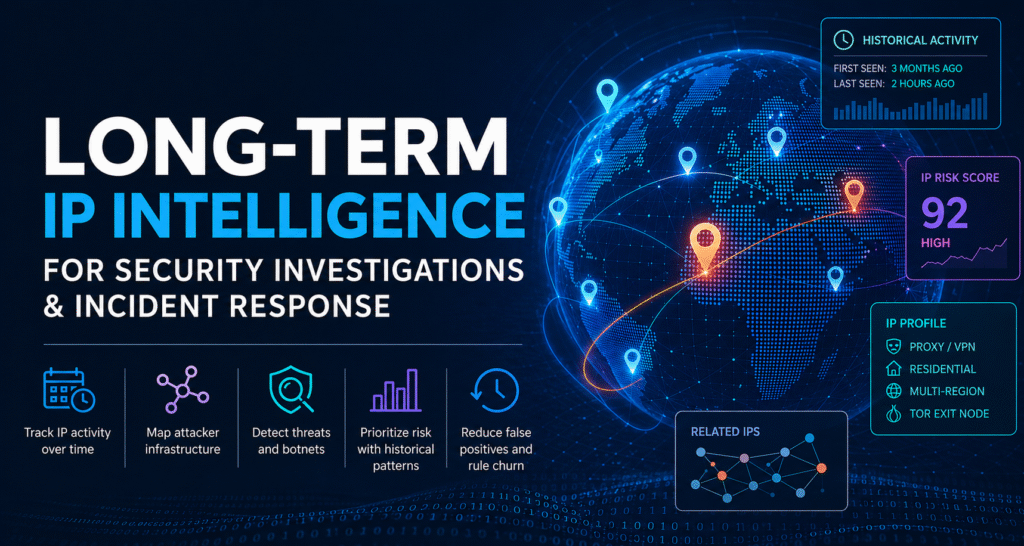
IP Forensics transforms IP data into a time-series signal, allowing security teams to analyze 24+ months of behavioral history for any IP address or batch of addresses.
That historical depth supports:
- Behavioral pattern detection across weeks and months
- Threat clustering across sessions and campaigns
- Risk scoring grounded in demonstrated historical activity
- More stable and accurate blocking decisions
In short, IP Forensics answers not just what an IP is, but what it has been doing, and for how long.
How to Map an Attacker’s IP Infrastructure Across Months of Activity
Attackers rarely rely on a single IP.
Instead, they operate across distributed infrastructure (VPNs, residential proxies, cloud nodes, and compromised devices).
IP Forensics is built to expose this infrastructure by looking back across time, not just at the moment.
1. Track IP Attribute Consistency Over Time
IP Forensics reveals patterns in Autonomous System Numbers (ASNs), the shift between hosting providers and residential ISPs, and geographic drift patterns over the lookback window. Even when IPs rotate, underlying infrastructure often leaves fingerprints — and IP Forensics makes those fingerprints visible.
2. Build Temporal Clusters
By analyzing time-based activity overlaps, repeated access patterns, and shared behavioral signatures across 24+ months of data, investigators can group related IPs into clusters. This allows teams to identify coordinated attacker infrastructure rather than treating each IP as an isolated event.
3. Analyze Historical Proxy and VPN Classifications
IP Forensics reveals past proxy and VPN classifications at specific points in time, including which provider was involved and what type of anonymization was used. This lets investigators identify when an IP changed behavior, detect reuse across multiple campaigns, and determine whether masking services were active at the exact moment of an incident. For teams that also need real-time proxy and VPN detection alongside historical lookback, Nodify provides 30+ contextual data points per provider and complements IP Forensics as part of a layered intelligence strategy.
In result, investigators move from chasing individual IPs to mapping entire attacker ecosystems across months of activity.
Correlating Lateral Movement with IP Persistence Signals
Lateral movement is one of the clearest indicators of a sophisticated attack, but it’s tricky to track when IP addresses are constantly changing. IP Forensics gives investigators the historical depth to connect movement events even when attackers attempt to obscure their tracks.
Step 1: Identify Initial Access Points
Start with known suspicious IPs and use IP Forensics to surface first-seen timestamps, geographic entry points, and historical classifications at the time of initial access.
Step 2: Track Session-to-IP Relationships
Correlate user sessions across multiple IPs over time, identifying IP reuse across different accounts and timing consistency between logins. IP Forensics supports both single-IP API queries and bulk batch analysis for large-scale investigations.
Step 3: Analyze Persistence Signals
Look for IPs that repeatedly reappear across the 24-month lookback window, consistent infrastructure patterns despite apparent rotation, and behavioral continuity; the same attack patterns appearing across different IPs over time.
Step 4: Enrich with Historical Masking Intelligence
IP Forensics identifies not just whether a masking service was involved, but which provider was used and when with detailed provider insights rather than simple yes/no flags. This allows investigators to detect residential proxy abuse, surface risk signals tied to historical activity, and connect lateral movement events with confidence.
Separating Shared Networks from Malicious Clusters
One of the biggest challenges in IP-based security is avoiding false positives, particularly with shared networks.
A single IP could represent a household, a corporate network, a mobile carrier NAT, or a proxy service. Without historical context, these can look similar in the present moment. IP Forensics provides the historical intelligence needed to distinguish legitimate network sharing from coordinated malicious activity.
Behavioral Diversity Over Time
Legitimate shared networks show varied, organic behavior across the lookback window. Malicious clusters exhibit repetitive, automated patterns that remain consistent even as IPs rotate. IP Forensics surfaces these differences by providing a time-based view of how each IP has actually behaved.
Temporal Pattern Analysis
Shared networks show natural usage cycles like activity tied to waking hours, weekends, and normal browsing behavior. Attack traffic often shows unnatural consistency or burst patterns that stand out clearly in a 24-month behavioral view.
Historical Classification Context
IP Forensics reveals how an IP has been classified over time, such as residential vs. commercial vs. hosting, and whether proxy or VPN usage appeared at specific points in that history. This classification history is what separates an informed decision from a guess.
Pro DE insight: Malicious clusters tend to prioritize efficiency and scale. Legitimate shared networks show organic variability. IP Forensics makes that distinction visible across time.
Distinguishing Botnet Traffic from Dynamic Consumer IPs
Botnets are increasingly sophisticated, often leveraging residential IP space specifically to evade detection. But even the most advanced botnets leave detectable patterns. Those patterns are most visible in historical data.
Botnet Indicators in Long-Term Data
- High request uniformity across time
- Coordinated timing across IPs that persists over weeks
- Repeated actions at scale with minimal variation
- Rapid IP rotation with consistent behavioral signatures beneath the surface
Dynamic Consumer IP Indicators
- Irregular usage patterns tied to real human behavior
- Mixed activity types across sessions
- Natural geographic consistency without sudden unexplained shifts
- Session variability that reflects organic use
IP Forensics enables detection of IPs that frequently change classification, residential IPs that exhibit automated behavioral patterns over time, and historical anomalies that point to botnet membership. The platform’s 24-month lookback window is what makes these patterns visible because botnet behavior doesn’t emerge from a single data point. It reveals itself over time.
Prioritizing Blocks Using Historical Risk Patterns
Static blocklists are reactive and often outdated by the time they’re applied. IP Forensics enables a fundamentally different approach: prioritizing blocking decisions based on demonstrated historical risk, not just current-state intelligence.
Build Risk Scores Grounded in History
IP Forensics supports risk scoring that incorporates the frequency of suspicious activity across the lookback window, the duration of an IP’s involvement in detected threats, and recurrence across multiple incidents over time. This produces risk signals that are stable and evidence-based rather than reactive.
Identify and Act on High-Risk Clusters
Rather than blocking individual IPs, investigators can use IP Forensics to identify clusters with shared historical characteristics and apply blocking rules at the infrastructure level.
Apply Time-Based Risk Weighting
Not all historical risk is equally relevant! IP Forensics allows teams to weigh recent behavior more heavily while maintaining visibility into older activity. This avoids overblocking legitimate users whose IPs may have changed hands while keeping focus on IPs with recent and sustained risk signals.
IP Forensics: Built for the Investigations That Matter Most
For organizations operating in cybersecurity, fraud prevention, e-commerce, fintech, or legal and compliance functions, IP Forensics addresses a fundamental gap in conventional IP intelligence: the inability to look back.
Incidents surface weeks or months after they occur. Fraudulent chargebacks are disputed long after the transaction. Compliance reviews require evidence from a specific date in the past. In each of these scenarios, a current-state IP lookup provides almost no investigative value, but 24 months of behavioral history changes the picture entirely.
IP Forensics is designed specifically for these situations:
- Cybersecurity analysts use it to trace attacker infrastructure across campaigns, detect lateral movement, and identify persistent threat actors operating behind rotating IP pools.
- Fraud prevention teams use it to validate transaction origins, reconstruct behavioral patterns, uncover false chargeback claims, and feed historical signals into machine learning models.
- Legal and compliance professionals use it to support litigation, sanctions reviews, and audits with reliable historical IP geolocation and masking detection evidence.
And critically, IP Forensics focuses on network-level intelligence (not personal data) and is built to comply with global privacy standards. It reveals digital behavior without crossing the line into personal identification.
Ready to Strengthen Your Investigations with Historical IP Intelligence?
Security threats don’t operate in snapshots. Your IP intelligence shouldn’t either.
IP Forensics by Digital Element delivers the 24-month behavioral lookback that modern investigations demand, helping teams map attacker infrastructure with precision, detect patterns that point-in-time tools miss.
Make smarter, more confident decisions at every stage of incident response.
Contact the Digital Element sales team to learn how IP Forensics can transform your security and fraud investigation workflows.
Frequently Asked Questions About IP Forensics
Can IP Forensics detect VPNs and proxies that were active in the past?
Yes, and this is one of IP Forensics’ most distinctive capabilities. Most VPN and proxy detection tools operate in real time, flagging masking services as they appear. IP Forensics goes further by identifying whether a VPN or proxy was active at a specific historical moment, which provider was involved, and what type of anonymization was used.
How does IP Forensics help reduce false positives in security operations?
False positives are one of the most costly problems in security operations. They consume analyst time, create alert fatigue, and can erode trust in automated systems. IP Forensics reduces false positives by providing behavioral context that current-state intelligence cannot. Rather than flagging an IP based solely on its present-moment classification, security teams can evaluate how that IP has behaved across 24 months.
Is IP Forensics compliant with global privacy regulations?
Yes. IP Forensics operates entirely at the network level, analyzing IP address behavior rather than collecting or processing personal data. It does not identify individuals, track named users, or access device-level information. This approach is designed to comply with global privacy frameworks including GDPR, CCPA, and equivalent regulations in other jurisdictions.