Digital Element Announces NAT Detector — Industry’s New Standard for Accurate IP Geolocation and Risk Intelligence.

Reverse Geocoding Technology Can Strengthen Real-Time Mobile Interactions

Today’s marketers need to show how their products and services are relevant to consumers―at different times and in different places throughout the day. However, creating that relevance requires data―and lots of it―many times from multiple sources. The “State of Marketing Report 2020” indicates that the median number of data sources used by marketers in 2019 was 8, is expected to grow to 10 this year, and projected up to 12 by 2021. Sourcing, aggregating, integrating and applying data from different providers can be a monumental challenge.

However, 51Degrees is an innovative company that has literally created a “one-stop shop” for real-time data with its Pipeline API. Founded in the United Kingdom, 51Degrees is the only commercial open-source, device-detection solution available. Leaders in ad tech, publishing, content management platforms, digital agencies and more than 1.5 million* websites, including global brands such as eBay, Sitecore, Opentext, Tencent and HSBC, use 51Degrees.

51Degrees is using reverse geocoding technology to convert the raw coordinates from latitude and longitude data derived from mobile devices into more useful geographical intelligence such as postcode, city, region, and country information. This “translated” data can then be used to provide more contextually and locally relevant advertising and content for on-the-go mobile interactions.

“We were delighted to integrate the Digital Element GeoMprint location solution for the launch of our new real-time data pipeline. Digital professionals can add location data to analytics, address capture and targeting systems.” said James Rosewell, CEO and founder of 51Degrees. “Setup takes a matter of minutes using the free-trial options. The permissively open source APIs make enhancements and audit super simple.”

Read the full press release to learn more about how to improve insights into online user preferences and device-specific behavior with geolocation technology…or jump right in and sign up for a free trial of the 51Degrees pipeline here.

*Numbers accurate at time of publication, but may be higher.

Why Geolocation Data Is Key to Reaching Local & Regional Travelers

Travel behavior has evolved dramatically over the past few years. While the height of the Covid-19 pandemic disrupted global mobility, the long-term impact has been a shift toward more regional, flexible, and digitally coordinated travel. Today, travelers move fluidly across borders, switch devices constantly, and rely heavily on online research before booking.

For travel, hospitality, and retail marketers, this makes accurate IP geolocation and location-compliance intelligence more critical than ever, especially for brands trying to reach travelers at the right moment without accidentally blocking legitimate users or misdirecting spend.

Below, we explore how modern IP intelligence helps businesses target regional travelers, prevent abuse, personalize experiences safely, and protect campaign accuracy in an increasingly dynamic digital landscape.

Regional Travel Continues to Drive Engagement & Requires Smarter Location InsightHome

Domestic and near-home travel still represents a major share of trip volume. People planning weekend getaways, reunions, or short-haul business trips often search for travel options within driving distance or regional flight paths.

To capture these high-intent users, marketers rely on precision geolocation, particularly city- and postal-level accuracy, to deliver highly relevant experiences. This includes timely hotel and lodging promotions, offers for nearby attractions, retail and restaurant deals close to key points of interest, and regionally tailored travel messaging such as “Book your long weekend escape” or “Explore your nearby national parks.”

Brands that align their targeting radius with real traveler behaviors consistently outperform those taking a broad national approach.

Using Geolocation in Today’s Travel Marketing: What’s Different Now

Modern geolocation strategy is no longer just about identifying who is nearby.

Instead, it focuses on recognizing legitimate users even as they travel, detecting anomalous or mismatched regional signals, and personalizing content without exposing personal information. At the same time, it helps reduce ad waste caused by location spoofing and ensures compliance checks are met before high-risk actions like logins, transactions, or bookings occur.

This is where premium IP data, like Digital Element’s NetAcuity®, directly supports both marketing performance and security posture.

Key Challenges Travel Brands Face & How IP Intelligence Solves Them

1. How can companies detect mismatched region settings without blocking legitimate travelers?

Travelers frequently hop between hotel Wi-Fi, mobile networks, airport hotspots, and VPN-enabled workplaces. This leads to mismatched device region settings.

By using IP-level signals such as:

  • Connection type (mobile, residential broadband, corporate network, public Wi-Fi)
  • IP address persistence and recent geographic consistency
  • Carrier identification and mobile roaming indicators
  • Network type classification (e.g., proxy, VPN, hosting provider)
  • Autonomous System Number (ASN) and network owner context

…travel brands can flag suspicious discrepancies while still allowing legitimate travelers through.

Example: A user’s device time zone is set to Germany, but they appear on a U.S. airport Wi-Fi. NetAcuity can validate that the IP belongs to an airport AS (Autonomous System) and treat this as expected traveler behavior, not fraud.

2. How do you stop region bypass via residential proxies without banning actual travelers

Residential proxy routing is a growing challenge because it mimics “normal” user behavior.

The solution is layered IP intelligence:

  • Proxy and VPN identification
  • Network type and address context (residential, hosting, mobile, corporate)
  • Contextual IP address history and observed usage patterns over time
  • Velocity of IP location or network changes
  • Connection method indicators (mobile vs. fixed broadband vs. data center)

With this combined view, brands can differentiate a real traveler on hotel Wi-Fi from a user intentionally spoofing their location through a residential proxy or VPN exit node.

This prevents misuse (like circumventing regional pricing or booking restrictions) without harming good customers.

3. What’s the best way to pre-screen location compliance before login or checkout?

A standardized approach often includes:

  • Identify country + region via IP
  • Check for anonymizers or proxies
  • Validate expected travel corridors (e.g., mobile carrier roaming)
  • Serve region-appropriate login or product options

4. Which IP fields help personalize homepage content safely?

Brands want dynamic content, but must avoid personal data.
IP geolocation remains one of the strongest privacy-friendly ways to do this.

Useful fields include:

  • Country and region for compliance and language settings
  • City/postal code for local offers
  • Connection type to adjust content for travelers vs. residents
  • Point-of-interest proximity for hotels, attractions, retail, etc.

Because IP data is non-PII, it helps create personalization without relying on cookies or user accounts.

5. How do you validate geo for campaign measurement and avoid off-target impressions?

When campaigns rely solely on self-reported location (GPS permissions, browser settings, etc.), impressions often land far outside the intended region.

Marketers use IP intelligence to:

  • Verify that an impression truly came from the campaign’s target region
  • Detect impressions delivered through VPNs or proxies
  • Identify fraudulent or mismatched location claims
  • Reduce wasted impressions and improve ROAS

Example: Accurate pre- and post-bid geolocation ensures that a Denver hotel is actually reaching users in Colorado, and not someone appearing to be “in Denver” via a misrepresented IP route.

Why NetAcuity® Outperforms Publicly Available IP Data

Not all IP datasets are equal.

Public or low-cost IP sources often suffer from:

  • Stale updates
  • Sparse location coverage
  • Inaccurate or unavailable city-level data
  • Poor detection of proxies, VPNs, and hosting networks

Digital Element’s NetAcuity® stands apart with:

  • Postcode-level granularity, globally
  • Advanced proxy, VPN, and residential proxy detection
  • Support for Carrier-Grade NAT (CGNAT) detection
  • Unparalleled IP address and network context
  • Industry leadership with more than 25 years of IP geolocation expertise

For travel, hospitality, retail, and tourism brands competing for attention, this level of accuracy enables geotargeting that is both effective and trustworthy.

Geolocation Is Essential to Today’s Traveler Journey

Travelers expect regionally relevant experiences whether they’re researching at home, browsing on the move, or logging in from multiple networks. With advanced IP geolocation and location-compliance intelligence, businesses can deliver precise regional messaging, personalize content without compromising privacy, detect spoofed or mismatched locations, and avoid unnecessary blocking that erodes trust.
As domestic and regional travel continue to grow, geolocation remains a critical tool for reaching travelers in authentic, compliant, and measurable ways.

Ready to strengthen your location strategy?

Explore how Digital Element’s IP intelligence can help you deliver more accurate targeting, reduce risk, and improve customer experiences across every traveler touchpoint. Contact our sales team for a personalized consultation or browse our resource library to learn more about geolocation, compliance, and data-driven traveler engagement.

Key Takeaways

  • Accurate IP geolocation is essential for reaching local and regional travelers, enabling contextually relevant marketing without relying on personal data.
  • Location signals help distinguish real travelers from users spoofing their location, reducing fraud while preserving access for legitimate customers.
  • Pre-screening location before login or checkout improves compliance and user experience, allowing brands to catch inconsistencies early without adding friction.
  • IP-based fields—like region, city/postal code, and connection type—enable privacy-safe personalization, making homepage content more useful without tracking individuals.
  • Advanced IP intelligence prevents wasted ad spend by validating that impressions truly come from the intended geography and not from proxies or mismatched settings.
  • Premium datasets like NetAcuity® deliver higher accuracy, reliable proxy detection, and continuous updates essential for real-time decisioning.
  • Geolocation remains one of the strongest tools for understanding traveler behavior, especially as users move across networks, devices, and regional contexts.

IP Geolocation Data Plays Key Role in Gaining and Retaining Online Shoppers

There is no doubt that online shopping has become firmly entrenched in our daily lives. In fact, according to a recent poll by Marist College and National Public Radio (NPR), 76 percent of all adults in the United States shop online. Online shopping platforms have also opened a plethora of options far beyond the physical location of the shopper.

Consumers now have more shopping choices than they could have ever dreamed of and seem to gravitate toward brands providing a positive and pleasant shopping experience. And, with what seems to be shorter and shorter attention spans from consumers, teamed with fierce competition, retailers are faced with the need to quickly attract their attention, anticipate needs, and provide an engaging, seamless shopping experience.

ShopRunner, a unique subscription service that matches savvy online shoppers with top retailers and brands, decided to focus on developing an innovative ecommerce presence so its retail partners could stand out in the crowded online space. Key factors to reaching this goal included identifying customers’ locations and effectively leveraging data science to make the shopping experience more personalized.

Because the fashion industry is very heavily influenced by geography, the company’s retail partners were looking for help in accurately deciphering trending data to help them establish filters based on attributes to enhance the shopping experience and provide recommendations for shoppers’ specific areas.

Due to the need to accurately identify and leverage shoppers’ locations, the company made the decision to incorporate IP geolocation technology. To that point, the company selected NetAcuity® Pulse Plus which combines device-derived data with reverse-geocoding data to determine members’ geographic locations and provide that information to its retail partners. An added benefit was this information was gained in a non-invasive way.

“We sometimes know very little about our shoppers, but with location we have a starting point that enables us to empower our retail partners to provide a meaningful online experience for them,” said Michelangelo D’Agostino, vice president of data science and engineering at ShopRunner. “This requires extremely accurate data so we were in need of an IP geolocation provider who could ensure reliable data as well as ease of use.”

With the use of NetAcuity Pulse Plus data, ShopRunner now helps its retail partners determine shopping trends by more pinpointed locations, allowing them to adapt and present products to consumers on the fly, whether on a website or via a mobile app.

“Today, we are using trend data to drive product innovation as well as leveraging latitude and longitude data in large metro areas for better targeting,” said Ali Vanderveld, director of data science at ShopRunner.

Read the full case study to better understand the importance of using accurate IP geolocation data to help your retail company identify potential customers, enhance the online shopping experience, and help your brand stand out in the ultra-competitive digital marketplace.


Government Organizations Gaining Ground with IP Intelligence and Geolocation

If you follow our blog posts, then you’d find us and our clients writing a lot about how IP data can be successfully applied across a number of traditional industries, from advertising to retail and streaming media to publishing.

Government, on the other hand, has been one business segment where the benefits of incorporating the use of geolocation and IP data can best be described as more like an “open secret.” However, with cyber and security risks ever increasing, more and more government organizations across all three levels―local, state and national―are now actively looking for more reliable and cost-effective solutions that can be delivered with IP intelligence data.

In recent years, the federal government has published several papers on cybersecurity, including Executive Order 13800 and the follow-on Cyber Risk Determination Report, the Trusted Internet Connection (TIC) paper, and NIST Special Publication 800-53 rev. 4 / National Vulnerability Database (NVD). All are particularly informative as to how cyber initiatives are being considered and managed by the government.

Specifically, NIST 800-53 and the NVD thoroughly address cybersecurity from start to finish, and the applicability of IP intelligence is clear and definitive. Contained within these documents are lists of low-, moderate-, and high-impact security controls. 

Of particular interest is the list of “High Impact Controls” of which IP intelligence is either directly or indirectly referenced dozens of times. Example references from different sections of NIST 800-53 include, but are not limited to: AC-17 Remote Access, AU-3 Content of Audit Records, IA-4 Identifier Management, PL-8 Information Security Architecture, SC-7 Boundary Protection, and SI-4 Information System Monitoring.

Almost any agency has cyber, security, or controlled-access priorities. Some the typical agencies are those involved with intelligence, security, law enforcement, fraud and investigative missions. Agencies that need targeted notifications as well as geospatial or demographic information or perform network analysis and management are among the most common users. Our government clients include the National Nuclear Security Administration, U.S. Department of Energy, U.S. Department of Justice, Drug Enforcement Administration, and New York State.

Digital Element’s NetAcuity® technology offers accurate and time-relevant information about online entities, users and attack vectors such as location, proxy/VPN and more. By leveraging IP intelligence data, government organizations can proactively employ real-time intelligence about inbound and outbound network traffic; identify location and connection type information; uncover potential threats; and add critical intelligence to the investigation of cyber events. The most popular solutions for government include proxy identification with PulseTM and ZIP+4 geotargeting with PulsePlusTM.

Examples of successful government applications include:

Cyber/anti-fraud: Identify incoming proxy and other circumvention tools used by bad actors or pinpoint the location of an originating IP to help prevent intrusion attempts.

Criminal investigations: Effectively sort through billions of IP and mobile connections for anomalous activity or connection types.

Intelligence community: By setting IP criteria, SIGINT and cyber analytics can be optimized and enhanced by reducing multiple orders of magnitude from billions of IP and mobile data points.

Credential verification: Compare and validate users’ IP information versus supposed origination location or proxy type.

Geofencing for inclusion/exclusion purposes: Set specific permissions or responses based on the location of IP- or mobile-based connections.

Targeted notifications: Alert users, specific geographic locations or system administrators of events based on location, domain or other criteria.

Server/network traffic analysis: Identify and analyze traffic patterns, location and connection types for IP- and mobile-based connections.

Content localization/customization: Allow for geographic, connection type or other criteria to be used to specify information, content or other personalized use cases.

As government organizations build their digital initiatives and bring increasingly more assets into the tech-enabled universe, more departments and agencies can easily and quickly apply IP intelligence to solve multiple cyber challenges on a number of fronts.

Learn more about our IP Geolocation solution here

Guest Post: How Smart Targeting Can Help You Achieve High-Performance Marketing

It goes without saying that location is one of the most important criteria for advertising smart targeting as well as for the optimization of ad campaigns.

Pinpoint data accuracy is a key factor for reaching a designated audience and, ultimately, facilitating better returns from advertising campaigns. From what the comparative statistics show, smart targeting allows advertisers to reach a more relevant audience in comparison to ordinary targeting, that often can leave behind around 30 to 40 percent of potential consumers.

As a solution provider for advertisers, affiliate networks and publishers, Affise offers a performance-marketing platform to run, manage and optimize their ad campaigns. Thus, we need to provide our clients with unmatched geo-accuracy to ad-campaign targeting and tracking.

However, we quickly realized that not all geolocation data providers are created equal and recognized that our current datasets were no longer enough for ensuring accurate targeting for our clients―for whom granular data is a must. The need arose to find a solution with global datasets that would accurately, reliably and non-invasively identify the location of digital consumers to help ensure smart targeting for our clients.

Integrating Industry-Leading IP Intelligence and Geolocation Data

Because the accuracy of geotargeting depends on the quality of the database being used to identify users’ locations, the only solution for us was to partner with Digital Element, the industry leader in global geolocation data and services.

With NetAcuity Edge technology, Affise is able to more accurately geotarget, either as a standalone targeting criterion or by adding accurate IP location data to other datasets to build better targeting profiles. Additional datasets, such as connection speed and mobile carrier, have been added to broaden targeting options and enrich capabilities, helping to improve the relevance and response for online campaigns.

Our team worked diligently to ensure the Affise platform integrated with and deployed the solution for our clients smoothly and effortlessly. Now, Affise clients benefit significantly from this new feature, and we’re changing the way affiliates target their designated audiences by greatly improving the accuracy of our geotargeting.

Multiple Benefits Provide Boosted Performance

The main results of integrating NetAcuity Edge within the Affise platform are highlighted below:

  • Deeper and More Far-Reaching Analytics
    It enables more accurate segmentation of online audiences and gives more detailed portraits of consumers. With this data, advertisers receive much clearer insights into particular customer behaviors and are able to adjust campaigns and target accordingly.
  • More Accurate Geotargeting and Traffic Tracking
    By using more accurate and reliable datasets, our clients reach the right audiences with more relevant ads―ultimately improving click-through rates.
  • Stronger Fraud Prevention
    Using IP intelligence reduces online fraud by more than 90 percent. We’ve seen this benefit through:
    1. More balanced risk management where geolocation information is used to identify and allow legitimate accounts access or identify and reject fraud sources;
    2. Enhanced identity verification that prevents access from non-targeted or high-fraud areas; and
    3. Detection and prevention of non-earmarked traffic from proxies.

With all these advantages, Affise has taken a big step forward to ensure that clients’ advertising campaigns would benefit from smart targeting and have the best possible performance―bringing more conversions and higher ROI.

Guest Author: Dmitrii Zotov, founder and CTO of Affise

How to Use Geolocation Data to Enhance Global Broadcast Services

In September, we at Spicy Mango announced our partnership with Digital Element to provide technical architecture and services to integrate its geolocation data into the Over-the- Top (OTT) platforms of some of the world’s most prominent broadcasters.

For those who aren’t too familiar, geolocation data is hugely useful to video providers and gives us as technologists a method to “translate” an IP address into a whole bunch of valuable information.

As an example, in modern handsets, laptops and tablets, GPS receivers extract your latitude and longitude, then pass this information back as a city, region or country code. However, in older devices, GPS receivers aren’t so common. Even in modern handsets, with privacy at the forefront of everyone’s minds these days, it’s a dwindling few that give applications and services access to their device location anymore.

Why Location Data Is Needed for Video Distribution

So why do we need geolocation data and services such as this? For a service provider or operator of video platforms, having global geographic-rights and entitlement-management capabilities are critical. Studios and broadcasters issue content to providers, such as Netflix or Hulu, with rules. These rules determine where and when the content may be viewed by the consumer (that’s you and me). Seems like a trifling issue, but the reality is that the penalties for a breach of the rules are severe.

These rich data sets are wrapped around interfaces that allow applications to provide an IP address, and have it translated to the data set demonstrated earlier. By using IP-address translation services, we can achieve almost the same results as we’d get with a GPS receiver, but without the pinpoint accuracy. In fact, for a video operator or service provider, a city or country is often only needed to be able to enforce these commercial and legal rules.

IP-Based Data Is Useful Beyond Geographic Rights Management

We’ve covered the why and the how, but what else can we do with geolocation data? Alongside its most frequently found use case, location information can serve us well in the wider context of the video distribution platform―when used to provide services, features or capabilities that are tailored to regions or markets. With that in mind, here are five other things that your location data can do for you on a day-to-day basis:

  1. Control Service Access

In many services, users are able to access the applications, even registering for accounts or perhaps in the worst cases, creating subscriptions, only to discover that at the point of playback, content-rights restrictions prevent playback. This can be hugely frustrating for consumers. Location data can be leveraged way before the entitlements check to verify that your users are in the right place to begin their journey with you.

  1. Personalize Catalogs

Finding a piece of content in catalogs―usually after a good old search―only to discover that your location prevents access is one of the most frustrating things consumers often encounter. We’d think in today’s age, that this shouldn’t be happening, but it still does. Location data can be queried and used at the point of catalog presentation―ensuring that only the video assets your users can view are presented before your carousels (or pages) are rendered. This is a great way to present country- or region-specific catalogs.

  1. Localize Messaging

The success of deploying and operating a truly international service involves meeting the needs of consumers wherever they may be. Location data can be used to tailor the application or portal to local requirements. It can be used to present translated text or information tables and localized offers or content, as well as player or play-back messaging. This is a refreshing approach to hard coding applications and portals in a handful of languages.

  1. Control Features

It’s not uncommon to want to control features or capabilities by territory. In the case of large multi-national events, features in the service such as download to play offline, instant restart or DVR may be subject to international restrictions as a result of licensing or partnership deals. Use location data to restrict capabilities based on location. When coupled with device-management platform technologies, the ability to enable or disable features based on location or other defined parameters requires no more than a simple change of a toggle in a console―not distribution of territory-version-specific applications.

  1. Build Reports

Location data can also be used to help build detailed reports, for example, where you might see the most activity in your service. By collating city or country codes and feeding these into analytics tools or proprietary interfaces, you can build accurate heat maps of where requests originate.

If you’re looking for a way to determine the next hot territory that’s desperate to use your service, this could be it. If you’re feeling particularly adventurous, use the data to spot abnormal traffic patterns―comparing this to volumes of requests or data hitting your APIs and interfaces. You’ll soon spot spammers or Distributed Denial of Service (DDoS) wannabe hackers.

The real-life applications don’t stop here. There is a lot you can do with geolocation data when you understand how to tie it to core services and functions inside of your video service or platform. Used correctly, it can be an incredibly powerful tool to enable true personalization and regionalization of services, as well as support the enforcement of rights.

Guest Author: Chris Wood, Chief Technology Officer, Spicy Mango

How IP Geolocation Technology Gives iGaming a Winning Hand

Dec. 18, 2017

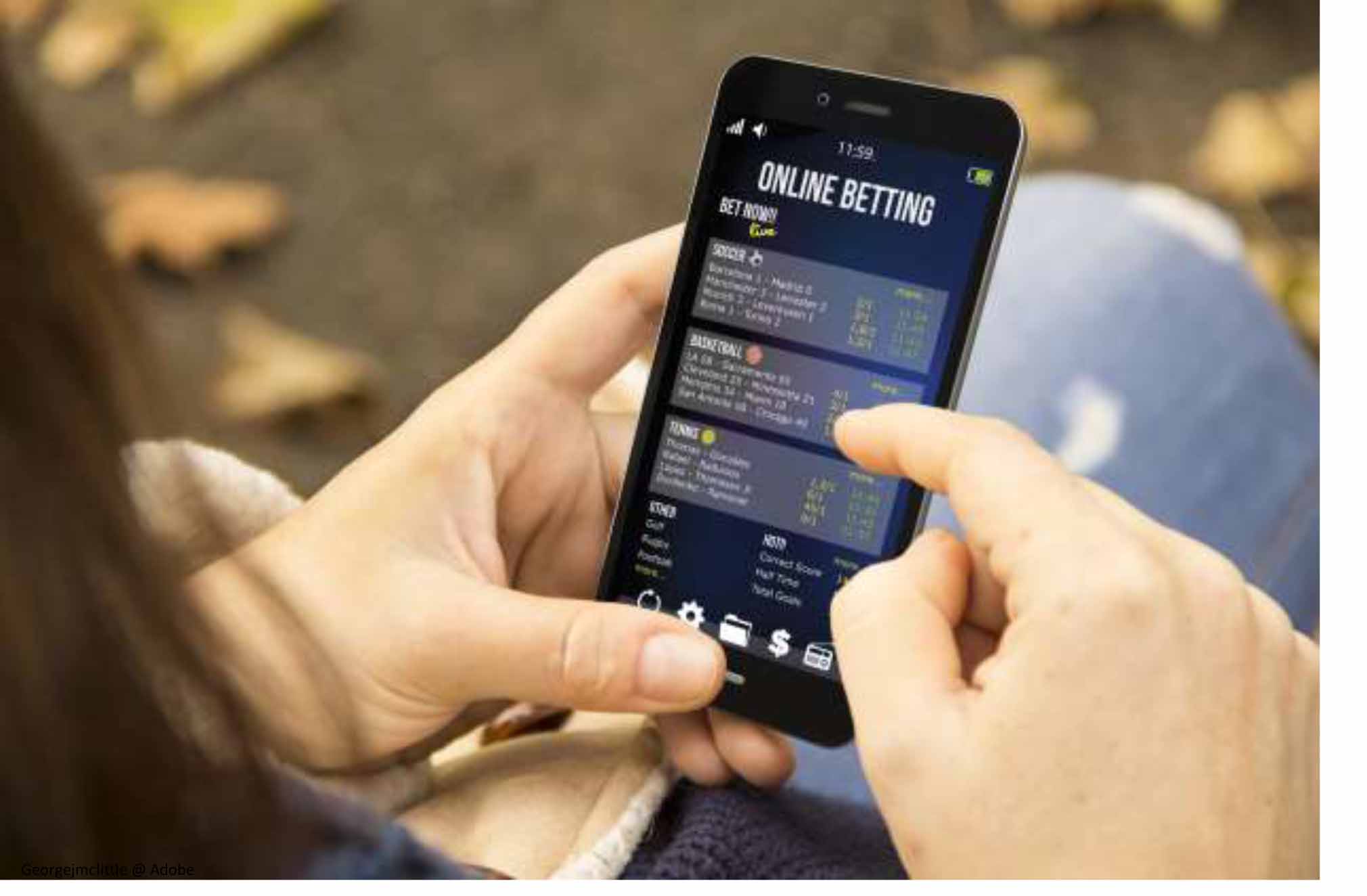
Online gambling is a thriving industry, growing at a rate of 13.29%, with its value projected to reach USD 153.57 billion by 2030, growing at a CAGR of 11.9% from 2025 to 2030.

Much of this growth will come from mobile channels, driven by a proliferation of smartphones and tablets; availability of low-cost data plans; and increased access to Wi-Fi―all of which allow consumers to gamble without location restrictions.

The expansion of the industry can also be accredited to more countries legalizing online gambling; a change in attitudes due to the rise of social and sports betting; and increased availability of non-cash payment options such as credit cards and virtual currencies͘. Take for example, the looming Supreme Court decision in 2018 to possibly repeal the Professional and Amateur Sports Protection Act (PASPA) that would put an end to the federal ban on sports betting and infuse the market by 2023 with $6.03 billion in annual revenues.

But, as the gambling market continues to grow, companies need to do more and more to stay ahead of the game. During the next few years, the priority for gambling sites will be to implement up-to-date technology to comply with country-specific jurisdictional requirements; ensure optimum quality across devices; and provide a more localized experience.

So how can companies guarantee jurisdictional control and keep up with consumer demands to ensure fair play for both users and advertisers? In short: IP geolocation technology.

Counter Strike Illegal Gamblers

The omnipresent nature of the internet means players can connect to gambling sites from all over the world͘. While this provides access to a wide audience, it also creates challenges for gambling sites that must ensure they hold a license for each user’s jurisdiction―allowing access to gambling where permitted and restricting where it is not.

As country regulations are tightened, gamblers increasingly attempt to gain illegal access by falsifying their location or hiding behind a proxy server such as a Tor, VPN or hosting center. To combat the issue of illegal betting and protect the integrity of their licenses, many companies are now using IP intelligence to detect suspicious activity.

The technology works by determining the users’ locations right down to a postcode level without them becoming personally identifiable. Additionally, premium IP data providers can accurately determine if users are trying to spoof their locations by masking their access via a proxy, Tor, VPN or routing via a hosting center. Users remain anonymous while gambling companies ensure compliance with data protection laws.

Bring Action to Every Device

With the rapid expansion of mobile betting that gives users “a piece of the action”  from an ever-increasing range of devices, gambling sites need to be optimized across all devices and screen types to provide the best possible customer experience. IP intelligence can be used to identify mobile traffic by determining the connection type and speed, allowing the most appropriate content format to be selected for that user.

In addition, this information can be used to determine the type of advertising the user is exposed to while using the site. For instance, a static display ad can be shown to an on-the-go smartphone gambler who is accessing via a slow internet connection, while an interactive video can be shown to a player who is using a tablet and a faster Wi-Fi connection.

Rack Up Points with Localized Content

Determining the locations of users means online gaming sites can automatically display content in their preferred language or currency, without them having to select options from a dropdown menu. Companies will also be able to share relevant information with the player such as local sports results.

In this way, IP geolocation technology helps gambling companies  build more meaningful relationships with their customers and yield higher levels of trust, brand loyalty and, ultimately, revenue.

Double Down on Advertising Campaigns

In recent years, both consumers and content providers have spoken out against the annoyance of intrusive, irrelevant ads and the detrimental effect that spamming has on potential online customers. Gambling sites are far more likely to attract and retain players who are served relevant ads, and advertisers will also feel they have hit the jackpot as they watch their click-through rates improve.

Both gambling sites and advertisers can use IP intelligence to raise their game by combining IP data with other criteria to target customers with highly relevant and timely campaigns; share promotions based on user location; and align ads with external events to make the gambling experience even more immersive and meaningful. They can also use location data to deliver personalized messaging that will drive customers into local casinos or betting shops.

In an industry that is governed by country-specific regulations; faces a constant threat of illegal use; and that is evolving to accommodate gambling across a growing number of devices, IP intelligence and geolocation technology is essential. For gambling sites that recognize the need to deliver targeted content and advertising without annoying or identifying the user, making use of good-quality, highly granular, real-time IP data will be the winning hand in the future.

How a Boost in Quality Geo and Carrier Data is Driving “Ridiculous” Conversions for Mobile Content Advertisers

Nov. 7, 2017

In August, we at Go2mobi made the announcement that our self-serve mobile DSP was taking  Geo-IP and Carrier targeting to a new level by integrating Digital Element’s NetAcuity Edge™ technology and data. Two and a half months later, we’re thrilled to say that nearly 1,000 campaigns are now leveraging this data to target their specific audience segments on specific carriers―more accurately than ever!

As the industry standard for carrier and geographic mapping, NetAcuity is leading the pack with city-level accuracy up to 97+ percent worldwide. In addition, NetAcuity is providing coverage for 99.9999 percent of the Internet and collecting more than 60-70 million points of view daily. With this intense boost of quality data, it’s no surprise that our advertisers have seen tremendous success in campaigns that are heavily reliant on targeting Geo-IPs and Carriers accurately.

Advertisers running 1-click Mobile Content, also known as carrier billing or Value-Added Services (VAS) campaigns, have been able to double down on this rich data and now have the ability to target approximately 2,400 carriers in more than 230 countries. This results in serving ads to the right customers, on the right carriers, at a precise place and time, and at scale! So in other words, conversions, conversions, and oh, did I mention CONVERSIONS?

As a pioneer in mobile programmatic advertising, Go2mobi knows that data is king. More importantly, we recognize the ability to make well-informed decisions based off of data is what truly makes it powerful. This is where Go2mobi’s DSP can be fully leveraged as our platform grants advertisers the ability to drill down to three levels of data combinations for more precise optimization. This allows them to unlock hidden pockets of profitable traffic with a degree of transparency that is simply not available on other DSPs.

In fact, Go2mobi’s advanced targeting enables advertisers to determine combinations of traffic that are driving not just high conversion rates, but also profitable effective costs per action (eCPAs). For instance, you could have a hyper-targeted combo set, such as Vodafone customers in Germany on iOS devices, that is highly profitable versus a combo set of Vodafone customers in Germany on Android devices that is not. This is critical information for any programmatic marketer to have in order to decide which combos should be whitelisted or blacklisted and/or bid up or bid down to successfully optimize campaign budgets.

While we’ve seen 1-Click Mobile Content campaigns leading the charge in leveraging our integration with Digital Element’s industry leading data, we know that the opportunities for other campaign successes are endless.

Guest Author: Grant Storry, COO at Go2mobi

How Big Players Use Device Intelligence for Web Optimization and Analytics

Today we spend as much as 68 percent of all digital media time using smartphones or tablets which only leaves 32 percent for using desktop computers. Not paying particular attention to mobile visitors is a wasted opportunity at best and a real threat to the business at worst, especially if the closest competition focuses on mobile. Device intelligence is an essential asset to get the most out of your mobile channels.

Understand and Address Your Mobile Audience

Device intelligence relates to a set of techniques for detecting connected devices and identifying their properties for business intelligence and web optimization purposes. Knowing everything about devices that your audience is using helps you better understand potential buyers and existing customers.

This is an extremely valuable asset used by most of the big players in the online space, including Google, Facebook, Twitter, Amazon, and many more.

Device Fragmentation Creates a Complex Mobile Landscape

Gartner recently reported that 99.6 percent of new phones shipped in Q4 2016 either used Android or iOS. With this in mind, you may get the mistaken impression that device fragmentation is not an issue and that you no longer need to address a variety of mobile devices on the market.

Today, the number of distinct connected device types, models, makers, screen sizes, screen resolutions, mobile browsers, etc. is truly immense. These characteristics can dramatically change how, when and where people interact with their devices.

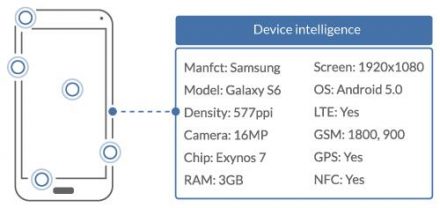
An example of device intelligence-based insight for analytics and optimization purposes.

A good example is user context. Laptop and desktop computers are typically used in an office environment, while tablets, smart TVs, and gaming consoles are used at home. For smartphones, it can be anywhere, including home, office, as well as “out and about.” The user context may also depend on input methods which vary according to the device, from mouse and keyboard to touchscreen, to remote control, even to gaming controllers.

These insights are an excellent source of information that is typically used for powerful user segmentation at every stage of the buying cycle, allowing for data-driven business decisions.

Device Intelligence for Web Optimization

Detailed knowledge of all visiting devices is widely used for web optimization to ensure that all content works and looks great regardless of the screen size, connectivity, and hardware. Web performance and user experience (UX) on mobile are the two most common reasons why big players abandon the one-size-fits-all approach and instead adapt content to address differences between connected devices:

Web Performance

According to Google, average loading time on mobile is as high as 19 seconds. This is a real problem, given that 53 percent of mobile users abandon websites that take longer than 3 seconds to load.

You can tackle this issue by loading content selectively. Serving the exact same web content to every device, big or small, is inefficient and misses the opportunity to better serve your user.

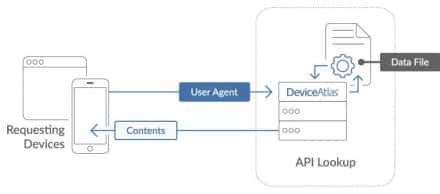
Device detection in the web environment.

To improve web performance on all device types, especially on mobile, it’s best to make sure that all content sent to a device is carefully optimized for that particular device, and that no unnecessary content is loaded. This approach can dramatically improve loading times and reduce page weight which optimizes the amount of bandwidth needed to access the website.

UX Optimization

Gone are the days when users were unwilling to make purchases on their phones due to a small screen size and security concerns. Screens have grown to over 5-inch, touchscreens are now really responsive, and the security level on mobile can be as good as on desktop. What is worrying is the fact that conversion rates on mobile are a lot lower than on desktop. According to Monetate, as much as one-third of users switch to a different device to complete a purchase process started on a smartphone.

Device intelligence can be used to dramatically improve UX on mobile, and thus boost conversion rate, user engagement, pages per session, as well as reduce bounce rate. Depending on the type of device and its capabilities, UX designers can optimize forms, search, navigation, CTAs, and build a consistent experience across all platforms.

With server-side detection, you can select the right website components that work and look great on the user’s device. At the same time, those website elements that won’t work or look great may not be loaded at all. For example, some desktop-focused, pop-up ads may be omitted on selected devices.

Device Intelligence for Analytics

Understanding how visitors interact with online content at device level makes it possible to ensure that all areas of your business—marketing, operations, support—are addressing audiences optimally, maximizing engagement and revenues.

Device data is integrated with web analytics solutions which scrutinize server logs to build a picture of historical traffic or establish the volume, breakdown, and frequency of visits from mobile and other device types to your site. It makes it possible to compare analytics across different channels, identify opportunities and resolve issues based on device characteristics.

Device intelligence also provides an excellent insight for analyzing campaign performance in the advertising space. It helps companies analyze campaign results at the device level and then optimize them based on that knowledge.

DeviceAtlas, a device intelligence provider, partnered with geolocation experts from Digital Element to provide customers with rich data on Carrier ID which can be returned with DeviceAtlas API calls. This information is typically used for analytics, business intelligence, and ad targeting purposes to build an even more detailed picture of the audience.

Visit the DeviceAtlas blog for the latest news and insights on today’s mobile device landscape and how-to guides helping you implement device detection in your environment.

Guest Author: Pawel Piejko, marketer at  DeviceAtlas

Improve Engagement for Email Marketing Campaigns by Adding Hyperlocal Geolocation Data

The Email Service Provider (ESP) landscape continues to evolve, and the competition is as intense as ever to reach and engage target audiences. ESPs using more data points to personalize communications to drive end-user engagement will be among those that differentiate themselves in the marketplace.

PostUp, the leader in end-to-end email marketing technology, has 20 years’ experience helping publishers and media companies grow audiences and send amazing―and effective―emails. An ESP with an award-winning platform, a proven services team and handpicked partners, PostUp delivers personalized communications that drive engagement and increase revenues

“It’s an arms race in terms of being able to offer the most innovative features and functions for the best price within the ESP marketplace,” said Keith Sibson, PostUp’s vice president, product & marketing. “Clients are looking for ESPs that are agile enough to address evolving challenges by providing leading technology and more bespoke services in order to up the ante when it comes to demand generation. Data enrichment is key.”

Geolocation data is among the different types of information that PostUp uses within its email marketing platform to help clients better communicate with their customers. Because the company stakes its reputation on the strength of its email marketing platform, PostUp wanted to find the most accurate geolocation data available. As a result, PostUp made the decision to incorporate industry-leading hyperlocal IP geolocation data into its platform.

According to Sibson, the addition of hyperlocal IP data has enabled PostUp to more accurately deliver clients’ email campaigns. Read the full case study to learn more about how your company can improve engagement for email marketing campaigns.