Digital Element Announces NAT Detector — Industry’s New Standard for Accurate IP Geolocation and Risk Intelligence.

Google Disrupts IPIDEA: What the Takedown Reveals About the Future of Residential Proxy Fraud

Google’s disruption of IPIDEA, one of the world’s largest residential proxy networks, is a defining moment in the ongoing fight against proxy-enabled cyber abuse. For fraud prevention and cybersecurity leaders, the announcement immediately raises an urgent question: does this signal meaningful change in the residential proxy ecosystem, or simply another reshuffling of attacker infrastructure?

At Digital Element, we see this event as both an important enforcement milestone and a reminder that residential proxy fraud remains one of the most persistent challenges in digital trust today.

What Happened With IPIDEA?

Google took coordinated action against IPIDEA after identifying it as a major residential proxy network being widely abused for malicious activity. According to reporting, IPIDEA relied heavily on SDKs embedded inside consumer applications that quietly enrolled end-user devices into proxy infrastructure, often without meaningful awareness or consent.

Google’s response included domain and infrastructure disruption, as well as enforcement through Google Play Protect. Importantly, this was a targeted disruption of IPIDEA and affiliated entities, rather than a blanket shutdown of residential proxy technology as a category.

The key takeaway is straightforward: IPIDEA was removed, but the broader residential proxy threat ecosystem remains intact.

Residential Proxy Networks Remain Core Infrastructure for Fraud

For most enterprises, residential proxy traffic is not theoretical. It is an everyday operational risk tied to account takeover attempts, automated bot attacks, ad fraud, inventory abuse, scraping, and fraud rings seeking to mask their true origin.

What makes residential proxies uniquely difficult is that they blend into legitimate consumer ISP traffic. Unlike datacenter infrastructure, residential proxy IPs carry the appearance of authenticity, which makes them one of the most effective evasion tools available to threat actors operating at scale.

Strengthen Proxy Risk Intelligence

Does This Takedown Reduce Residential Proxy Fraud?

In the near term, only partially and likely very temporary.

While IPIDEA was significant, the residential proxy ecosystem is highly distributed, economically valuable to attackers, and quick to rebuild. In practice, disruptions of this kind often lead to traffic redistribution rather than elimination. Threat actors may shift quickly to alternative proxy operators, VPN services, or emerging proxy-as-a-service infrastructure.

The residential proxy threat does not disappear. It adapts.

As long as attackers can access residential IP space through alternative providers and models, this traffic will continue to pose a significant challenge for fraud and security teams. 

Why Proxy Detection Requires More Than Blocking

Enterprises cannot solve residential proxy abuse through static IP blocking alone. As Digital Element explains in Beyond Detection: A Strategic Approach to Managing Residential Proxy Traffic, modern defense requires moving beyond binary classification toward contextual intelligence.

The challenge is no longer simply identifying that proxies exist. The real challenge is understanding intent, attribution, and risk at scale. Residential proxy traffic often requires proxy-aware enrichment, behavioral signals, and proportionate enforcement strategies that reduce abuse without introducing unnecessary friction for legitimate users.

Move Beyond Proxy Detection

What This Signals for the Market

Google’s disruption of IPIDEA is not the end of residential proxies, but it does signal increasing scrutiny on the most abusive and opaque proxy ecosystems. It also highlights the widening gap between how quickly attacker infrastructure evolves and how difficult it remains for enterprises to confidently attribute suspicious traffic.

For fraud and security leaders, the message is clear: residential proxies will remain one of the dominant evasion layers in digital abuse, and organizations are wise to invest in intelligence-driven defenses that can keep pace.

Frequently Asked Questions (FAQ)

What does Google’s disruption of IPIDEA mean?

Google disrupted IPIDEA after identifying it as a major residential proxy network widely abused for malicious activity, including unconsented device enrollment through embedded SDKs.

Does this mean residential proxy fraud is going away?

No. While IPIDEA was significant, residential proxy-enabled fraud remains widespread, and threat actors are expected to migrate quickly to other infrastructure.

Is Google shutting down all residential proxy networks?

No. Google’s action was targeted specifically at IPIDEA due to malware-linked behavior and abuse patterns. It does not represent a universal shutdown of residential proxy technology.

What should enterprises do in response?

Enterprises should strengthen proxy-aware fraud and security strategies by using contextual IP intelligence, behavioral risk scoring, and continuous monitoring rather than relying solely on takedowns or static blocking.

Will attackers shift to other proxy networks?

Yes. Proxy ecosystems are adaptive, and traffic redistribution is expected following disruptions of this scale.

Does this impact Digital Element’s residential proxy intelligence or collection process?

No. This disruption focused on malware-linked enrollment networks. Digital Element’s intelligence and collection methodologies are not dependent on abusive SDK-based proxy schemes and remain unaffected.

How can Digital Element help enterprises manage residential proxy abuse

Digital Element provides IP intelligence and enrichment that enables enterprises to identify proxy-driven risk, improve attribution, and support smarter fraud and security decisioning.


NAT Detector: A Smarter Way to Interpret IP Data in a Shared-IP World

If you’ve ever tried to make a critical decision based on IP intelligence — whether that’s targeting an ad, stopping fraud, enforcing content licensing, or investigating suspicious activity,  you already know one thing: IP data is only as valuable as your ability to interpret it correctly.

And increasingly, that’s becoming harder.

As the internet continues to evolve, IP addresses are no longer a clean one-to-one signal tied to a single user, device, or location. More and more often, multiple subscribers may appear to share a single public IP address, which can distort location accuracy, dilute risk signals, and complicate identity-based decisioning.

That’s why Digital Envoy introduced NAT Detector — a proprietary backend process within NetAcuity designed to identify NAT-enabled networks and shared-IP environments (including large-scale, carrier-grade deployments). NAT insights are processed and surfaced directly within our NetAcuity Connection Type database as a dedicated call-out: “nat” — giving teams critical context for more accurate, reliable decisioning in a shared-IP world.

Why shared IPs are becoming the norm

Network Address Translation (NAT) has been a foundational part of networking for decades. At its core, NAT allows multiple devices to share a single public IP address — a capability that’s extremely common in home, enterprise, and managed network environments.

But what’s changed dramatically in recent years is the scale.

As the global supply of IPv4 addresses has dwindled, many internet service providers (ISPs) and mobile carriers have accelerated their use of Carrier-Grade NAT (CGNAT) and other shared-IP strategies. In simple terms:   more users are being routed through fewer public IP addresses.

This approach helps networks stay operational,  but it also introduces new challenges for businesses that rely on IP intelligence for precision, trust, and enforcement.

The challenge: IP behavior is changing

For years, IP intelligence has served as a cornerstone signal across industries. But today, traditional assumptions about IP-based identification — such as uniqueness and stability — are becoming less reliable.

In high-value decisioning environments, that matters.

When many users share the same outward-facing IP address, it can lead to issues like:

  • Reduced geolocation accuracy
  • Inconsistent attribution and measurement
  • Unstable device and identity signals
  • False positives in fraud and cybersecurity systems
  • Compliance and licensing friction for legitimate users    

Put simply: it’s not enough to know where an IP appears to be — you need to understand how it behaves.  

As Digital Envoy Chief Product Officer Vinod Kashyap puts it:

 “IP geolocation has evolved far beyond geolocating an IP address to a point on a map. With the growth of shared IP environments, and persistent IPv4 scarcity, understanding IP behavior is now a prerequisite for trustable insights.”

Smarter Decisions Start With NAT Insight

When NAT connection is in play, an IP address may represent multiple users, subscribers, or endpoints. NAT Detector helps surface that insight directly, so teams can:

  • improve geolocation precision  
  • better contextualize IP-level activity 
  • make decisions based on more realistic IP assumptions  
  • reduce reliance on fragile “one IP = one user” logic  

When NAT is detected, NetAcuity will explicitly identify the connection type as “nat,” making it easy to flag shared-IP environments in downstream workflows.

This matters because NAT doesn’t just affect location, it can impact the reliability of  every downstream signal  derived from IP data.

How NAT detection improves decisions across industries

NAT Detector isn’t limited to one market. It supports a wide range of use cases where IP intelligence plays a central role — especially when accuracy, trust, and performance are on the line.

Adtech & Marketing: more accurate targeting and measurement

In advertising and marketing environments, IP is often used for:

  • audience segmentation
  • regional targeting
  • contextual decisioning
  • measurement and modeling  

But if a public IP address is actually shared across many subscribers, it can inflate or distort assumptions about who’s behind a given signal.

With NAT Detector, teams gain clearer insight into when an IP address may not represent a precise geographic user  — improving targeting quality and helping reduce misinterpretation across campaigns.

Cybersecurity & Fraud Prevention: better risk context and fewer blind spots

Fraud and security teams often look at IP behavior as part of:

  • risk scoring
  • threat analysis 
  • anomaly detection 
  • enforcement decisions  

But shared infrastructure changes the picture. When traffic originates from NAT-enabled environments, traditional IP-level signals can become diluted.

NAT Detector helps strengthen decisioning by highlighting when traffic is tied to shared IP infrastructure, enabling more accurate risk interpretation and more resilient scoring. 

DRM & Content Licensing: stronger enforcement with fewer false flags

Streaming platforms, publishers, and content providers commonly use IP-based signals for:

  • licensing enforcement
  • regional restrictions
  • compliance checks  

But NAT and CGNAT can create a mismatch between IP-based location and real end-user location, resulting in friction for legitimate viewers — or allowing unauthorized access to slip through.

NAT Detector helps teams identify potential discrepancies and make smarter enforcement decisions without over-relying on “IP location = user location” assumptions. 

Fintech & Compliance: sharper interpretation for high-stakes flows

In fintech and compliance environments, confidence is everything. Teams rely on IP intelligence to support:

  • fraud prevention
  • transaction risk analysis
  • KYC / KYB workflows
  • compliance validation  

When IP addresses represent shared NAT environments, behavior signals can become harder to interpret — especially in workflows built around uniqueness or consistency.

By identifying NAT-associated connections, NAT Detector supports more refined interpretation of IP address behavior, improving outcomes in both fraud detection and compliance decisioning. 

A more realistic foundation for modern IP intelligence Insights

The shift toward shared IP address environments isn’t a temporary trend — it’s a structural change driven by real-world pressures like IPv4 scarcity and expanding global connectivity.

That means the future of IP intelligence will be defined not only by “where” an IP appears to be, but also   what it represents   in today’s network conditions.

NAT Detector helps address that reality — delivering a more accurate foundation for teams that need dependable IP-based decisioning at scale.

To see how NAT Detector can improve your IP decisioning, reach out to our sales team here.

FAQs

What is NAT Detector?

NAT Detector is a proprietary backend process within Digital Envoy’s NetAcuity that identifies NAT-enabled and carrier-grade NAT (CGNAT) environments. These NAT insights are processed and surfaced in the NetAcuity Connection Type database as a specific call-out: “nat” — enabling more accurate interpretation of IP intelligence in shared-IP conditions.

What is NAT (Network Address Translation)?

Network Address Translation (NAT) is a method that allows multiple devices or subscribers to share a single public IP address, which is common across home networks, enterprises, and ISPs.

Why are shared IP addresses increasing?

Shared IP addresses are becoming more common due to IPv4 scarcity. Many ISPs and mobile carriers use carrier-grade NAT (CGNAT) to route more users through fewer public IPv4 addresses.

How does NAT impact IP geolocation accuracy?

NAT can reduce IP geolocation accuracy because a single public IP address may represent many different users, devices, or locations—making “one IP = one user” assumptions less reliable.

How does NAT detection help with fraud prevention and cybersecurity?

NAT detection helps security and fraud teams better interpret IP address behavior by revealing when traffic comes from shared-IP environments, reducing blind spots and improving risk decisioning.

How does NAT affect ad targeting and marketing analytics?

In marketing, NAT can distort IP-based audience signals and regional targeting because shared IPs may represent multiple users. NAT Detector provides added context for more accurate targeting and measurement.

How does NAT impact content licensing and streaming enforcement?

NAT and CGNAT can create location ambiguity, which may lead to licensing friction or false enforcement. NAT Detector helps platforms interpret IP location signals more realistically.

How does NAT detection support fintech and compliance teams?

Detecting NAT-enabled networks helps fintech and compliance teams interpret IP address behavior more accurately in shared-IP environments — strengthening risk decisioning in fraud prevention, KYC/KYB workflows, and regulatory compliance flows.

From Firefighting to Foresight: When Does the Cybersecurity Journey Turn Proactive?

Key Highlights

  • Reactive cybersecurity focuses on cleaning up after incidents. Proactive cybersecurity anticipates threats and blocks them before they cause damage.
  • Signs of a reactive posture include outdated antivirus tools, slow response times, and minimal security planning.
  • Organizations typically shift to proactive strategies after breaches, compliance audits, or facing new sophisticated cyber threats.
  • Proactive tactics such as threat hunting, penetration testing, and continuous monitoring enhance resilience.
  • Building a culture of foresight through training and collaboration strengthens cybersecurity maturity.

The best defense blends proactive and reactive measures for comprehensive coverage.

Introduction

Cyber threats are evolving at an unprecedented rate. Is your organization keeping up? Many businesses start their cybersecurity journey in firefighting mode—patching holes and reacting to breaches as they happen. But in today’s landscape, simply reacting isn’t enough.

Proactive cybersecurity changes the game. Instead of scrambling to contain attacks, you’re anticipating risks and shutting them down before they disrupt operations. That shift strengthens your defenses and helps you outpace even the most determined attackers.

So, when should a company make the leap from reactive to proactive security? And what does it take to get there? Let’s break it down.

The Reactive Security Phase: Where Most Start

Most organizations begin by focusing on damage control. Reactive security often relies on firewalls, antivirus software, and incident response plans created after breaches. While these are important, they leave critical gaps that attackers can exploit.

5 Signs You’re Stuck in Reactive Mode

  • Outdated Antivirus: Fails to catch modern, sophisticated malware.
  • Alert Fatigue: Too many alerts create noise, making it harder to identify genuine threats.
  • Weak Password Practices: Poor authentication increases the risk of credential theft.
  • Post-Breach Focus: Security teams act only after damage is done.
  • Rare Security Audits: Vulnerabilities persist without regular checks.

If any of these resonate, it’s time to rethink your cybersecurity posture.

Why Staying Reactive is Risky

Relying solely on reactive measures is like locking the door after the break-in. Breaches lead to staggering recovery costs, regulatory fines, and damaged customer trust. Outdated systems and limited employee training only compound the risks.

Vulnerability management and analysis

What Does Proactive Cybersecurity Look Like?

Proactive cybersecurity involves staying ahead of emerging threats. It involves continuous, deliberate efforts to identify and mitigate risks before they can impact your organization.

Hallmarks of a Proactive Strategy:

  • Threat Intelligence: Stay ahead of emerging risks with real-time data. IP geolocation can strengthen this intelligence by identifying suspicious access attempts from unexpected regions or blocking traffic from known high-risk IP ranges.
  • Vulnerability Management: Patch weaknesses before attackers exploit them.
  • Employee Awareness: Equip your team to detect and report suspicious activity.
  • Continuous Monitoring: Spot anomalies early and respond quickly. Granular IP data provides valuable context for monitoring efforts, enabling teams to identify and investigate traffic patterns that don’t align with expected geographies or behaviors.
  • Incident Response Plans: Define clear steps before a crisis strikes.

What Triggers the Shift to Proactive Security?

Many organizations only adopt proactive cybersecurity after:

  • A Costly Breach: Nothing spurs change like cleaning up after an attack.
  • Compliance Audits: Regulations demand higher security standards.
  • Rapid Growth: A larger digital footprint increases vulnerabilities.
  • Emerging Threats: Attackers using AI and machine learning using advanced defenses.

Core Tactics to Get Ahead

  • Threat Hunting: Actively search for hidden attackers in your systems.
  • Penetration Testing: Simulate attacks to uncover and patch vulnerabilities.
  • Network Monitoring: Detect and respond to suspicious activity in real time. Here, IP geolocation is especially powerful—it enables adaptive access policies based on location intelligence, helping prevent credential-stuffing attacks or unauthorized logins from unexpected countries.
  • AI-Powered Tools: Leverage machine learning for smarter, faster detection.
  • Endpoint Protection: Secure every device connecting to your network.

Together, these tactics—especially when enriched with IP geolocation data—help prevent breaches and strengthen operational resilience.

Computer and smartphone protection

Building a Culture of Foresight

Tools alone won’t cut it. True proactive security depends on people. Regular employee training, simulated phishing exercises, and cross-department collaboration ensure everyone is engaged in keeping your organization secure.

Conclusion

Proactive cybersecurity isn’t just a box to check—it’s a sign of true organizational maturity. By shifting from reactive firefighting to strategic prevention, you protect your systems, earn customer trust, and position your business to thrive in an unpredictable threat landscape.

Solutions like IP geolocation are often-overlooked yet powerful assets in proactive cybersecurity. They provide critical context around user activity, enabling teams to block high-risk traffic based on location data and stop attacks before they gain a foothold.

Now’s the time to ask: Is your team ready to stay ahead of cyber risks?

Frequently Asked Questions

How can I tell if my organization is too reactive?

Frequent breaches, outdated tools, and no regular risk assessments are red flags.

What are the first steps toward proactive security?

Conduct a thorough audit, provide employee training, and deploy real-time monitoring tools.

What tools support proactive cybersecurity?

SIEM systems, EDR solutions, threat intelligence platforms, and automated vulnerability management tools are essential.

What’s the difference between proactive and reactive?

Proactive measures prevent incidents, while reactive measures clean up after the damage. The strongest strategies blend both.

Password-Sharing Crackdown: Where IP Geolocation Can Help

The video streaming industry has solidified itself as an economic driver globally, with projections indicating that by 2032 it will grow to $2,660 billion in value.

This anticipated growth is fueled not only by an increasing global demand for digital streaming services but also through technology advancements, delivery innovations, and better security initiatives that protect both content providers and consumers. Perhaps one of the biggest security initiatives across the industry involves the crackdown on password sharing.

After Netflix and Hulu were estimated to have previously lost billions a year from password sharing, the industry has collectively taken notice. Increased competition, lost potential for revenue optimization, partnership obligations, shareholder pressure and ever-changing piracy tactics have contributed to an environment where multiple streaming services are now cracking down on password sharing, among them Netflix, Disney, Hulu and Max—with more certainly to follow.

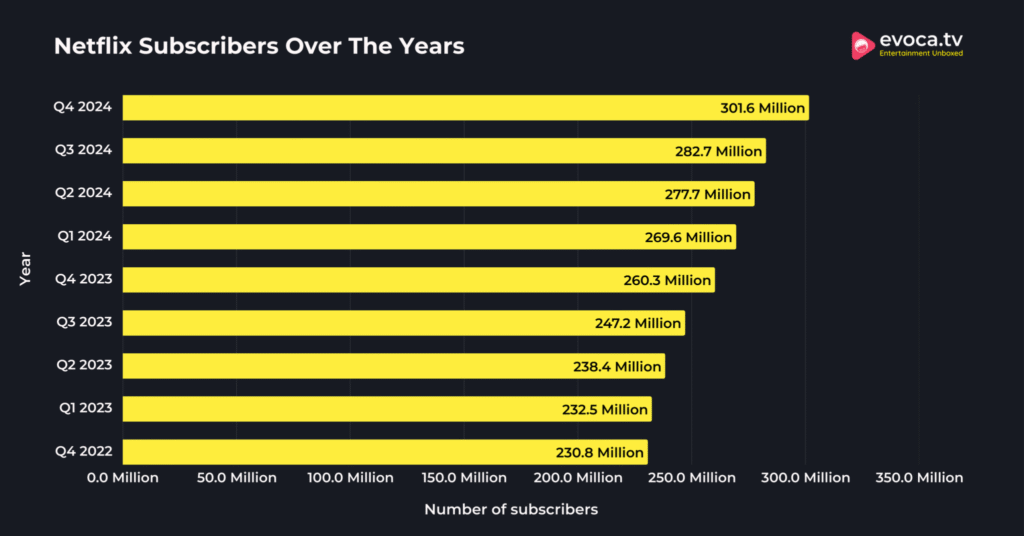
Since alerting subscribers in the United States that it would begin to curb password sharing on May 23, 2023, Netflix has had the four single largest days of U.S. user acquisition. Based on the most current data available, Netflix saw nearly 100,000 daily sign-ups on both May 26 and May 27—with healthy quarterly global subscriber additions continuing through 2024.

But while the first phase of password-sharing crackdowns is having an impact, there is still work to be done. According to recent surveys, upward of 79 percent of Americans admit to sharing passwords on streaming accounts with someone outside their homes.

As streaming retail prices continue to rise, consumers will continue to look for ways to circumvent the subscription system to get entertainment for free or at a price that is lower than what it should be. Surprisingly, a significant number of streaming services are not following the lead of industry giants due to one or a combination of these factors:

  • Platform or delivery technical limitations
  • Backlash from subscribers
  • Fear of disrupting the overall user experience
  • Competitive pressure to offer content anywhere, at anytime
  • Internal resistance from leadership or tech teams
  • Accuracy of data to allow/restrict access based on geography

Fortunately, a comprehensive data-driven solution built on IP address intelligence gives streaming service providers the ability to more reliably identify password violations and capture revenue without losing subscribers.

IP Intelligence Data as the Solution

IP intelligence is a collection of data and technologies related to IP addresses that can be used to understand online user behavior and identify threats in a more privacy-sensitive manner.

IP intelligence delivers not only the geographic location of the IP address, but also IP characteristics including the connection type, ISP, domain details, organizational data, location stability, number of devices observed for a given IP address, and insights into anonymized connections specific to VPNs and proxies.

It’s important to note that not all IP intelligence data providers are created equal. IP addresses can be re-allocated at the discretion of internet service providers (ISPs), and frequently are.

Reliable IP intelligence data, therefore, requires network geography experts to regularly apply their experience and judgment in order to resolve ambiguities. It must also be constantly updated using the most current data from multiple sources.

Beyond being reliable and up-to-date, the most important qualities to consider when evaluating IP intelligence data providers include:

  • Granularity: The more precisely you can determine a location, the better you can detect password sharing. A single account with logins from different continents is easy to flag, but sharing is just as likely to occur between friends in the same city. Ideally, geolocation attributes will include not only country and state, but also city, DMA, and postal or ZIP code.Support for IPv6 as well as IPv4: While most addresses still use the older v4 Internet Protocol, use of IPv6 is growing, particularly for mobile devices. You’ll get an incomplete picture without data from both protocols, and it will only get worse in the future.
  • Ability to detect logins from anonymous proxy servers and VPNs: Proxy and VPN usage masks a user’s actual IP address and allows them to log in anonymously. In fact, studies indicate that the residential proxy server market is projected to grow substantially in the coming years, which adds yet another threat. Residential proxies are another method to cloak online users’ identities, as these types of proxy networks channel internet traffic through real-world IP addresses provided by ISPs. All this may be completely innocent, or a deliberate attempt to utilize someone else’s password. Either way, knowing what percentage of traffic is affected by this technology is the first step in understanding how big (or small) the challenge is.
  • Compliance with consumer privacy regulations and standards: To avoid the possibility of heavy fines and negative publicity, IP intelligence data must comply with privacy regulations such as Europe’s GDPR and California’s Consumer Privacy Act (CCPA), and must not comprise personally identifiable information (PII).
  • Flexible delivery methods: In this day and age, companies don’t need long, drawn-out technology and data integrations. The ability to deploy IP intelligence solutions to support how your team works—whether it’s API-based server software, flat-file downloads or a high-performance cloud service—means a quicker, more seamless integration with your IT systems or platforms.
  • Data beyond geolocation: IP Intelligence begins with reliably pinpointing an IP address’ location. It is imperative to have sophisticated processes to provide geolocation data down to a postcode level, laying the foundation for deeper insights into the identity and behavior behind an IP address. See IP characteristics above. Some providers also offer risk insight data that flags suspicious IP addresses and non-human (bot or server) traffic. This kind of intelligence can help identify more serious password threats, such as dictionary attacks, in addition to individual password sharing. It also ensures that geolocation-based initiatives to prevent password sharing are focused on actual humans.
  • Support and service: Dedicated 24/7 support teams staffed with seasoned industry experts can help you leverage IP intelligence data to create the most value for your streaming business—based on your needs and circumstances. These specialists will also be able to collect and decipher risks, identify the red flags deserving of a customer prompt, and know when to follow up with further action.

How Streaming Media Companies Are Leveraging IP Intelligence Insights

Here are some real-world use cases from streaming media companies that are successfully utilizing IP intelligence insights to curb password sharing:

Identifying login locations

The simplest and surest way to identify password sharing is to pinpoint accounts with regular logins from multiple, geographically separate locations.

IP geolocation data, which associates a user’s IP address with geographic location information: where they are logging in, how they are connecting to the internet, and more. IP geolocation decisioning data helps you set your organization’s rules for allowing access and establishing criteria for suspicious behavior—so the more granular this data is, the better.

To enforce password-sharing guidelines, you’ll want to use the most robust and current IP geolocation data available. This ensures you can accurately locate your users and identify logins originating from alternative locations, which may indicate password compromise.

Managing anonymous users

Increasingly more online users are consuming content through a VPN or proxy server. This masks their originating/assigned IP address and allows these users to log in anonymously. Not all proxy use is nefarious.

However, when someone uses a proxy server to mask their location for the purpose of evading geographic boundaries, their action may violate terms of service or content viewing restrictions. In some cases, the action may be prohibited.

Location masking complicates the determination of password sharing. If you can’t assess the location from which your users are logging in, it makes it difficult to identify fraudulent logins from alternative locations.

IP intelligence data lets media providers create rules to both “geo-authenticate” users and “geo-fence” their content if necessary. This blocks unauthorized users from connecting from outside of an approved area.

Creating user profiles

Providers can incorporate IP intelligence information for logins to develop user data sets. The data structure accommodates a time-stamped record of every login for each subscriber, as well as the type of connection, including VPN and proxy servers. This record enables the creation of a baseline geo-footprint of normal logins for each user.

The baseline for most users will be a single location, or two nearby locations—representing a home and an office, for example. Some users, however, may travel extensively and regularly, logging in from Boston one day, Houston the next, and São Paulo the following week. The file structure must be flexible enough to accommodate the profiles of these frequent travelers.

Any departure from a baseline pattern could indicate password sharing for an account— but it could also just be the result of travel. To more accurately identify actual password sharing, providers can take these additional factors into account:

  • Velocity checking for logins from multiple locations: A login from a new location eight hours after a baseline location could be the result of legitimate travel; a login that occurs five minutes later from a different state or country is probably not.
  • Change in type of connection: When a customer who regularly connects via a conventional ISP logs in via a proxy server, it may indicate password sharing.
  • Logins from suspicious IP addresses: Even a first-time login from an IP address that is associated with risky activity is cause for concern.

Executing a “soft” enforcement approach

Since the goal is to limit password sharing while retaining legitimate customers, providers should act on the insights they obtain with the presumption that customers are innocent. No one wants to be accused of wrongdoing, or blocked from seeing a much-anticipated movie, program or sports event. Conversely, customers are generally supportive of efforts to protect the security of their accounts.

Providers are adopting a “soft enforcement” approach that reaches out to flagged users with friendly messages that engage them and ask for their help, rather than scold or accuse them. Your initial communication might include:

  • Messaging that assumes legitimate behavior and indicates concern: “We saw you logged in from a new location, and want to ensure that your account has not been compromised.”
  • A request for verification and a convenient way to provide it: “Please confirm your user ID and password at this link, or by calling our confirmation hotline toll-free at 1-800-XXX-XXXX.”

A comprehensive outreach program will include calibrated escalations for unanswered requests, while continuing to assume innocent behavior. For example, a second message might start by noting that “we haven’t heard from you regarding a new login location,” and request a response by a specific day to “ensure the safety and security of your account.”

Continued non-response might result in a notification that the account will be blocked unless the customer verifies his or her identity to ensure account security. Only a failure to respond to this third request would result in a block on the account, accompanied by a message that “your account has been blocked to ensure your security” and inviting the customer to get in touch to provide verification.

Rely on a Smart Strategy to Fight Password Sharing

Although the login for an NFL Sunday Ticket package may be shared across a Fantasy Football League or a Netflix password might find its way from a roommate to a classmate to a boyfriend’s cousin, content providers now have a smarter strategy to fight password sharing.

With the right IP intelligence data, streaming media providers can strengthen their ability to identify suspicious activity and configure effective access criteria and rules—enabling them to capture revenues, retain subscribers, encourage account upgrades, and increase customer satisfaction.

Are you ready to implement a smart strategy to fight password sharing? Reach out to support@digitalenvoy.com today!