The video streaming industry has solidified itself as an economic driver globally, with projections indicating that by 2032 it will grow to $2,660 billion in value.
This anticipated growth is fueled not only by an increasing global demand for digital streaming services but also through technology advancements, delivery innovations, and better security initiatives that protect both content providers and consumers. As password-sharing policies evolve, many streaming providers are asking a critical question: how can you accurately detect shared account access while maintaining a seamless experience for legitimate users?
Why Streaming Services Are Cracking Down on Password Sharing
After Netflix and Hulu were estimated to have previously lost billions a year from password sharing, the industry has collectively taken notice. Increased competition, lost potential for revenue optimization, partnership obligations, shareholder pressure and ever-changing piracy tactics have contributed to an environment where multiple streaming services are now cracking down on password sharing, among them Netflix, Disney, Hulu and Max—with more certainly to follow.
Since alerting subscribers in the United States that it would begin to curb password sharing on May 23, 2023, Netflix has had the four single largest days of U.S. user acquisition. Based on the most current data available, Netflix saw nearly 100,000 daily sign-ups on both May 26 and May 27—with healthy quarterly global subscriber additions continuing through 2024.
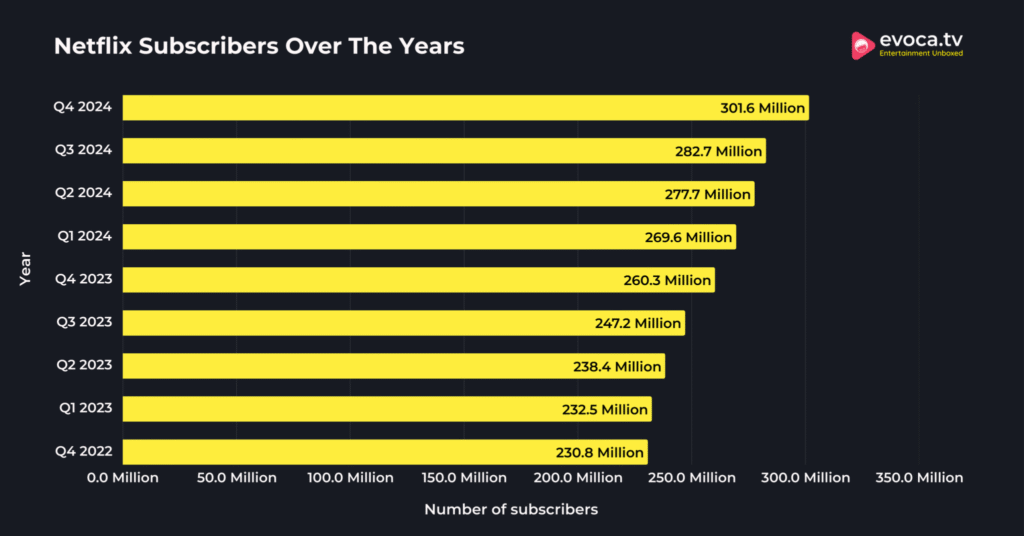
But while the first phase of password-sharing crackdowns is having an impact, there is still work to be done. According to recent surveys, upward of 79 percent of Americans admit to sharing passwords on streaming accounts with someone outside their homes.
As streaming retail prices continue to rise, consumers will continue to look for ways to circumvent the subscription system to get entertainment for free or at a price that is lower than what it should be. Surprisingly, a significant number of streaming services are not following the lead of industry giants due to one or a combination of these factors:
- Platform or delivery technical limitations
- Backlash from subscribers
- Fear of disrupting the overall user experience
- Competitive pressure to offer content anywhere, at any time
- Internal resistance from leadership or tech teams
- Accuracy of data to allow/restrict access based on geography
Fortunately, a comprehensive data-driven solution built on IP address intelligence gives streaming service providers the ability to more reliably identify password violations and capture revenue without losing subscribers.
IP Intelligence Data: The Foundation for Detecting Shared Accounts and Location-Based Risk
IP intelligence is a collection of data and technologies related to IP addresses that can be used to understand online user behavior and identify threats in a more privacy-sensitive manner.
IP intelligence delivers not only the geographic location of the IP address, but also IP characteristics including the connection type, ISP, domain details, organizational data, location stability, number of devices observed for a given IP address, and insights into anonymized connections specific to VPNs and proxies.
It’s important to note that not all IP intelligence data providers are created equal. IP addresses can be reallocated at the discretion of internet service providers (ISPs), and frequently are.
Reliable IP intelligence data, therefore, requires network geography experts to regularly apply their experience and judgment in order to resolve ambiguities. It must also be constantly updated using the most current data from multiple sources.
Beyond being reliable and up-to-date, the most important qualities to consider when evaluating IP intelligence data providers include:
- Granularity: The more accurately you can determine a location, the better you can detect password sharing. A single account with logins from different continents is easy to flag, but sharing is just as likely to occur between friends in the same city. Ideally, geolocation attributes will include not only country and state, but also city and postal code. Support for IPv6 as well as IPv4: While most addresses still use the older v4 Internet Protocol, use of IPv6 is growing, particularly for mobile devices. You’ll get an incomplete picture without data from both protocols, and it will only get worse in the future.
- Ability to detect logins from anonymous proxy servers and VPNs: Proxy and VPN usage masks a user’s actual IP address and allows them to log in anonymously. In fact, studies indicate that the residential proxy server market is projected to grow substantially in the coming years, which adds yet another threat. Residential proxies are another method to cloak online users’ identities, as these types of proxy networks channel internet traffic through real-world IP addresses provided by ISPs. Without knowing what percentage of traffic is affected by this technology, the challenge is impossible.
- Flexible delivery methods: In this day and age, companies don’t need long, drawn-out technology and data integrations. The ability to deploy IP intelligence solutions to support how your team works—whether it’s API-based server software, flat-file downloads or a high-performance cloud service—means a quicker, more seamless integration with your IT systems or platforms.
- Data beyond geolocation: Location tells you where a login came from; context tells you whether it should concern you. The most useful IP intelligence pairs accurate geolocation with behavioral metadata about the IP address itself — the signal that separates a subscriber on vacation from an account quietly serving three households. Look for providers that draw on historical observation of each IP address to report activity (how many devices have connected through it), location (how many distinct places it has been observed), range (the geographic spread of those observations), and persistence (how long it has stayed in one place, tracked week over week). An unusually high device count on a residential connection, or an IP that never settles, is far more telling than any single login location. Risk insight that flags suspicious IP addresses and non-human (bot or server) traffic adds a further layer, helping you catch more serious credential threats — such as credential stuffing — alongside routine password sharing, while keeping enforcement focused on actual humans.
- Support and service: Ask who you actually get to talk to, and how quickly — you want people who work with IP data every day and can tell you whether an anomaly is a real signal or a network quirk – not a self-help article on a portal. The best partners don’t just answer questions; they review how you’re applying the data and flag when another dataset would measurably improve your results. You’re buying expertise as much as data.
How Streaming Media Companies Are Leveraging IP Intelligence Insights
Here are some real-world use cases from streaming media companies that are successfully utilizing IP intelligence insights to curb password sharing:
Identifying Login Locations and Location Variance Across Sessions
The simplest and surest way to identify password sharing is to pinpoint accounts with regular logins from multiple, geographically separate locations.
IP geolocation data, which associates a user’s IP address with geographic location information: where they are logging in, how they are connecting to the internet, and more. IP geolocation decisioning data helps you set your organization’s rules for allowing access and establishing criteria for suspicious behavior—so the more granular this data is, the better.
To enforce password-sharing guidelines, you’ll want to use the most robust and current IP geolocation data available. This ensures you can accurately locate your users and identify logins originating from alternative locations, which may indicate password compromise.
Managing Anonymous Users and Preventing Geo-Evasion via VPNs and Proxies
A growing share of viewers now connect through VPNs and proxies. Most have ordinary reasons — privacy, public Wi-Fi, a corporate network — and blocking them outright would punish paying subscribers. But the same technology that protects a legitimate user also conceals where they actually are, and some use it deliberately to cross geographic boundaries they’ve agreed not to cross, violating your terms of service or the content licensing agreements you’re bound by.
Either way, the enforcement problem is identical: if you can’t see where a session originates, you can’t distinguish a shared login from a traveling subscriber. Anonymized traffic doesn’t just evade geo-restrictions — it erases the signal that password-sharing detection depends on.
However, overly aggressive blocking can frustrate legitimate users.
A smarter approach includes:
- Detecting VPN, proxy, and anonymizer usage
- Applying risk-based decisioning instead of blanket blocking
- Allowing access with step-up authentication or verification
- Monitoring persistent anonymized behavior over time
This ensures enforcement actions are targeted, not disruptive.
User Profiles to Score Session Risk and Detect Behavioral Anomalies
Providers can incorporate IP intelligence information for logins to develop user data sets. The data structure accommodates a time-stamped record of every login for each subscriber, as well as the type of connection, including VPN and proxy servers. This record enables the creation of a baseline geo-footprint of normal logins for each user.
The baseline for most users will be a single location, or two nearby locations—representing a home and an office, for example. Some users, however, may travel extensively and regularly, logging in from Boston one day, Houston the next, and São Paulo the following week. The file structure must be flexible enough to accommodate the profiles of these frequent travelers.
Any departure from a baseline pattern could indicate password sharing for an account— but it could also just be the result of travel. To more accurately identify actual password sharing, providers can take these additional factors into account:
- Velocity checking for logins from multiple locations: A login from a new location eight hours after a baseline location could be the result of legitimate travel; a login that occurs five minutes later from a different state or country is probably not.
- Change in type of connection: When a customer who regularly connects via a conventional ISP logs in via a proxy server, it may indicate password sharing.
- Logins from suspicious IP addresses: Even a first-time login from an IP address that is associated with risky activity could be cause for closer review. Unlike the other signals here, this one needs no baseline to interpret — an address with a history of bot traffic or credential-stuffing attempts is a red flag on the very first session.
How to Score Session Risk from IP Behavior, Movement, and Persistence
The signals above — location variance, connection type, IP risk, and deviation from a user’s baseline — are more useful combined than evaluated one at a time. A business traveler will trip several in an ordinary week. Session risk scoring weights each signal and returns one number per session, so you act on the overall picture rather than whichever flag fired first.
Persistence makes that score reliable. An IP anchored to the same location for months carries different weight than one that has moved repeatedly in a matter of days, even when both return the same single-session result. A score can express that difference; a binary flag cannot.
The payoff is a graduated response. Instead of one threshold that either blocks or allows, define tiers: allow and log at low risk, monitor at moderate, require step-up verification at elevated, and hold the session pending confirmation at high. Most flagged accounts never reach the top tier — which is the point, and the foundation of the soft enforcement approach below.
Executing a “Soft” Enforcement Approach to Minimize Customer Friction
Since the goal is to limit password sharing while retaining legitimate customers, act on your insights with the presumption that the customer is innocent. No one wants to be accused of wrongdoing, or blocked from a much-anticipated movie or live event. Handled well, customers are broadly supportive of measures that protect their own accounts.
In practice, the leading providers resolve this in-session rather than through outreach campaigns. When a device falls outside the established household, the viewer sees a brief prompt explaining that the device isn’t recognized, and a one-time code goes to the email address or phone number already on the account. Entering it restores access in seconds.
Two details make this work:
- Never ask the customer to re-enter their password, and never send a link requesting credentials. That is the shape of a phishing attack, and training subscribers to respond to it undermines the account security you’re trying to protect. A one-time code sent to a contact method already on file verifies the person without exposing anything.
- Give the flagged user somewhere to go. The most effective soft enforcement isn’t a challenge; it’s an offer — a paid extra-member option that converts a shared login into legitimate revenue. Most major services now price this between $7 and $10 per month, and it’s where accurate detection turns an account review into an upgrade rather than a cancellation.
Reserve harder measures for accounts that repeatedly fail verification or show sustained high-risk patterns, and even then frame the action around account security rather than accusation. Escalation should be rare. If your detection is accurate, most sessions never need challenging at all.
Rely on a Smart Strategy to Fight Password Sharing
Password sharing isn’t really a blocking problem — it’s an interpretation problem. Every provider can see that an account logged in from two places. The ones capturing revenue are the ones that can tell which of those logins is a subscriber on vacation, which is a second household, and which is worth acting on.
That distinction is made or lost at the data layer. Geolocation accurate enough to separate neighborhoods, behavioral context showing how an IP address actually behaves over time, and reliable detection of VPN and proxy traffic are what turn a raw location signal into a decision you can defend to a customer. Without them, enforcement is guesswork — and guesswork costs you either revenue or subscribers, usually both.
Get this right, and the outcome isn’t a wave of blocked accounts. It’s fewer false positives, fewer support escalations, and more shared logins converting into paid extra members.
Ready to build enforcement on data you can trust? Talk to our team about how IP intelligence fits into your detection and verification workflows — starting with an honest assessment of what your current data can and can’t tell you.
Frequently Asked Questions About IP Intelligence and Password Sharing
How do streaming services detect shared account access?
Streaming services detect shared account access using IP geolocation, device data, and session behavior analysis. By analyzing location variance, login frequency, and IP risk signals, providers can identify patterns that indicate unauthorized sharing.
How can streaming platforms stop VPN-based geo-evasion?
Platforms can detect VPNs and proxies using IP intelligence data and apply risk-based controls such as step-up authentication, session monitoring, or selective blocking to prevent abuse without impacting legitimate users.
Why is location accuracy important for password-sharing enforcement?
Higher geolocation accuracy enables platforms to distinguish between legitimate users (such as those traveling) and suspicious activity. Granular data at the city or ZIP code level improves detection and reduces false positives.
Can Digital Element help enforce regional compliance while minimizing traveler friction?
Yes. With accurate, frequently updated IP data, streaming providers can:
- Enforce regional content licensing requirements
- Maintain high geolocation accuracy at city and ZIP/postcode level
- Identify legitimate travel vs. suspicious access
- Reduce false positives that impact real users
This balance allows providers to protect revenue, maintain compliance, and preserve a positive customer experience.