
When evaluating an IP geolocation service, it’s important to look beyond surface-level claims and focus on the factors that matter most for your specific business and use case.
While many vendors offer some form of IP geolocation data, there are meaningful differences in how that data is sourced, validated, updated, and delivered. Those differences can directly impact accuracy, scalability, and long-term performance.
In this guide, we’ll walk through what to look for in an IP geolocation service while covering accuracy, data freshness, coverage, and real-world applicability, so you can make an informed decision and understand how Digital Element approaches IP-based location intelligence.
What is IP Geolocation and Why Does it Matter?
IP geolocation refers to identifying the physical location of a device connected to the internet using its IP address. Businesses can use this information for various applications, such as improving user experience, personalizing content, managing digital rights, detecting fraudulent activities, and targeting marketing campaigns.
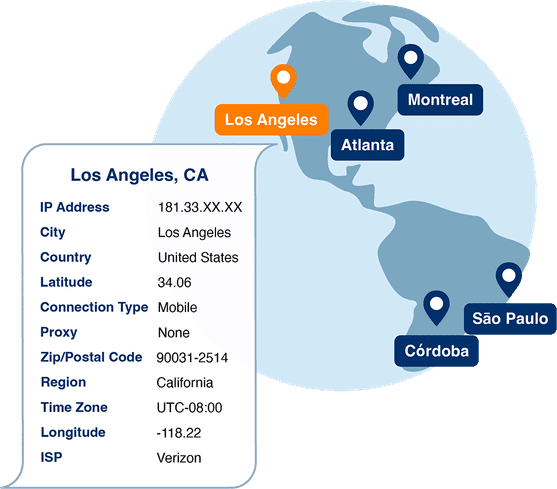
IP geolocation is helpful for businesses that operate online and need to provide location-based services or track the location of their website visitors.
What to look for in an IP geolocation service
With so many options available, how do you choose the best IP geolocation database for your business? Read on to dive deeper into these factors and provide actionable tips to help you make an informed decision.
1. Trusted Brand Reputation
Perhaps the most important part of selecting any vendor for your business, it’s critical to start by ensuring the IP geolocation service provider has a proven track record of success and a reputation for providing high quality data, reliable service, and exemplary customer support. This is bigger than simply ensuring your business gets results — your own reputation is also at stake.
Ask vendors for a client list, examples of tangible results, and any awards recognizing their superior technology and solutions.
2. Accuracy of Data Beyond Country and Region
Data accuracy is one of the essential features to consider when selecting an IP geolocation service provider. Accuracy varies widely among vendors, and depends on several factors, such as the number of data sources, the frequency of updates, and the methodology used to collect and analyze the data. The data’s accuracy and reliability directly affects the service’s usefulness for your business.
Country-level accuracy is generally 95-99.99% for most IP geolocation vendors, whereas city-level accuracy can range from 40-97%. Poor accuracy results in off-target ads and content, or might allow unauthorized access to digital content and services.
You want an IP geolocation service that can provide up-to-date and precise geolocation data, such as real-time ISP and ASN lookup, IPv4 and IPv6 data, and time zone and postal/ZIP code information.
Look for an IP geolocation service with a reputation for providing the most accurate data, which can positively impact your business.
Beyond merely accepting accuracy at face value, it’s important to choose a vendor that can verify its data accuracy with independent review from third-party auditors. This assesses the data itself and the methods used to collect it, and is a great way to prove that a vendor can “put its money where its mouth is.”
3. City-Level and ZIP-Code Granularity at Scale
Ask yourself: How hyperlocal is the data within my target geographies? Do you return postcode-level geography? If so, do you default to city-center postcodes?
If highly granular city or postcode-level data is important to your business, then it is important to understand that most vendors do not perform well (or at all) at this level. Most either aggregate traffic into large metropolitan areas and/or provide city-center default postcodes which may be 10 or even 100 miles away from web visitors’ actual locations.
ZIP+4 data is especially beneficial to marketers who want to target very specific audiences concentrated in more pinpointed locations within the United States.
4. Data Freshness and Update Frequency
IP geolocation provides various features and functionalities that enable you to get accurate geographical information about an IP address. The API returns essential details such as the country, region, city, postal code, time zone, ISP, and ASN of the IP address.
Additionally, it provides endpoint URLs to retrieve the country flag, calling code, and other essential information such as proxy and VPN details.
One of the fundamental features of IP geolocation is its ability to provide location-based information, which can be used for ad targeting, content personalization, online fraud detection, and digital rights management.
Most IP geolocation vendors simply repackage publically available (free) Whois registration data, and some supplement with user-supplied data. Simple Whois information and/or user-supplied data, however, are not reliable methods for accurate geolocation when used in isolation.
If accuracy, coverage, and granularity are important to your business, select a vendor that employs multiple methodologies, including network infrastructure analysis and user-validated location feedback, as well as has a team of data analysts that double checks automated data collection methods and runs quality-assurance checks.
5. IP Coverage and Global Reach
Ask yourself: Besides IP geolocation information, what other datasets do they offer?
Information such as proxy or VPN type; mobile carrier; connection type/speed; home/business user; industry classifications; longitude/latitude; time zone; domain name; ISP; company name; organization name; demographics; and more can be impactful datasets for creating more meaningful user experiences.
6. Ease of Geolocation Integration
Ease of integration is another crucial factor when choosing an IP geolocation service.
You want an API that can be quickly and seamlessly integrated into your existing systems, such as your website, mobile app, or CRM. Look for an IP geolocation API with various integration options, such as REST API, JSON, XML, and CSV. Some IP geolocation services also offer SDKs and client libraries for popular programming languages like JavaScript.
Integration is a massive compliment to accuracy, especially for things such as urban planning and placing locational services. The easier it is to integrate the IP geolocation service, the faster you can start taking advantage of the benefits it provides.
7. Product Pricing
The pricing model of IP geolocation varies from one service provider to another. While some IP geolocation providers offer a free plan, others require a subscription plan. Pricing depends on various factors, such as the number of API calls, the level of accuracy and precision required, the level of support, and the number of features needed.
Some IP geolocation service providers have a pay-as-you-go pricing model, while others require an annual or monthly subscription. Some providers offer discounts for bulk purchases or special pricing for non-profit organizations or educational institutions.
When selecting an IP geolocation service provider, it is necessary to consider the pricing model and ensure that it is within your budget. Consider the API’s response time, uptime, and latency to provide a smooth user experience.
IP Geolocation vs. GPS: Understanding Accuracy at Scale
When teams evaluate location data for advertising or personalization, IP geolocation is often compared directly to device‑based GPS. While both serve important roles, they’re designed for very different use cases.
GPS data delivers extremely precise, real‑world positioning, often down to a few meters. However, that level of accuracy comes with limitations: it requires explicit user permission, is restricted by mobile operating systems, and doesn’t scale easily across all devices, browsers, and environments.
IP geolocation, on the other hand, is built for scale. It allows businesses to understand where users are connecting from without relying on app‑level permissions or device sensors. For ad delivery, streaming, ecommerce personalization, and fraud prevention, IP geolocation offers a practical balance of accuracy, reach, and privacy compliance.
Rather than replacing GPS, IP geolocation complements it by enabling consistent location intelligence across desktop, mobile web, CTV, and server‑side environments where GPS simply isn’t available.
Frequently Asked Questions About IP Geolocation for Businesses
How accurate is IP geolocation in general?
High-quality IP geolocation data can reliably identify a user’s country, region, and city, and in many cases supports ZIP-code or postal-level targeting. Accuracy depends on factors such as data sources, validation methods, IP coverage, and how frequently the data is updated.
For most digital use cases, IP geolocation provides a strong balance of precision, scale, and reliability.
How does IP geolocation compare to device GPS for advertising use cases?
Device GPS can provide very precise real-world location data, but it requires explicit user permission and is limited to environments where GPS access is available. That makes it difficult to scale across all advertising channels.
IP geolocation is designed for scale. It works across desktop, mobile web, connected TV, and server-side environments without relying on device-level permissions. While it doesn’t offer meter-level precision, it supports consistent city- and ZIP-level targeting, which is often more practical for large-scale ad delivery and personalization.
Why does data freshness matter for IP geolocation?
IP addresses and network assignments change frequently as internet infrastructure evolves. If geolocation data isn’t updated regularly, accuracy can degrade over time, especially at the city and ZIP-code level.
Frequent updates help ensure location mappings reflect how users are actually connecting to the internet, rather than relying on outdated assumptions.
How can ecommerce teams evaluate the freshness of IP geolocation data week to week?
Ecommerce teams often look at update frequency as a key indicator of data quality. Weekly updates are generally considered best practice, as they help capture changes in IP usage patterns and reduce the risk of mis-targeted traffic.
Fresher data supports better regional personalization, more accurate analytics, and improved performance for time-sensitive campaigns like promotions or seasonal sales.
How does Digital Element’s NetAcuity data compare to other IP geolocation providers?
Most leading providers deliver strong accuracy at the country level, but differences become more apparent at finer levels of granularity and at scale. NetAcuity is designed to support consistent city-level and ZIP-code targeting across large global audiences, which is particularly important for programmatic and connected TV advertising.
When comparing providers, teams often look beyond headline accuracy claims to factors like update cadence, IP coverage, and consistency across markets.
Is IP geolocation suitable for connected TV and programmatic advertising?
Yes. IP geolocation is widely used for CTV and programmatic advertising because it works across devices, doesn’t require user opt-in, and supports geographic targeting at scale. This makes it well suited for streaming and household-level environments where GPS data isn’t available.
Looking for the best IP geolocation service? Try Digital Element today.
Choosing the right IP geolocation service starts with understanding your goals—whether that’s improving website personalization, strengthening fraud detection, supporting cybersecurity efforts, enabling targeted advertising, localizing content, or managing digital rights.
Many providers can deliver basic IP location data. What separates leading solutions is how well they balance accuracy, precision, coverage, and granularity at scale. These factors become especially important when location data is used to power real-time decisions across advertising, ecommerce, streaming, and security environments.
Digital Element’s NetAcuity solution is designed to meet those demands, offering highly accurate and consistently updated IP geolocation and intelligence data, broad global coverage, and dedicated service and support.
To see how Digital Element approaches IP-based location intelligence, watch the video below or schedule a conversation with one of our experts to discuss your specific use case.
Resources to help you learn more about Digital Element’s capabilities
- The Tricky Science Behind IP Geolocation
- Finding the Perfect Fit: How Digital Element’s Decode Balances IP Precision with User Needs
- Why Choose Digital Element for Your IP Geolocation & Intelligence Provider
- Digital Element’s NetAcuity IP geolocation database
- Digital Element’s Nodify Proxy and VPN intelligence database
- Digital Element’s IP intelligence database descriptions
- Applications of IP intelligence and IP geolocation data
- Most Frequently Asked Questions about Digital Element’s IP Geolocation & Intelligence Solutions
- Finding the Perfect Fit: How Digital Element’s Decode Balances IP Precision with User Needs