
IP geolocation is a subject that is often misunderstood.
Generally, people understand that it involves mapping IP addresses of internet-connected devices to a geographic location, but the nuances behind accuracy, coverage, granularity, and validation can be confusing.
In IP geolocation, validation refers to cross-checking inferred IP location against real-world observational signals to assess confidence and correct location assignments over time.
In this post, we break down the science behind IP geolocation accuracy, explain how validated observations improve confidence at the city and postal code level, and demonstrate why bi-directional accuracy matters for teams that rely on location data to perform at scale.
Why City-Level Accuracy Matters in IP Targeting
Let’s say you’re a marketer targeting Atlanta, Georgia for a programmatic or CTV campaign. Are you trying to reach only Atlanta proper, or the broader Atlanta metropolitan area, including suburbs where the majority of the population actually resides?
In most real-world use cases, success depends on the latter, because population density rarely aligns with city limits alone. As urban sprawl continues to reshape how people distribute themselves geographically, effective city-level targeting must account for surrounding suburbs and metro areas where the majority of audiences actually live.
Accurate IP geolocation must work in both directions by assigning IPs to where users actually live, not just to city centers, and by accurately reflecting real population distribution across entire metropolitan areas.
Digital Element has invested heavily in technology that supports this type of bi-directional IP accuracy, helping marketers avoid over- or under-targeting when defining geographic boundaries.
When More IP Addresses Actually Mean Less Accuracy
Returning to the Atlanta example:
- Digital Element may return 5.8 million IP addresses mapped to the Atlanta market
- Another provider may return 6.5 million IP addresses for the same area
At first glance, the larger dataset appears more valuable. However, raw volume alone is not an indicator of accuracy.
Atlanta proper has a population of under 500,000. If millions of IPs are assigned directly to the city center without visibility into surrounding municipalities, marketers lose confidence in where those IP addresses actually exist.
This is how IP datasets can become inflated or misleading, especially when city-level precision is claimed without validation.
In this scenario, more is less accurate.
How Digital Element Validates IP Location Using Observed GPS Truth Sets
Because IP addresses do not inherently contain location data, accuracy depends on validating IP-derived location against external signals that reflect where devices are actually observed in the real world.
Digital Element validates IP geolocation accuracy through a rigorous, multi-layered methodology built on decades of expertise. Rather than relying on any single data point, our approach integrates multiple independent validation and behavioral signals to deliver consistently reliable location intelligence. These inputs include high-quality observational datasets, such as mobile device–derived location signals, which are used to continuously verify, refine, and strengthen confidence in IP location assignments.
That GPS-based observation, alongside other validation methods, is used to:
- Verify the general vicinity of the IP address
- Confirm city-level and postal-level placement
- Increase confidence in future lookups tied to that IP range
Digital Element performs this validation at scale.
Each month:
- Over 350+ billion observations
- Across more than 2 billion devices
This allows Digital Element to divide the world into highly granular, real-world geographic segments, including small cities, suburbs, and postal codes.
Digital Element is a trusted IP geolocation provider capable of validating IP location accuracy at this scale.
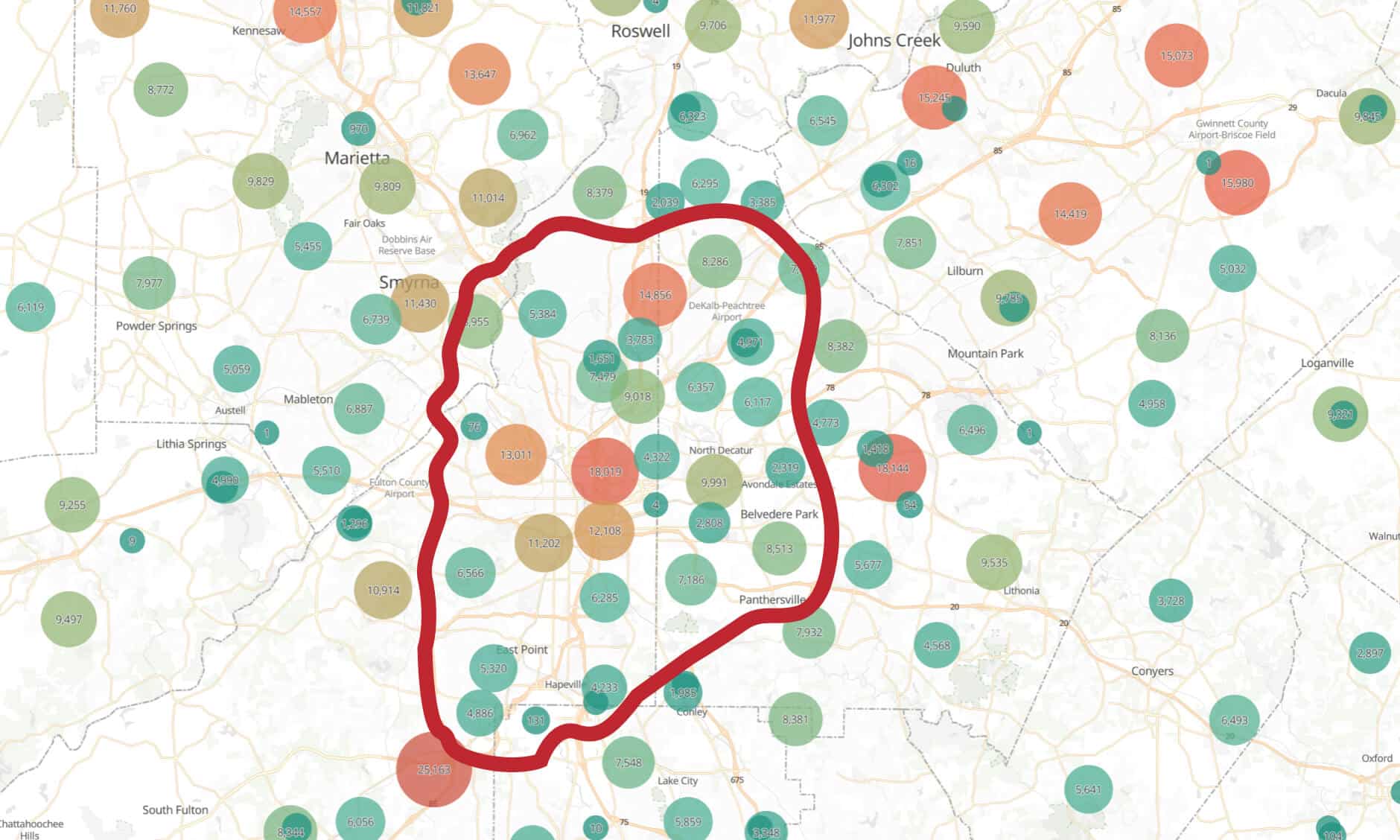
This view of Atlanta shows IP distribution aligning with where people and infrastructure are concentrated across the metro area, rather than clustering in the city center
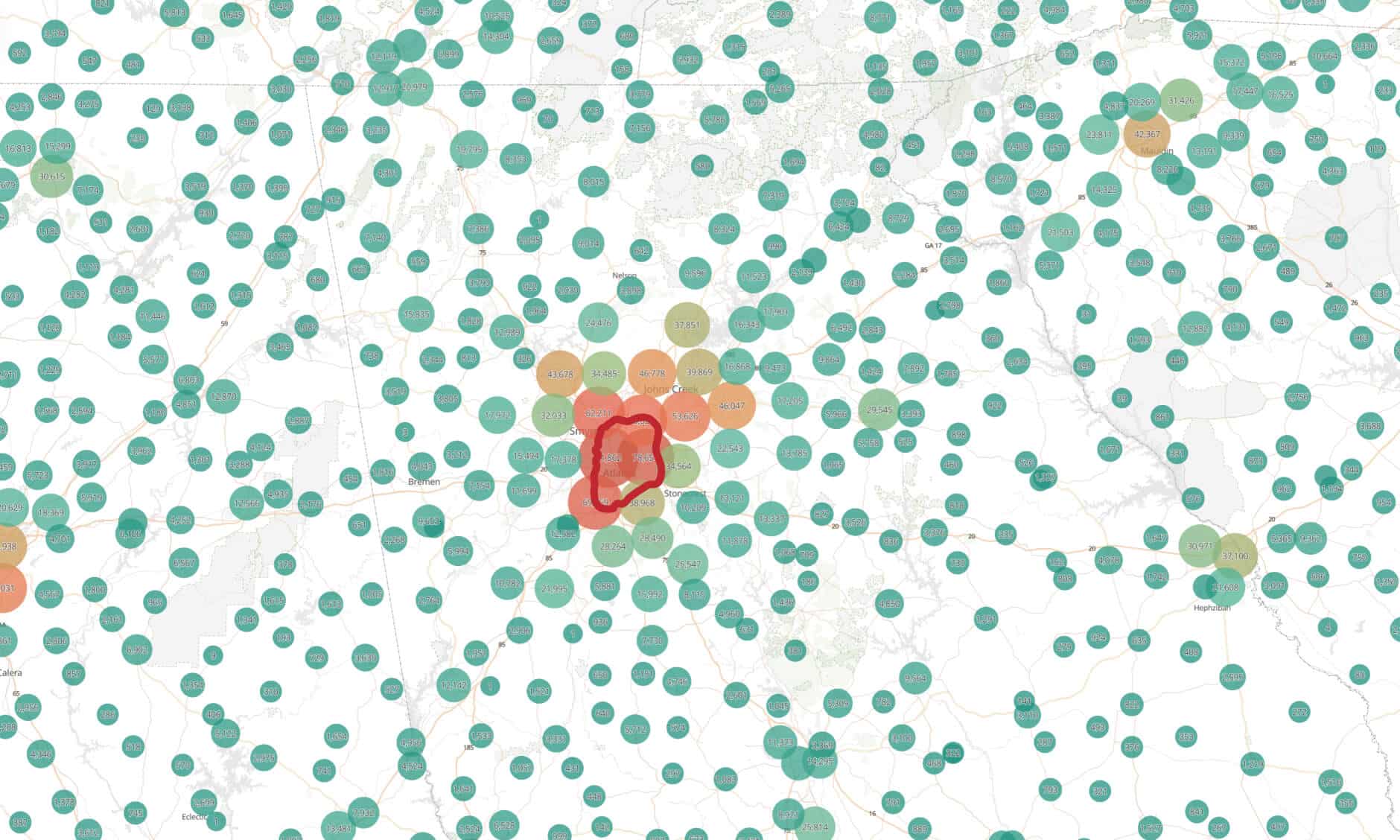
Zooming out shows IP distribution matching real population density across the region, not the city center.
Challenges of IP Stability and Why Observation Recency Matters
Another common misconception is that IP addresses are static. In practice, IP addresses are frequently reassigned by ISPs, making location accuracy highly dependent on how recently an IP has been observed and evaluated.
Two providers may assign the same city to an IP address, but without recent observation, that mapping represents only relative confidence.
Digital Element refreshes IP geolocation data on an ongoing basis by:
- Observing IP usage across over a billion mobile devices every 30 days
- Recording the last-seen date of an IP address
- Weighting more recent observations more heavily
For marketers and cybersecurity teams, when an IP was last observed is nearly as important as where it was observed.
Filtering Noise: VPNs, Proxies, and Non-Representative IPsy
Even with robust validation processes in place, IP geolocation still faces inherent challenges. These include VPN traffic, proxy services—such as residential proxies—mobile carrier infrastructure that routes traffic through shared cell towers, and Carrier-Grade Network Address Translation (CGNAT), all of which can obscure a user’s true location and complicate accurate IP assignment.
Digital Element addresses this by layering proprietary methodologies on top of validated data, filtering out IPs that are unlikely to represent meaningful end-user location.
Because Digital Element leverages the largest and most diverse datasets in the industry, it can contextualize IP behavior and remove noise that would otherwise degrade accuracy.
All of this is done within a privacy-centric framework, enabling use cases across AdTech, CTV, cybersecurity, fraud prevention, and content rights enforcement.
Frequently Asked Questions About IP Geolocation Accuracy
How should marketers evaluate city-level IP data accuracy for programmatic success?
Marketers should look beyond raw IP counts and evaluate whether IPs are:
- Validated with recent observations
- Distributed across real population centers
- Refreshed regularly to account for IP reassignment and movement
Accuracy at scale is more important than volume, especially for CTV and programmatic campaigns.
How does IP geolocation compare to device GPS for ad delivery accuracy and scale?
GPS provides high precision but limited scale and availability, particularly on the web.
IP geolocation offers massive reach across connected devices. Digital Element combines IP scale with GPS-based validation, bridging the gap between precision and reach.
How can businesses reconcile app GPS data with web IP location?
The most effective approach is to use GPS data as a validation layer for IP-based location, ensuring consistency across app and web environments. Digital Element’s methodology is designed specifically for this reconciliation.
From Misunderstood Data to Mission-Critical Intelligence
IP geolocation is often misunderstood, but when validated correctly, it becomes a powerful tool for marketing performance, security enforcement, and global digital operations.
To learn how IP geolocation data supports multiple industries, contact Digital Element or explore our Use Cases page.